When John Basil Cartland walked out of his front door and down the steps of his home at 11 Powis Square, Brighton on Monday 12 March 1973, he was not to know that within six days he was to be brutally murdered in France.

When John Basil Cartland walked out of his front door and down the steps of his home at 11 Powis Square, Brighton on Monday 12 March 1973, he was not to know that within six days he was to be brutally murdered in France.
When John Sebastian Glouton died in at 98 Western Road, Brighton in 1864, he was described as “a very plain and unpretending man, possessing a kind and genial nature.” He was much more complex than that. Forget the unfortunate name of Glouton [Glutton]. Monsieur Glouton was a highly intelligent man and reputedly a brilliant teacher. Alas, he was no businessman.
Continue readingFor four days in 2022, part of the Unitarian Church in New Road, Brighton became a little bit of France. Look hard and you will see the “writing on the door”. On a background of the French tricolore is the single word Élections.
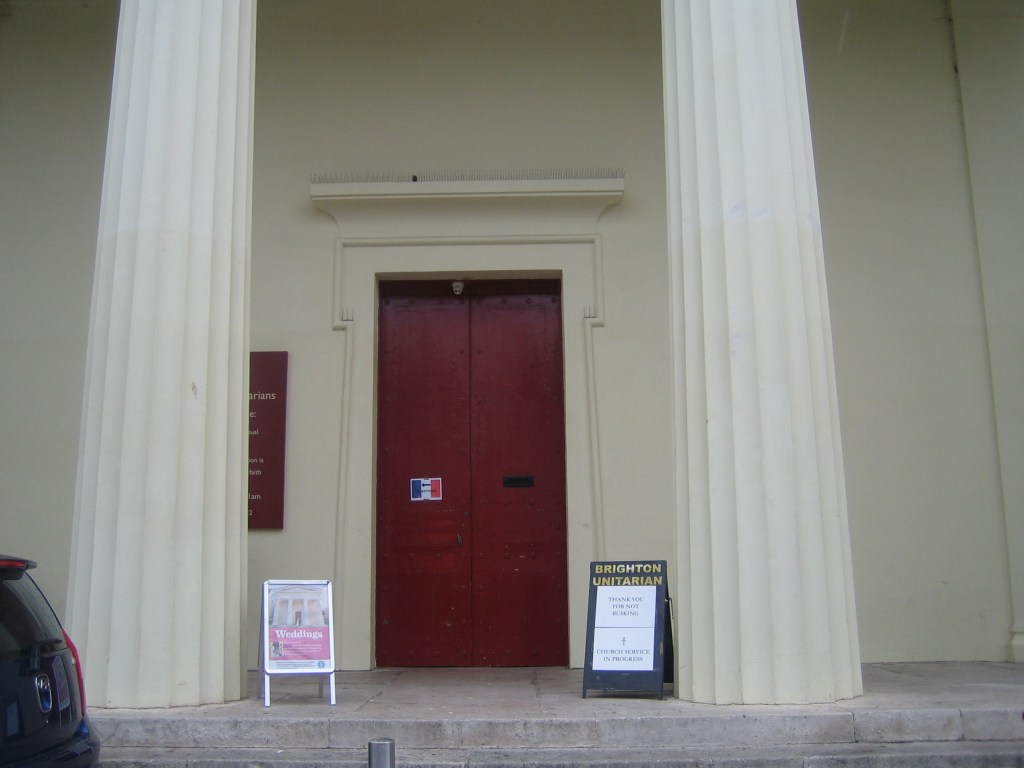
Sunday 10 April was the day of the first round of the French les présidentielles [presidential election]. The several thousand French voters in the Brighton area and wider afield (postcodes BN, PO and SO) seemed to have preferred to stay in bed.
When I started work in October 1974 as the part-time French teacher at Davies’s College in Cromwell Road, Hove, all I knew of my predecessor was that she was called Thyra Creke-Clark and had died suddenly the previous July. According to the Principal of the college she had been “a formidable woman”
Once they became mined out, the underground quarries of Caen stone generally presented no problems. They were excellent for producing mushrooms on a commercial basis. However, with pressure to build for an expanding population in the mid-20th century, many of the voids had to be filled in before building could take place. Several quarries, however, played an important and very positive role in the 1940s. During the bombardment of Caen by the Allies in 1944 these quarries provided safe refuge.
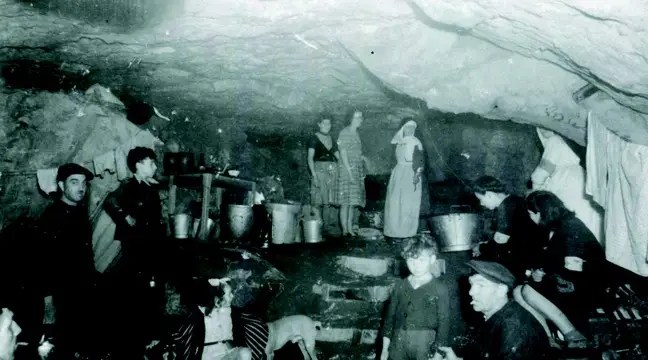
Refugees (including dogs) from Allied bombing on Caen in June 1944. Image courtesy of “Le Parisien” newspaper.
Although nearly 2000 inhabitants of the city died within two months of the D-Day landings on 6 June, many hundreds more owed their lives to the redundant quarries where their forefathers may have worked for many generations before them.

French diplomat Auguste-Charles-Joseph de Flahaut de La Billarderie, comte de Flahaut had the characteristics of a Don Juan and those of a courageous soldier in equal parts. With his charm and tact, he must have been a popular visitor to Brighton. It is not entirely clear whether the same can be said of his wife.
Portrait of Charles de Flahaut c. 1864 Source: commons.wikimedia.org/wiki/File:Portrait_de_Charles_de_Flahaut.JPG”>MOSSOT
In the 11th century, the honey-coloured French limestone used in Sussex may well have come from quarries beneath the centre of the town of Caen itself. William of Normandy had his own quarry at the foot of his castle in the town. Other quarries opened and closed over the centuries.
Today there are over 250 hectares (600 acres) of mined galleries beneath the streets of Caen and its suburbs. In a somewhat unpatriotic statement, an inhabitant of the town has compared the area to a certain Swiss cheese: Le sous-sol de Caen est devenu un véritable gruyère constellé d’anciennes carrières. [Underground Caen has become a veritable gruyere cheese, with its constellation of ancient quarries.]
On 5 February 1908, two little girls were born at 18 Riley Road, Brighton. They were the conjoined twins, Daisy and Violet Hilton.
Five weeks later, Tristan Bernard published his comedy Les Jumeaux de Brighton [The Brighton Twins ].

Title screen of the 1936 film version of the Bernard play. Rights owner sought
You have taken off in a small private plane from Brighton City Airport at Shoreham-by-Sea. The plane heads directly due south. About 40 minutes and 177 km later you pass over the coast of France at Ouistreham. Your pilot follows the course of the river Orne. Below you, you spot a white gash amid the pattern of green fields.

The port of Ouistreham, the Orne river and its canal. In the bottom left-hand corner, the modern outskirts of Caen. (c) Google

 French Brighton