John Tilt and his royal patrons

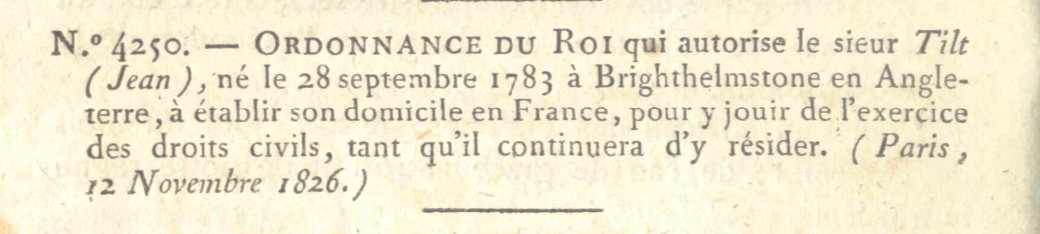
This little snippet, found by chance on-line, whetted my appetite.  I had to find out more about Jean or John Tilt, a Brighton lad, and his connection to France:

No. 425- By Order of the King who authorises John Tilt esq, born 28 September 1783 at Brighton in England, to make his domicile in France and there to enjoy the exercise of his civil rights for as long as he shall continue to reside there. (Paris, 12 November 1826) Source BnF/Gallica

Why would Charles X extend such hospitality to an Englishman?  And why, seven years later, would Louis-Philippe, King of the French, allow a pension of 1,000 francs to the same man? Tilt (Jean) was listed as a minster of the Anglican Church who had lost his fortune, that is to say, he had lost his ecclesiastical living.  Not the usual beneficiary of a Catholic king’s bounty.

Source BnF/Gallica

I’ll start by going back a generation.

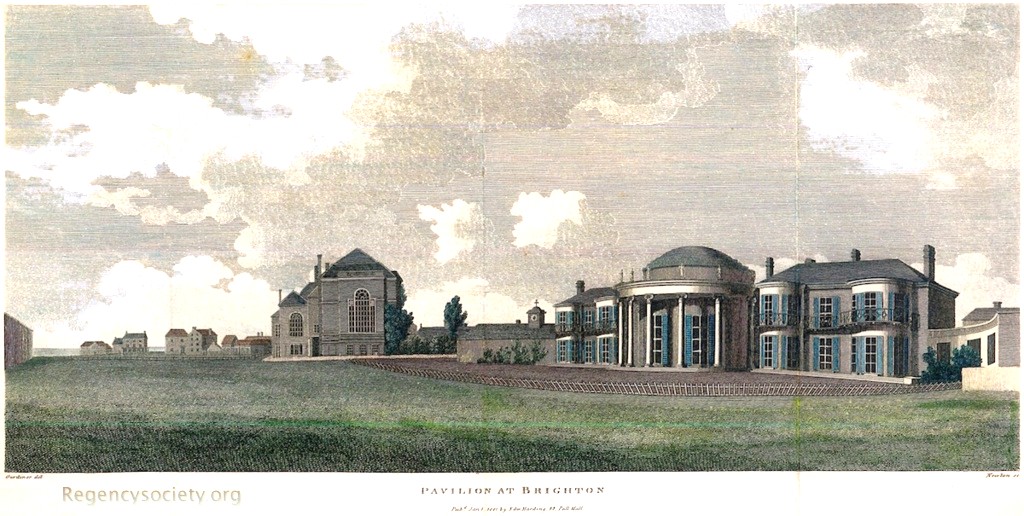
Thomas Tilt, John’s father, was a native of Kidderminster. He arrived in Brighton in 1776.  In their mid-20s, he and his wife Mary already had three sons, four more children would be born in Brighton.  Thomas soon took over the running of the Castle Inn which stood on the Old Steine at the heart of Brighton. So very conveniently near the Marine (later Royal) Pavilion.  So far so English.  So far so Anglican.

The Castle Inn in 1801, the large building centre left of the engraving.  Image courtesy of the Society of Brighton Print Collectors / Regency Society of Brighton and Hove

All William and Mary’s sons seem to have had a good education. Of the Tilt brood, the eldest son William, born in 1773, was educated at Lewes Grammar School, then Eton and finally Trinity College, Cambridge.  He became an Anglican clergyman.

Second son Thomas followed in his father’s footsteps by renting out accommodation for visitors to the burgeoning tourist town that Brighton was becoming. The fourth child, Andrew, became a colonel in the army, serving in France, the West Indies and Canada.  Of the two girls, little is known: Sarah died aged 13, although Mary outlived them all.  She died in 1863, her 80th year.

Born in 1783, John / Jean Tilt was the couple’s the sixth child and fifth son.  He does not seem to have been physically adventurous like Andrew.  Nor was he conventional like brother William.  Nor was he a businessman like Thomas jnr. John was, however, perhaps the most interesting of the bunch.

John seemed restless.  He made a start on a career by becoming a schoolmaster in Southwick, near Brighton but in an advert he placed in the London Courrier and Evening Gazette, he tells prospective clients that he has “been several years in France”.  Later reports suggest that his stay of “several years” may not have been voluntary.  If it can be assumed that he went to France aged about 20, he would have found himself trapped in an enemy country.  Napoleon declared war against Britain in 1803.

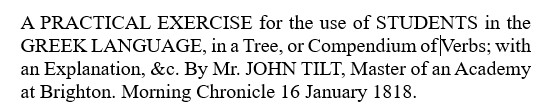
Back in England, two major events happened in John’s life in 1809: he married Elizabeth Gates and he moved his school from Southwick to Bedford Square, at “the Western extremity of Brighton”. Not surprisingly, John’s school specialized in languages: “Latin, Greek, French and lastly Hebrew” (Sussex Advertiser  12 July 1819).  He also turned his hand to writing school books.  His first publication was rather expensive (at 5 shillings).  It advertised itself as:

Three sons were born to John and Elizabeth between 1813 and 1817. Less than two years after the birth of his youngest child, John decided that school-mastering was not for him, so he enrolled at St Alban Hall, an Oxford college.  Aged 34 and with three children under the age of seven, John Tilt became a clergyman – although it would appear he never attended lectures and maybe never set foot in “his” college.

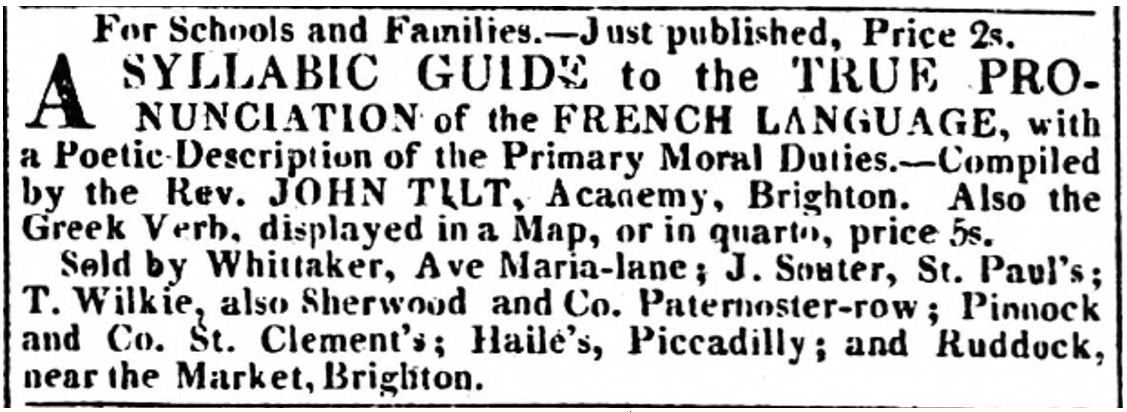
John was now a fully fledged Reverend. The title Rev. may well have improved sales of his books.

Morning Post, Thursday 20 January 1820 ©The British Library Board

In 1823, he was given the curacy at All Hallows Church, Lombard Street in London.  Perhaps now was the time to settle down.  Instead, he found Catholicism – five years before the Catholic Emancipation Act of 1829.  It was an audacious move.  The story is told in detail by La Quotidienne on 12 December 1824.  Here are the bare bones of the story as told by the newspaper:

One day, John Tilt, a good Anglican, heard that a Catholic priest, Prince Alex de Hohenlohe, had recently cured two nuns in Ireland of an unspecified illness.  This he had achieved through the medium of prayer, and remotely, from his monastery in Germany.  Tilt was initially skeptical of what the Catholic church considered miraculous.  First, he examined in detail this particular miracle.  Then he set about delving into the phenomenon in general.  When he learned that each century had famous examples of miracles, he came to the conclusion that l’église à laquelle il était attaché n’était point la vraie Église. [The Church to which he was attached was not the true Church.]

After long discussions with eminent Catholics he made up his mind et fit son abjuration, le 29 juillet [he abjured on 29 July] in the chapel of St Mary’s, Moorfields in the City of London. His wife followed his example, despite also being an Anglican born and bred.

The newspaper was not slow to recognize that the couple had children and, henceforth, no income. This, it stated, would be a problem, but the Tilts were strong in their belief.  The couple were confirmed in their new faith by no less a person than William Poynter, who the newspaper called, inaccurately, Bishop of London.

Whether Elizabeth Tilt spoke French is not clear.  No matter! The family (John?) decided that Catholic France was a better place to live than their home country.  Almost immediately on his arrival in France, John was given a post as a senior librarian in the Sorbonne.  The Étoile newspaper reveals that the Ministre des affaires ecclésiastiques et de l’instruction publique [Minister for Church Affairs and Public Education] who appointed John Tilt was doing so, not out of charity but because

M. Tilt est un homme instruit, en état de rendre des services à l’église dans l’étude des langues anciennes et des matières de controverse. [Mr Tilt is an educated man and is in a position to be of service to the Church through his studies of ancient languages and polemics.]

Somewhat later, English newspapers told the story differently – and rather more pithily:

A jesuit (sic) got hold of him, and he being a man of unstable mind, perverted him to the Catholic faith.  He renounced Protestantism, and fled to Paris where he had the enviable distinction of being pointed out [appointed?] sub-librarian to some Bibliotheque there … and betook himself to the sophistry of Catholicism, which was more congenial to his elastic conscience and utter destitution of principle … The Age Sunday 07 February 1830

Strong words indeed. 

Perhaps John Tilt was not a good librarian.  The family’s affairs do not seem to have gone well. There is nothing to show when or why he left the Sorbonne, but in 1833, King Louis-Philippe was persuaded that the family needed financial support.  The King stepped in and awarded Jean Tilt a pension of 1,000 francs.

A series of letters in the Cambridgeshire archive reveal the extent to which Richard Huddleson, a wealthy Catholic of Sawston Hall near Cambridge, also supported the family financially.

This help appears to have started in 1837 as the result of an appeal sent to Huddelston from a friend of his, Kenelm Digby.  Tilt and Digby lived in the same street in the centre of Paris. Digby had been moved by the plight of the family.  He wrote to Huddleston and Huddleston must have sent funds immediately, for within three weeks Tilt had written his thanks to his benefactor in a letter dated 19 November 1837 from N0 48 rue de Grenelle. 

Alas, the situation did not improve for the family.  By 1841 matters had gone from bad to worse: Digby was asking for Huddleston’s help once again.

The family to whom you were so generous last year is reduced low indeed.  The father for some days was near losing his reason.  Absolute starvation was near being their end.  Mr Hunt is voucher for their honesty.  We are going to get one son apprenticed and to pay £30 for him.  £20 is wanting.  We are going to place one daughter in a convent school to get her education perfected… Young Tilt who was near dying of hunger in Paris last winter has just had an offer through us of being a Partner to a Surgeon apothecary of Southampton.  I have not yet received his answer to say whether he will be tempted by it to abandon his dear old Father and Mother in Paris. (Letter dated 27 August 1841 from Springfield House, Polygon, Southampton)

Two years later, John Tilt was dead leaving his wife, yet again, to rely on the charity of Richard Huddlestone.

…  Poor Mrs Tilt is residing with her son, the Doctor.  Their address is No 11 rue de la Paix. I shall say nothing to her about your last letter. & indeed I shall not probably see her, but as I have given you her address, I shall not have to reproach myself for your alms will be grateful to her.  Her own recovery is considered miraculous.  She is respected by all who know her and she has to struggle with poverty with her son. (Letter dated 6 June 1843 from Digby to Huddleston)

“Poor Mrs Tilt” may, in fact, have had a better life following the death of her husband.  Her three boys had been brought up in France and each was in a position to support her in her old age.

Postscript

John Tilt’s eldest son became a Catholic priest.  When he died, aged just 47, in 1859 he had spent several years as Missionary Rector of the fledgling St Mary’s Catholic Chapel in Richmond as well as undertaking “religious instruction” of the pupils at St Mary’s Collegiate Catholic School.  When he had had to retire through ill health in 1859 his congregation gave him 105 guineas, much of the money coming from “the munificent donation of the French Royal Family at Claremont and Twickenham” – that is, the deposed Orléans family who had fled France after the 1848 revolution.

Second son, Edward John, graduated as a doctor in Paris in 1829.  He returned to England and became eminent in the realm of women’s health.  He had brough with him from France enlightened ideas about the menopause and gynaecology in general.  He did not die until 1893, at which time the British Medical Journal gave him a 20-line obituary and he appears at some length in the Dictionary of National Biography.

Third son, William Henry (aka Henri) Gates Tilt is more of a mystery. He lived most of his life in England and seemed to have private means from property.  His links with France, and in particular with the town of Rennes in Britanny, remained strong: two of his daughters were born in Rennes in the late 1850s; one of his twin sons married a woman who had been born and, much later, died in that same town; the other son married a woman from Saint-Brieux, just 60 miles from Rennes. 

The Limes Convent School 1902-1916

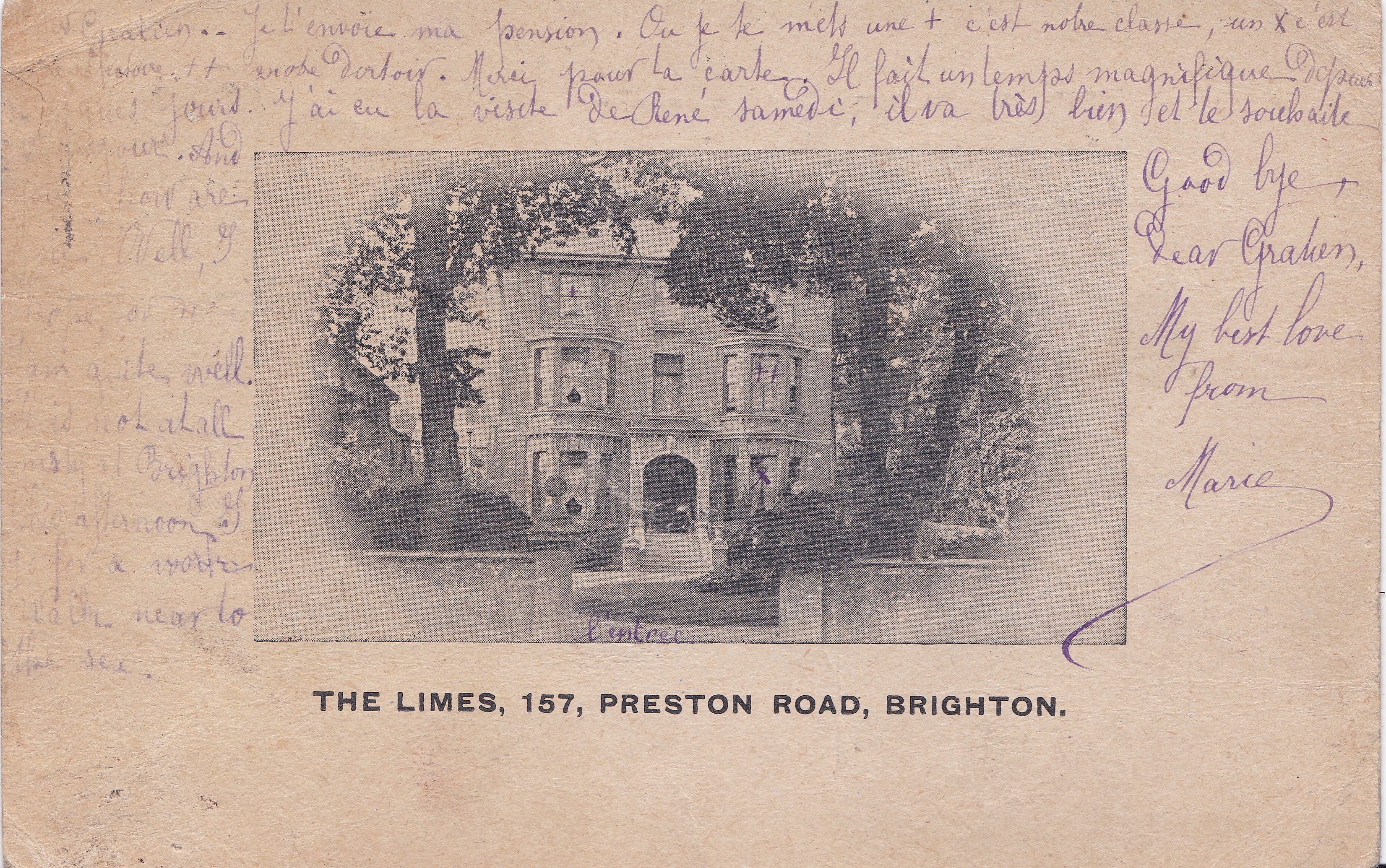
Writing this postcard to a pupil at a prestigious boys’ Catholic school in western France, Marie explains the layout of her school.

Postcard supplied by Anthony Beeson,  See also “North Brighton through Time” by A Beeston

Cher Gratien, je t’envoie ma pension.  Où je te mets une + c’est notre classe, une X c’est la réfectoire, ++ notre dortoir.  Merci pour la carte.  Il fait un temps magnifique depuis quelques jours. J’ai eu la visite de René samedi, il va très bien et te souhaite … bonjour. [Dear Gratien, I’m sending you our boarding school.  Our classroom is where I have put a + for you, an X is for the refectory, ++ our dormitory.  Thank you for the card.  The weather has been magnificent for the last few days.  René visited on Saturday, he’s very well and says “hello”.]

The writer was French but was clearly was at ease in writing in English.  She was resident in no ordinary English ladies’ school.  No 157 Preston Road, opposite Preston Park in Brighton, was a convent school run by French nuns.  The 1911 census shows that 10 of the 11 nuns teaching at the school had been born in France, as had all 15 pupils.  Even the 15 year old servant, Anna Pescher, was a French national.

For the first few years of the 20th century, French politics had a considerable impact on girls’ education in Brighton.

In 1901, la loi des associations was passed by a Republican government.  On the surface, this law seemed very positive:  for the first time since the revolution in 1789, groups of more than 20 people could gather together legally to pursue their own interests (occasionally subversive, of course).  Nowadays, this law is used to help voluntary groups run their activities.

However, at the time the law came into force, there was continuing suspicion of religious groups.  The 1901 law was seen as a way of curbing their hold over young minds.  One of the many new rules stipulated that associations which had an “earned income” (usually from teaching, in the case of nuns) would now be taxed on the value of their, often very extensive, lands and properties.  Owning property therefore became prohibitively expensive for religious communities.

Most congregations, such as that of les Sœurs de la Providence de Portieux (Sisters of Providence of Portieux), ploughed their income from their fee-paying students into schools for the poor in the same neighbourhood, or into other charitable activities. This did not allay the government’s suspicion of them.  By 1904 many congregations, both male and female, had delegated their teaching sisters to set up convents, and particularly convent schools, abroad. Sussex and Kent were at the forefront of welcoming them.  Brighton and Hove in particular.

The Community of the Sisters of Providence of Portieux had been founded in the Vosges region (north-east) of France in 1762.  As a religious order, they had flourished, surviving the French Revolution, Napoleon and the Franco-Prussian War (1870).  The Law of Association in 1901 lead to hundreds of the sister leaving the dozens of schools they had founded across France.  In the Paris region alone, seven schools were shut and the nuns dismissed. 

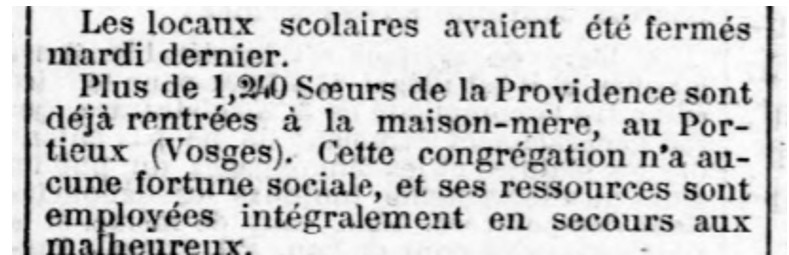
 La Libre Parole 26 July 1902 Source: BnF Gallica

[The school premises was closed last Tuesday.  More than 1,240 Sisters of Providence have already returned to the mother-house in Portieux (Vosges).  This congregation has no communal assets and its income is used exclusively in helping the unfortunate.]

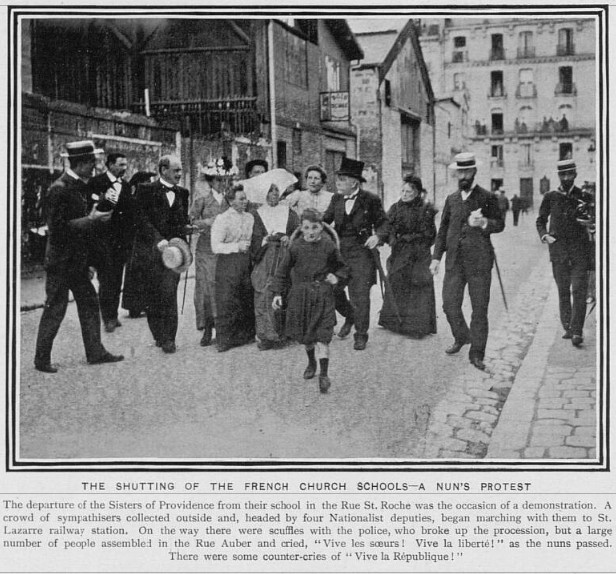
Not all French people wanted to see nuns ousted from their teaching post as reported by The Sphere, Saturday 2 August 1902 Image © Illustrated London News Group. Image created courtesy of The British Library Board.

When a group of refugee Sisters of Providence arrived in Brighton, they were able to settle in The Limes in Preston Road. At The Limes they set about establishing a school. 

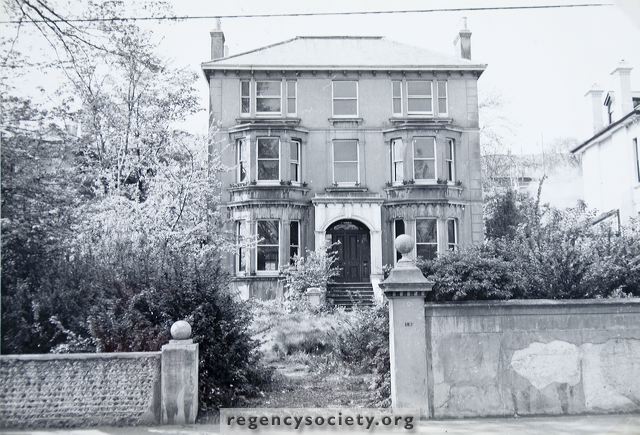
The Limes c. 1960 Image courtesy of the Regency Society of Brighton and Hove

The Limes had been built in 1878.  It was a large, detached house, symmetrical in plan and had four floors, including a basement. It was not the largest of the houses along Preston Road, but it had the advantage of having a coach-house and a two-storey cottage in the grounds.  The park opposite was well patrolled by members of the local police force as well as its formidable but watchful park keeper. It was a suitable place for young ladies to walk and take exercise. 

The Limes was used as a comfortable family home for the final 20 years of the 19th century. The last private owner was John Salkeld Horsley.  Horsley ran a cycle shop at 4 Pool Valley.  As cycling became a popular and affordable pastime – even for ladies – Horsely made enough money to move both his shop and his home to 75 Grand Parade in about 1902 or 1903.  The Limes became available.  To let or to buy is not known.  The Sisters of Portieux were able to acquire the property and set up their convent and school.

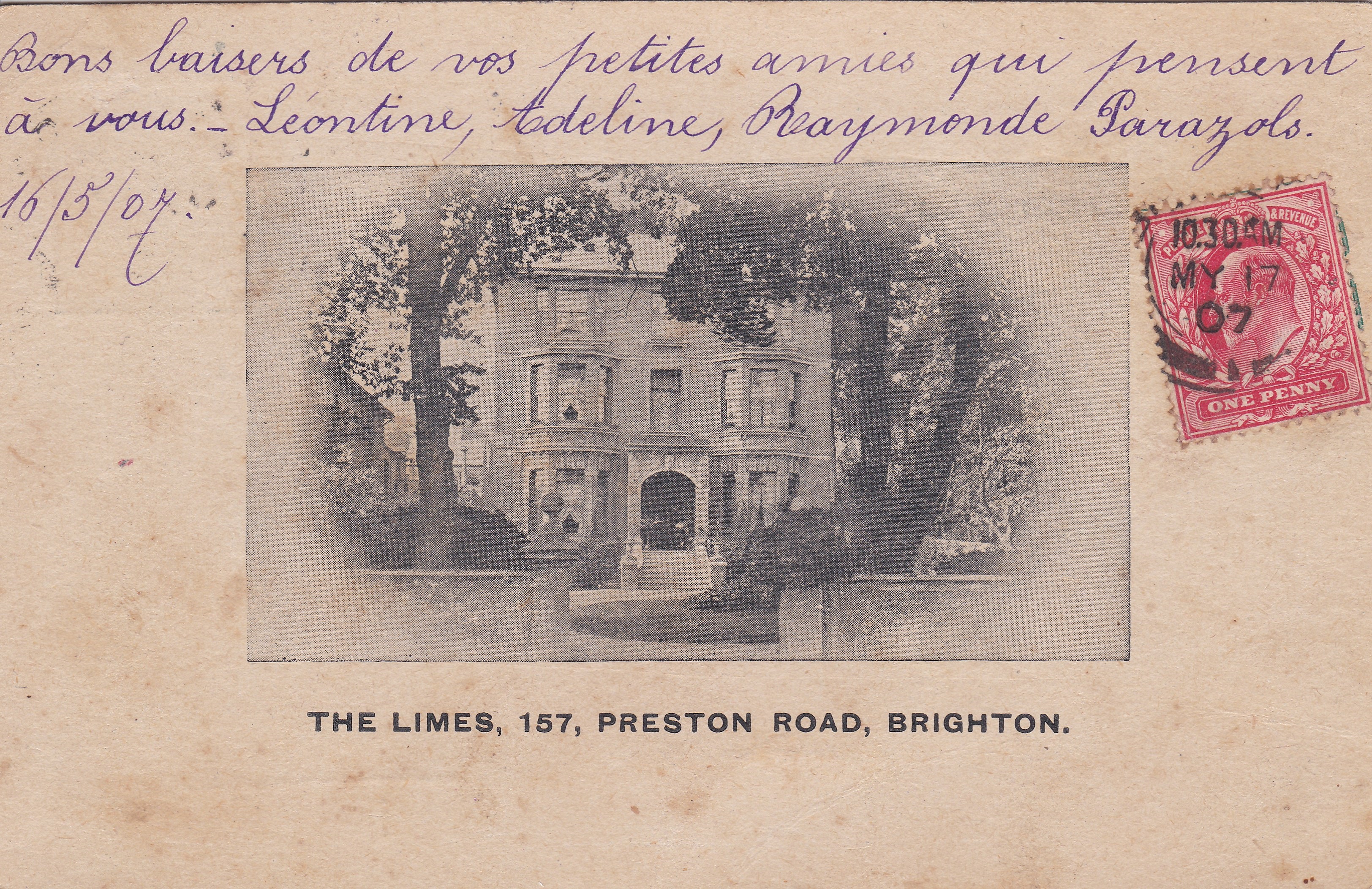
Little is known of the pupils:  The card below was sent on 18 May 1907 by the three Parazols sisters, Léontine (aged 11), Adeline (10) and Raymonde (a few days before her sixth birthday).  The desire of many Catholic parents to keep their girls in a convent school is perhaps exemplified, if rather to an extreme, by the Parazols family.  M. and Mme Parazols had sent their three girls away to England at a time when the family was already mourning the loss of four babies who had died in the five years between 1899 and 1900.  Each had died either at birth or within a few weeks of birth.

Post card from the personal collection of the Suzanne Hinton

Raymonde Parazols was not the only “tiny” in the school.  Both Adrien Lenfant and Jean Rozière, the only two boys in the school, were aged just eight years old when they appear in the 1911 census for the school.

Adeline Parazols died in France, apparently homeless, aged 34; Raymonde married in France; Adrien and Jean would have been too young to serve in WW1.  Reliable sources show that Adrien lived to the age of 87, dying in 1990 in France.

Extensive searches for information about the nuns or about the other pupils has been unfruitful.

The school had vanished from Preston Road by 1916.  Perhaps it was no longer needed by the Sisters of Providence.  A convent school run by a similar community had been flourishing in Bexhill since 1898. Many French parents would be glad that their daughters were out of harm’s way in England during the fighting on French soil in WW1 – but would also feel it prudent to ensure that the girls were further inland, far from any threat of attack or even invasion.

The Limes was subsequently used as a residence for a Ministry of Labour (re)training centre.  In 1921, the house and outbuilding were home to about 30 men, mostly in their 20s and early 30s and mostly handicapped following their war injuries.  The atmosphere must have been very different from the sedate young ladies’ school of just a very few year previously.

Chargois et Burluraux à Brighton

I don’t know whether Pierre Chargois and Jean Nicolas Burluraux left Rupt-en-Woëvre in north-east France together in 1850, or even if they left at much the same time. They were both in their mid-twenties. Their small home town had a population of just 665. They may well have been related. The population was slowly declining and the two young men were part of that decline. The movement away from the countryside to the towns had begun. Pierre and Jean Nicolas had decided that they would go further than the nearest big town, Verdun.

Pierre’s father, Richard, was a merchant and had already crossed the Channel with his merchant father, Jean who was a frequent visitor to England. The two young men would sell high quality basket ware. It is likely that Jean Nicloas was a skilled basket weaver as one of the main crops in the very water-rich Rupt valley was osier or willow cane.

Osier Cutting by H. R. Robertson. Source: Life on the Upper Thames. Credit: the University of Toronto and the Internet Archive https://victorianweb.org/history/work/22.html

Continue reading

Maurice Jacobs : Teacher and French Honorary Consul

The 20th century had dawned just a few short years ago. Their son was a young teenager, so M. and Mme Léon, in Bordeaux, decided that it was high time for their lad, René, to perfect his English. The family was very internationally minded. They knew that Brighton already had an excellent reputation for good schools.  Its climate was healthy and its Jewish community was thriving.

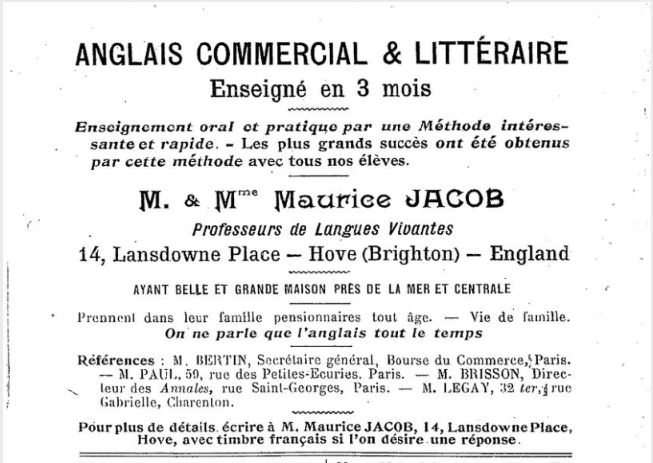
prof-de-francais-1907

© Gallica : Bulletin de la Société de la Propagation des langues étrangères en France 1906

“Ah”, said M. Léon, “there is a school in Hove that would do very well.”  So he sent off a letter of enquiry to 14 Lansdowne Place in Hove.  Alas, it came to M. Léon’s ears that this school, run by a Frenchman and his English wife, was very, very small and that it had changed address several times over the previous few years. This did not bode well.  The Léons looked elsewhere.  Then they remembered that a few years previously, they had seen an advert in the “Jewish Chronicle” for a school in Brighton.  This looked more like what they wanted:

Continue reading