I don’t know whether Pierre Chargois and Jean Nicolas Burluraux left Rupt-en-Woëvre in north-east France together in 1850, or even if they left at much the same time. They were both in their mid-twenties. Their small home town had a population of just 665. They may well have been related. The population was slowly declining and the two young men were part of that decline. The movement away from the countryside to the towns had begun. Pierre and Jean Nicolas had decided that they would go further than the nearest big town, Verdun.
Pierre’s father, Richard, was a merchant and had already crossed the Channel with his merchant father, Jean who was a frequent visitor to England. The two young men would sell high quality basket ware. It is likely that Jean Nicloas was a skilled basket weaver as one of the main crops in the very water-rich Rupt valley was osier or willow cane.

Osier Cutting by H. R. Robertson. Source: Life on the Upper Thames. Credit: the University of Toronto and the Internet Archive https://victorianweb.org/history/work/22.html
Pierre Chargois seems to have arrived first in Brighton where he lodged at 17 King Street. He set himself up as ‘Basket and Toy Merchant’ according to the 1851 census. This probably means that he hawked his goods around the streets. However, he seems to have been a fairly canny businessman as his later story will prove.
Believing in strength in numbers, Pierre set up in business with Jean Nicolas Burluraux as a ‘Dealer in Francy Goods’. The partnership soon failed. By 1855, the two men had gone their separate ways. Pierre tried several homes and several trades: in 1859 he was a ‘Second Hand Clothes Dealer’ living at Gardner street with, by then, an English wife and three small children (in very cramped conditions, it must be said); two years later he had turned his hand to being variously a boot and shoe maker, a shopkeeper and/or a clothier. My admiration for this hard-working man suddenly paled when I spotted this this little snippet which had appeared in the Sussex Advertiser of 10 June 1865:
Peter Chargois, of Brighton, shopkeeper, was charged by Hannah Seamer, of Buxted, servant, with being the father of her illegitimate child. The defendant did not appear. He is a married man, complainant lived with him as servant. An order was made for the payment of 1s. 6d. a week and costs.
A man used to getting his own way, perhaps. In business Peter Chargois seems to have been fairly tough. His name appears in local Brighton newspapers several times in connection with thefts of or from his property. It would seem that he was always willing to prosecute. The mid-1870s, by which time Pierre had become a British citizen, saw the family established in a small shop at 13 Western Road. Later, Pierre must have had some delusions of grandeur when he took on 14 Western Road as well, and called his business Pierre Chargois et Cie, claiming to import shoes from Paris (wholesale and retail).
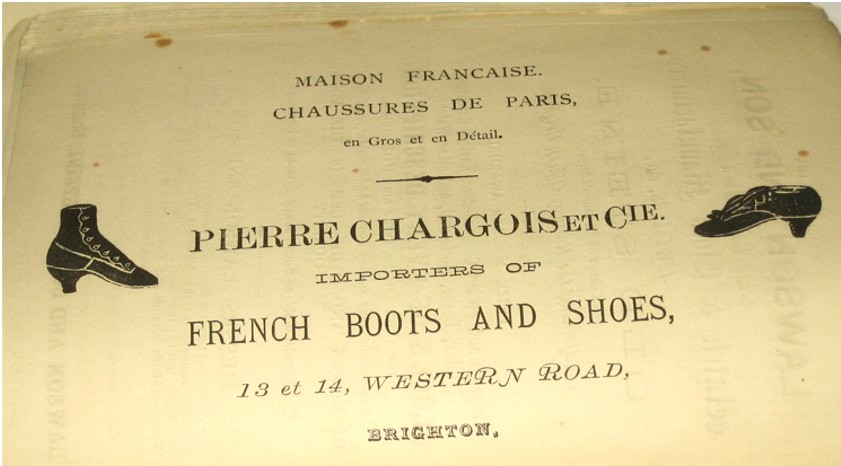
The family lived above the shop and the business relied on family members: in 1881, four of Pierre’s six children were working as his assistants: Marie Cathrine aged 25, Emelie (21), Alphonse (19) and Alice (17). The baby of the family, Frederick Charles, seems to have taken himself off to join the Canadian Pacific Railway Police before returning to the UK to join the 6th Dragoon Guards. The eldest, Anne, had married and settled in Preston Village just north of Brighton.
Emelie married and settled in England. Alphonse emigrated to Australia where he set up a successful photography business. Marie Cathrine married Liverpool-born Constant Latarche … whose father, Jean François, was a basket maker from, not surprisingly, Rupt-en-Woëvre.
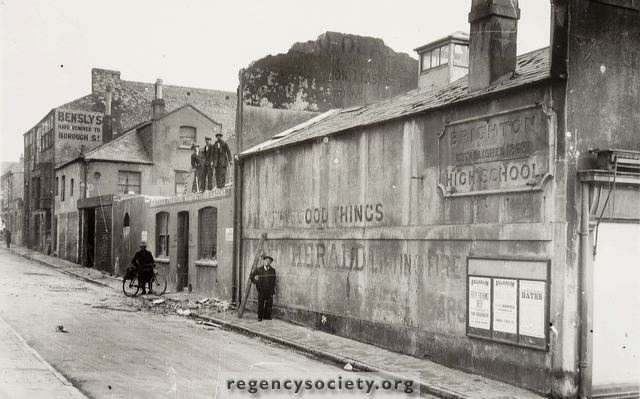
Of all the children, it was probably Alphonse who had had the best education while he was in Brighton. Aged 12 , in 1873, he was attending the Brighton High School in Hampton Place where he won a prize for Arithmetic (no prizes for him for French, though) and gained a certificate in Algebra and Mensuration.
Later Alphonse was a student at the Brighton and Hove School of Science and Art where he won a ‘1st class’ certificate in elementary Machine construction and Drawing. It was clear that his talents did not lay in shopkeeping.
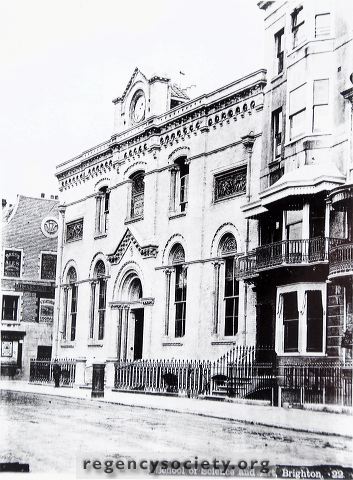
The School of Art and Science in the 1880s. This stood at the corner of Grand Parade and what is now Kingswood Street (formerly Carlton Hill). The University of Brighton School of Art and Media building now stands on this part of Grand Parade. Image courtesy of the Regency Society (James Gray Collection)
Pierre Chargois died in October 1890. The shopkeeping baton was therefore taken up by his unmarried daughter Alice who continued to run 13 Western Road until the 1920s. Over the years, the merchandise of the shop had moved from footwear to ‘Imitation Jewellery and Foreign Fancy Goods’.
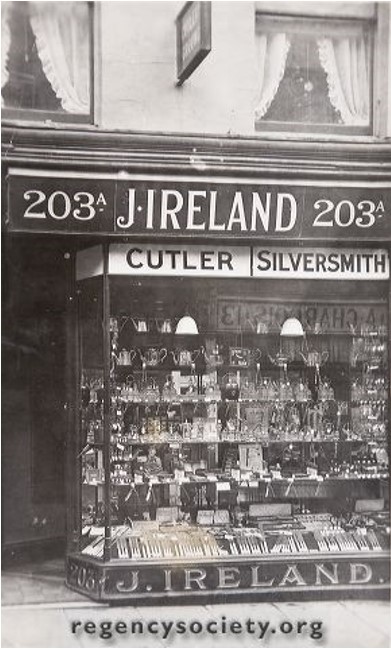
Western Road, Brighton, 1920s. Image courtesy of the Regency Society (James Gray Collection)
Western Road was extremely narrow to the east of Imperial Arcade (roughly 10m wide, shop window to shop window) before it was redeveloped in the 1930s. In the 1920s photo above, the fascia of Miss Chargois’ shop is reflected in the window of Ireland’s shop opposite. In 2025, the carriage way of Western Road, at the same point, is exactly 10m wide, kerb to kerb.
Alice died in 1932 at 58 Osmond Road in Hove. Her estate amounted to over £13,000 – worth some £1,000,000 in 2025. Alice must have inherited many of her father’s entrepreneurial skills.
The same could not be true of Jean Nicolas Burluraux. His background was in basket making. In the mid-19th century, there were various members of the extended Burluraux family ( a very common name in Rupt-en-Woëvre) trading in basketware in London, Huddersfield and Redruth, Cornwall. Two of them traded successfully, the other did not. Alas, Jean Nicolas took after the latter.
Jean Nicolas had married a local Brighton girl, Frances, in 1853. Following the dissolution of the partnership with Pierre Chargois, Jean Nicolas set up as a ‘Dealer in Toys’ at 62 North Street. Trade did not go well. By 1860 the business was insolvent. Two years later Jean Nicolas was bankrupt. By August 1869 Jean Nicolas Burluraux was dead, by his own hand. He was just 48 years old. The Brighton Gazette reported the case:
SUICIDE OF A FRENCHMAN
A distressing case of suicide took place on Monday night in the Lewes Road, where a young Frenchman, names Burluraux, hanged himself in consequence of serious losses which he had sustained in business. His wife and young family were left in such destitute circumstances that his compatriots raised a public subscription on their behalf, … Upon dissolving the partnership, the deceased set up on his own account in Duke Street, but failed, and went to reside on the Lewes Road.
For Mrs Frances Burluraux this was not quite the last straw. Four of her children had died before his or her second birthday. Her husband had committed suicide. Five years later, one of her two surviving children died in Church Street, Brighton. He was just 17. Her one remaining son moved away to London soon after.
Once Alice Chargois had died in 1932, all traces of those two hopeful young men from Rupt-en-Woëvre had vanished from Brighton.