On 10 July 1833, young Mr Peter Black inserted the following advertisement in the Brighton Guardian.
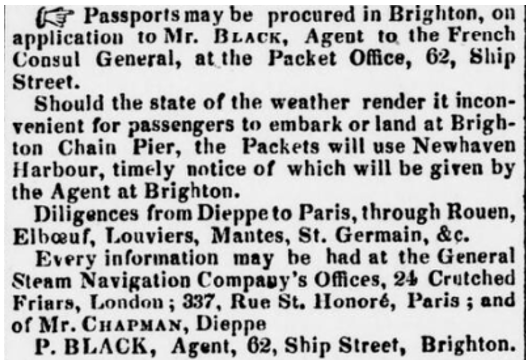
On 10 July 1833, young Mr Peter Black inserted the following advertisement in the Brighton Guardian.
The Napoleonic Wars had cost the lives of many tens of thousands of British soldiers between 1803 and 1814. Even before the Battle of Waterloo, prisoners from both sides of the war were being repatriated. Writing about the boats bringing these suffering men across the channel, the Journal de Paris published the following snippet on 10 May 1814:
Il en est arrivé six le 4 de ce mois à Cherbourg, avec 284 prisonniers de guerre. Le six, une gabarre française est partie du même port pour l’Angleterre, avec 400 prisonniers anglais.
[Six such boats carrying 284 prisoners arrived in Cherbourg on the 4th of this month. On the 6th, a French river barge left the same port for England, with 400 English prisoners.]
The French honorary consul’s main function is to aid French nationals on his (or her) patch of British soil. Over the years, French nationals have had their political differences: Bonapartists v. royalists; royalists v. imperialists; imperialists v. republicans and republicans v. communards. However, once any French citizen is on British soil, s/he is under the protection of the apolitical French consul in their area.
In 1940, The Brighton consul was an exception to the ‘apolitical’ rule.
Honoré Migot Honorary Consul for Brighton 1937-1947
Following the armistice of 22 June 1940 and the occupation of large parts of France by the Nazi forces, the French, yet again, became a divided nation. The government decamped to Vichy and became a puppet of the Nazi regime. General de Gaulle decamped to London and vowed to fight on – with or without the British. Most of the consular staff in London were attached to the Vichy (collaborationist) regime. Many of them hurried back home to France.
For four days in 2022, part of the Unitarian Church in New Road, Brighton became a little bit of France. Look hard and you will see the “writing on the door”. On a background of the French tricolore is the single word Élections.
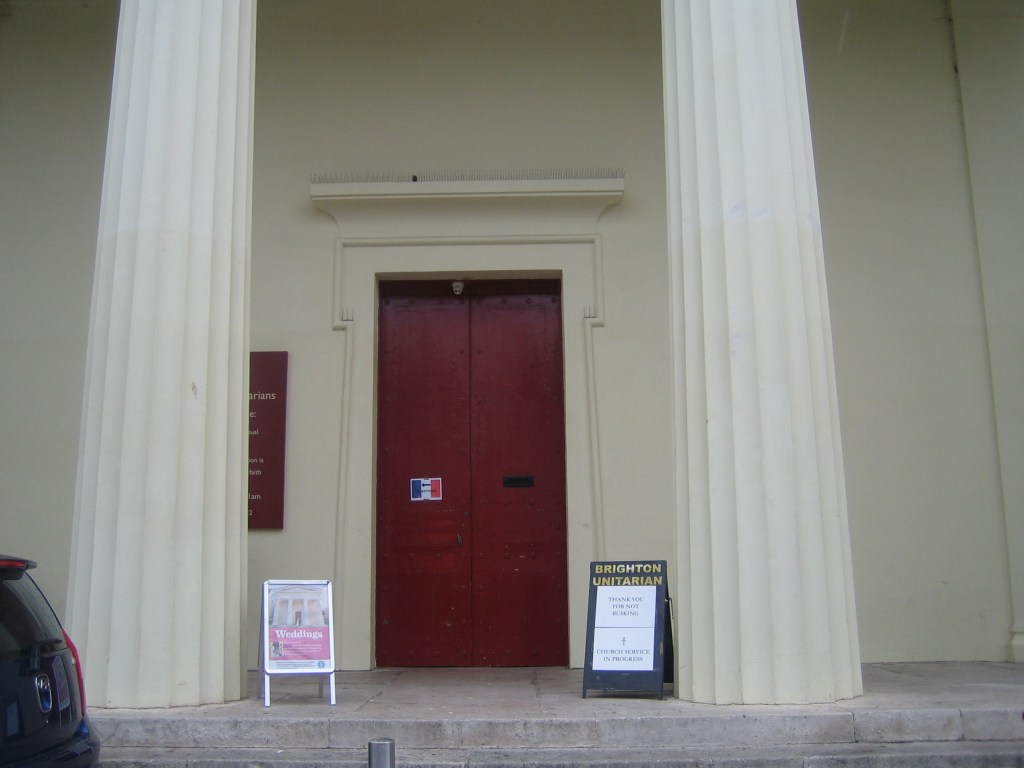
Sunday 10 April was the day of the first round of the French les présidentielles [presidential election]. The several thousand French voters in the Brighton area and wider afield (postcodes BN, PO and SO) seemed to have preferred to stay in bed.

French diplomat Auguste-Charles-Joseph de Flahaut de La Billarderie, comte de Flahaut had the characteristics of a Don Juan and those of a courageous soldier in equal parts. With his charm and tact, he must have been a popular visitor to Brighton. It is not entirely clear whether the same can be said of his wife.
Portrait of Charles de Flahaut c. 1864 Source: commons.wikimedia.org/wiki/File:Portrait_de_Charles_de_Flahaut.JPG”>MOSSOT
Early in 2021 Frederic Laloux was appointed French Honorary Consul for Brighton and Newhaven. M. Laloux is the most recent incumbent of an official post reaching back to at least 1821. This post is unpaid, apart from expenses. It occasionally carries the title Vice-Consul as the local consuls (there are about 30 across the UK) report to the Consul Général in London.

Brighton as the first Honorary French Consul would have known it in the 1820s. Image (c) Regency Society / Society of Brighton Print Collectors
Continue reading
Brighton and Biarritz have much in common: they are former fishing towns (mackerel for Brighton, whales for Biarritz); their growth depended much on royal patronage; they are successful tourist towns.

The Labour Party was in power. The Labour Party was in town. In Brighton, on 3 October 1966. All was not well in the state of Britain. The French newspapers did not hesitate to mention the fact: Prime Minister Harold Wilson was announcing a pay freeze; 750 strikers from car-plants in the Middlands (sic) had marched on Brighton and were shouting, according to Paris-presse, l’Intransigeant newspaper, at members of the cabinet:


“Portrait présumé de Nathalie de Laborde d’Augustin Pajou” © 1994 Musée du Louvre / Pierre Philibert
“Mrs. Fitzherbert, the Duchess de Noailles, and many other ladies of distinction, were present at the Cricket match, and dined in a marquee pitched on the ground, for that purpose. The Prince’s band of music attended, and played during the whole time the ladies were at dinner. In the evening, Mrs. Fitzherbert, the Duchess, Lady Clermont, and Miss Piggott, walked round the ground, seemingly the better to gratify the spectators with a sight of the French lady. The Duchess de Noailles appears to be 21, or 22 years of age, is very handsome, and her figure and deportment are remarkably interesting.”
 Saturday July 31, 1937.
Leaving Wembley at 8.15 am for Victoria Station, joining crowds of Woodcrafters there, taking our places in the 10am Woodcrafter’s Special, and we realise we are really on our way to the first International Children’s Camp held in this country.
Walking from Brighton Station to Ovingdean, the procession of boys and girls clad in green jerkins, waving flags and banners attracted a considerable amount of attention from the holiday makers at Brighton. We found the campsite at Beacon Hill a very desirous place.
 French Brighton