The French honorary consul’s main function is to aid French nationals on his (or her) patch of British soil. Over the years, French nationals have had their political differences: Bonapartists v. royalists; royalists v. imperialists; imperialists v. republicans and republicans v. communards. However, once any French citizen is on British soil, s/he is under the protection of the apolitical French consul in their area.
In 1940, The Brighton consul was an exception to the ‘apolitical’ rule.
Honoré Migot Honorary Consul for Brighton 1937-1947
Following the armistice of 22 June 1940 and the occupation of large parts of France by the Nazi forces, the French, yet again, became a divided nation. The government decamped to Vichy and became a puppet of the Nazi regime. General de Gaulle decamped to London and vowed to fight on – with or without the British. Most of the consular staff in London were attached to the Vichy (collaborationist) regime. Many of them hurried back home to France.
De Gaulle was not universally supported or popular when he first arrived in England. The French community in Britain was fractured. There was still much support for the Vichy regime from, for example, some of the thousands of French troops who had been evacuated from Dunkirk to Britain in May 1940.
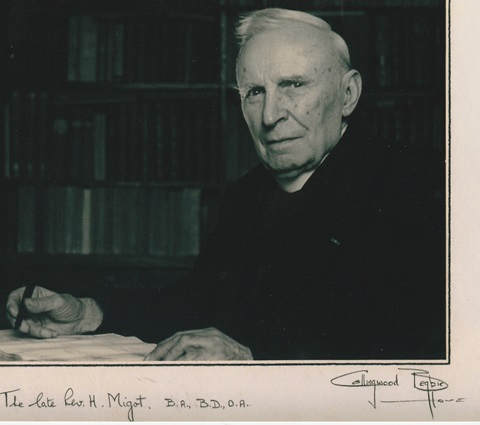
Honoré Migot had arrived in England in 1914 to take up to the post of Pastor of l’Église Réformée Française in Monmouth Street Bayswater. He and his French wife moved to Brighton in 1921 to take up a very similar post in the little French Church in Queensbury Mews.
After the death of his first wife, Rosalie Dulca Migot, in 1931, he married London born Gladys Embery who appears to have been his secretary for quite some time. The couple moved into a modest flat at 3 Prestonville Road, Brighton in about 1935, soon after their marriage.
At the outbreak of WW2, Rev. Migot was 76. Old enough, perhaps, to feel that he could defy the restrictions of his consular duties. Rather than remain neutral, he came out quite strongly in favour of a continued fight against Nazism and against the ultra-right in France. As pastor, the Rev Migot clearly had a well-defined moral stance. According to Nicholas Atkin in his book “The Forgotten French: Exiles in the British Isles, 1940-1944”, Migot was:
“… born in Saint-Sauvant in 1873 and a resident in Brighton since 1916 [sic], who coupled his consular duties with acting as minister in the local French Protestant Church. For many years he had held Germanophobe views and regularly insulted Germans in the street. At the time of Dunkirk he had visited men in hospital and advised them not to return to France. Although he had not resigned his office, he had admitted this was only because he could not afford to lose his income, and readily broadcast his admiration for de Gaulle.”
Dr Atkin bases his statement on a report made by the Brighton CID (Criminal Investigation Department of the police) on Rev Migot in October 1940. Provincial honorary vice-consuls were not paid a salary. Pasteur Migot must therefore have been concerned about his stipend from the Church.
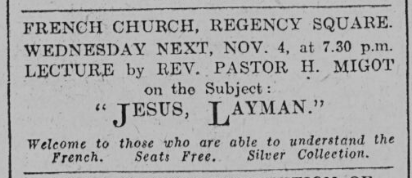
Pasteur Migot’s income depended on la collecte [the collection ‘plate’ passed round at services], donations from benefactors and sales of work. As early as 1933, the Church was in straightened financial circumstances:
Le Conseil constate qu’il y a £27.10.0 en banque et il remet au Pasteur un chèque de £27 en exprimant le désir que la situation financière conséquent de décès successifs puisse s’améliorer, afin d’arriver à remettre au Pasteur ce qui lui est dû.
[The Trustees note that there is £27 10s 0d in the bank and that they are giving the Pastor a cheque for £27. They express their hope that the financial situation, brought about by several recent deaths, will improve, thus allowing them to give the Paster what is owing to him.] What was owing to the Pastor was £200 a year. He rarely received it.
When, in late 1944, a sale of work raised £100 9s 2d, the Trustees of the Church minuted:
… (ce montant) paraît une grande somme, mais il ne faut pas oublier que faute de ressources le Pasteur n’a pu recevoir sur son stipend [sic] que la somme de £134 19s 6d sur £200. Il a fait remarquer qu’au 15 juin la chèque était seulement de £10 pour ce trimestre alors que son loyer était de £18 pour la même période.
[… (this amount) appears to be a large sum of money, but it must not be forgotten that the Pastor has received only £134.19.6. of his £200 stipend as resources are so limited. He pointed out that on 15 June, his cheque was for only £10.00 for the quarter whereas his rent was £18 for the same period.]
By the middle of the war, in 1942, the Trustees were noting that travel restrictions meant fewer derrières on pews and to make matters worse, blackout restrictions meant that the 6.15pm service had to be brought forward to 3.15pm, thus preventing many working men and women from attending. The organist must be paid and repairs were needed to the outside of the church. Bad winters meant extra heating costs. To make matters worse, several older and more affluent members had died.
Although the Trust needed new members and although the ladies seemed very capable of becoming Trustees, Le Pasteur fait remarquer qu’elles devraient avoir fait preuves de leur intérêt pour la prospérité de l’Église. Minute of 28 December 1944.
[The Pastor commented that they (the ladies) would have to have shown their commitment to the financial wellbeing of the Church.]
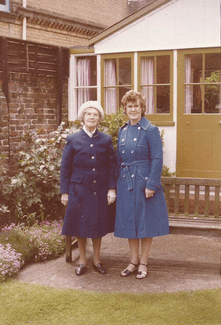
Mrs Gladys Migot (left) with her niece, Frances Appleman, in Brighton. With thanks to Stella Hammond, great-niece of Mrs Migot for permission to publish this photograph (via Ancestry)
Mrs Gladys Migot had already shown her mettle: whereas the vast majority of middle-class women were listed in the 1939 Register as carrying out “unpaid domestic duties”, Mrs Migot was listed as “Secretary At the French Consular Agency (Unpaid)”. Later she was a driving force behind several sales of work, and in 1944 did, indeed, become a Trustee of the Church.
Rev Migot died in 1947. Gladys, 35 years her husband’s junior, lived on in the flat at 3 Prestonville Road until the early 1960s.
The published Church accounts of 1949-50 show just how indispensable Gladys Migot had become to the Church.
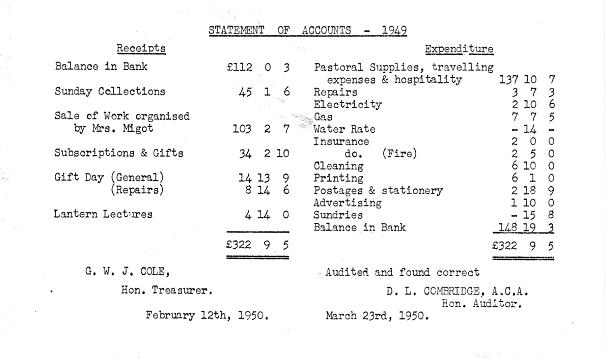
Of the £322 pounds spent by the Church, over £100 had been raised thanks to Mrs Migot’s having organised and run Sales of Work. In addition to that her “Bun-Pennies” (presumably sale of buns at the Church) and her Penny-a-Week Fund raised a further £7 1s 4d. Later that year the Church paid tribute to this hard-working woman:
“The year 1950 finds the Brighton Church still without an appointed Leader. We cannot thank Mrs. Migot enough for the sympathetic and practical interest that she continues to show in the work so long directed by her husband, the late Pastor H. Migot. Her activities were not confined to the organisation of the Annual Gift Day and the Sale of Work. Week by week Mrs. Migot has ensured the attendance of Pastors and Laymen who have maintained the Services … and very kindly ministered to them in her own home.”
Gladys Migot died in Hove in 1984.