John Edward Courtenay Bodley moved into 24 Brunswick Terrace, Hove in 1904. He must have liked Hove. Within two years he had moved just 400 yards west, to 2 Adelaide Mansions, also on the seafront.

Oscar Wilde and JECBodley in 1875: Image from ‘Oscar Wilde’, by Richard Ellmann (1987)., Public domain, via Wikimedia Commons
By the time of his arrival in Hove, J. E. C. Bodley was 50 years old and a highly respected writer on France. When he died, exactly 100 years ago, on the 28th May 1925 the London Times said of him:
His magnum opus was his two volumed work on France, which in many ways paved the way for the sympathies necessary to the Entente [Cordiale of 1904], for he wrote at a time of great hostilities between the countries.
The first edition of the magnum opus in question had been published in 1898. Since 1890 he had immersed himself in the politics, cultures and institutions of France.
So keen was his desire to get to know France that he explains in Part II of the introduction to the book:
I came to France in May 1890 and wrote the last lines of these volumes more than seven years later, having in the interval not spent seven weeks away from French soil.
We must remember that in the 1890s, following the Franco-Prussian war, Alsace and Lorraine had been lost to Germany and that Algeria was an integral part of France – not a colony but a fully fledged département.
Despite having started his professional career as a barrister, Bodley had already made friends in high places in France before 1890. We could almost accuse him of name dropping when he lists such grandees of French literature and politics as Ernest Renan, Hyppolite Taine and Georges Clemenceau amongst his friends and acquaintances.
Bodley’s must have been pretty resilient physically. In 1891 alone he lists staying in 16 different towns during his round-France travels – but then he was only in his late 30s and presumably quite fit.
1891 was to change his life.
After passing some months in Paris I set out again in 1891 returning to Lyons [sic] … Thence I went to Marseilles and stayed long enough to get a certain insight into the life of the composite population. Crossing to Algeria, during a long visit I was able to examine the peculiar system of administration … After a brief summer season in Paris, we …
“I” has changed to “we”. In May 1891, 37 year old Bodley married Evelyn Frances Bell at Algiers “in the Republic of France” as it says on the marriage certificate. The bride was just 21 years old. She was the daughter of a wealthy iron founder from Middlesborough. Her family regularly spent the winter in Algiers and her father eventually became the British Consul General of that city.
The newspaper, Le Temps, makes a very revealing, perhaps very Gallic, comment on why this marriage might have taken place:
M. Bodley avait, jusqu’alors, voyagé seul. Cette solitude nuisait à son enquête, parce que un célibataire étranger n’est point admis facilement dans l’intimité de nos demeures, et que les familles françaises – même celles où il y a des jeunes filles à marier – sont entourées par un amoncellement de fortifications qu’on ne peut pas renverser si l’on n’est pas aidé, dans cet assaut, par une frêle main de femme. [Up to that point, Mr Bodley had travelled alone. His single state was hindering his research, for an unmarried foreigner is not easily admitted into our homes and French families – even those with marriageable daughters – are surrounded by many a battlement which cannot be overrun without the help of a wife’s delicate hand.]
Once wed, the Bodleys criss-crossed France as Bodley had done before their marriage. Following another summer break in Paris, the couple visited Le Mans, Angers, Vannes, the Morbihan region, Nantes, La Rochelle, Bordeaux, “several Pyrenean towns”, Lourdes, Carcassonne, Toulouse, Limoges. “Then we drove through George Sand’s country, lingering in many a forgotten town and village in the Creuse and the Indre”.
The word “drove” presents a conundrum. Motor cars were in their very earliest days and unreliable on long journeys. One of the Bodleys’ journeys was made by river, down the Rhone valley. Le Temps, on 21 July 1901, maintained that M. Bodley se servit de nos chemins de fer, choisissant volontiers les trains omnibus qui déposent, en des localités peu connues, les voyageurs curieux. [Mr Bodley readily uses our railways, choosing slow trains which leave the inquisitive traveller in little-known places.] Bodley was known to dislike modern roads “filled with automobiles” (in the 1890s!). I’m sure that any train journey they made would have been in a first class carriage.
With wonderful masculine understatement, Bodley continues: “The circumstances of my life now made prolonged journeys somewhat difficult.” This was an oblique reference to the fact that Evelyn had given birth, in Paris, to their first child, Ronald, on 3 March 1892. The travels did not stop. The couple’s second son Josselin was born 17 months later at Vaux in the Hautes-Alpes.
The list of the Bodleys’ travels over the next two years makes exhausting reading. However, by 1896 the couple had settled briefly in the chateau of Sucy-en-Brie, just 11 miles south-east of Paris. It was in the chateau that their third child, Yveline Courtney Bodley was born.

Birth certificate of Yveline Bodley 1895. Transcript below.
Du treize décembre mil huit cent quatre vingt quinze, à midi, Acte de naissance de Bodley Yveline Courtenay du sexe féminin, née hier, douze, à dix heures dix minutes du soir au château de Sucy, domicile de ses père et mère, en cette Commune, fille légitime de Bodley John Edward Courtenay, sans profession, âgé de quarante deux ans, et de Bell Evelyn Frances, son épouse, sans profession, âgée de vingt six ans, tous deux demeurant au château de Sucy en cette Commune. Les témoins ont été … [On 13th December 1895, at midday, birth certificate of Bodley Yveline Courtenay (sic), girl, born yesterday, 12th at 6.10 in the evening at the chateau of Sucy, residence of her father and mother, in this district, legitimate daughter of Bodley John Edward Courtenay, of no profession, aged 42 and of Bell Evelyn Frances, his wife, of no profession, aged 26, both residing at the chateau of Sucy in this district. The witnesses were …]
As with most of their temporary homes, the couple were renting – in this case from Henry Bruce Meux, heir to the English Meux brewing company. Meux had inherited the chateau from his aristocratic mother, but never lived in it.
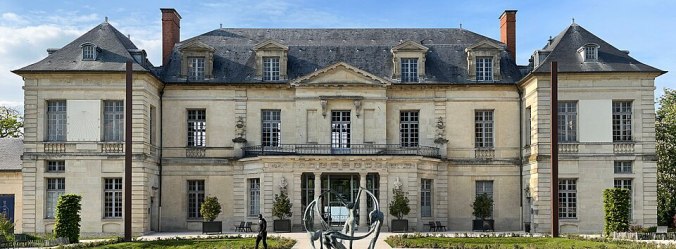
Le château de Sucy-en-Brie Image: Chabe01, CC BY-SA 4.0 <https://creativecommons.org/licenses/by-sa/4.0>
When living in Sucy, Bodley was proud to reveal that “Ludovic Halévy … was my neighbour for two pleasant summers.”

Plan of Sucy-en-Brie. Image: Roland45, CC BY-SA 4.0 <https://creativecommons.org/licenses/by-sa/4.0>, via Wikimedia Commons (Adapted)
Ludovic Halévy was famed as the joint librettist for most of Offenbach’s operettas and of Bizet’s Carmen. He lived just a few yards from the chateau in a vast house called Haute Maison. Writing to his cousin, Bizet’s widow, in late August 1895, Halévy gives us a glimpse of Eveline Bodley just a few months before she gave birth to her daughter:
Sucy est plus calme , et peut-être, je crois, trop calme à notre jolie voisine, Madame Bodley. Elle a été fort surprise quand Louise lui a dit que tout dormait vers dix heures du soir … [Sucy is quieter, and perhaps, I think, too quiet for our pretty neighbour, Mrs Bodley. She was very surprised when Louise told her that everyone was in bed by about ten in the evening …]
This portrait of Madame Bodley by Léon Bonnat hung in the salon of the chateau in Sucy-en-Brie.
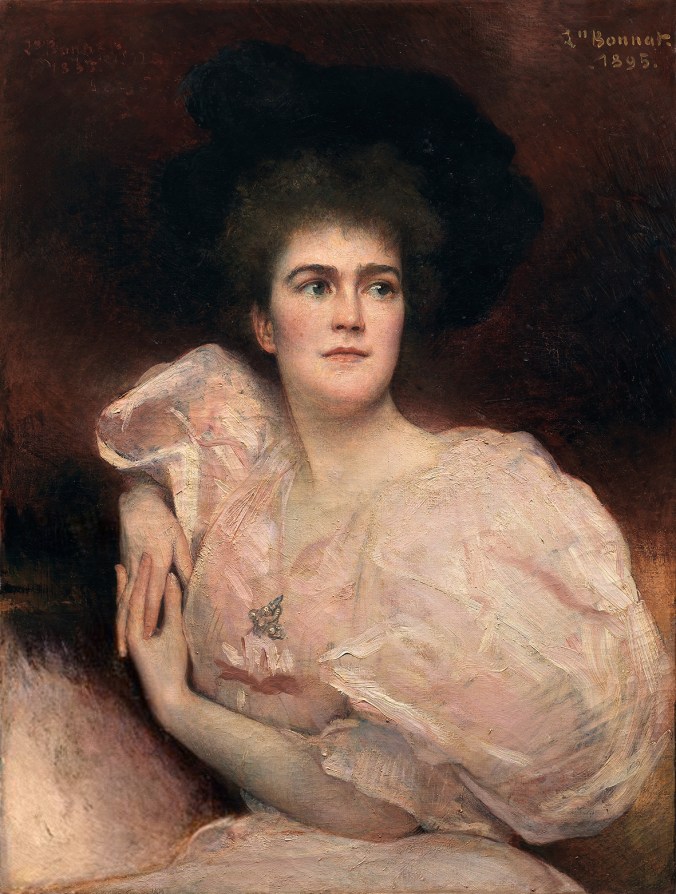
Léon Bonnat, “Portrait d’Evelyn Frances Bodley”, 1895 (huile sur toile / H. 81,6 cm ; l. 65,4 cm / numéro d’inventaire : CM 859 / © Bayonne, musée Bonnat-Helleu / cliché A. Vaquero)
From late 1900 until 1904, the couple spent most of their time at the Château Bellefontaine in Biarritz, where on one notable occasion in April 1902, according to the New York Herald “the King honoured Mr Bodley, the author of ‘France’ and Mrs Bodley with his company at breakfast on Sunday.” This may well have been the day on which Edward VII, as yet uncrowned, asked Bodley to write The Coronation of Edward the Seventh: A Chapter of European and Imperial History (published in 1903)
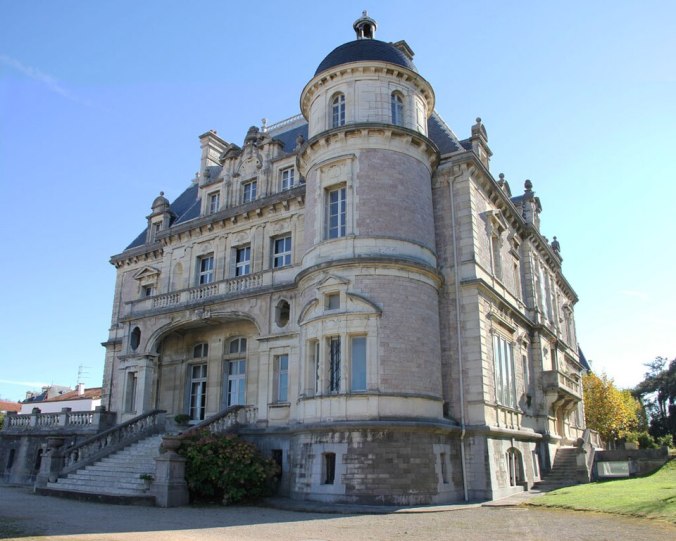
Château Bellefontaine, Biarritz. Built in 1880. Image: Remi.touja Creative Commons 4.0
There are no clues to the circumstances which brought Bodley to Hove in 1904. This was a turbulent time in his life. His fourth child had died, aged just 2, that September while the couple were staying at the Château Bellefontaine; in the same year, Bodley and his wife sought, acrimoniously, a divorce which was not granted. The couple separated and by 1908, they had managed to divorce. Their 15 year old daughter seems to have sided with her father. The 1911 census lists Alix Yveline Ava Courtney Bodley as living at 2 Adelaide Mansions with her father and two servants.

La Folie Boulart, formerly Château Bellefontaine, now a private hotel. The house at Adelaide Mansions was extremely modest by comparison. © La Folie Boulart / M. Pierre Delalonde
2 Adelaide Mansions was advertised for sale by Maple and Co. in 1903. It is possible that Bodley bought the house at this time, or perhaps he rented it from the purchaser. Either way, it was a stunning property:
… the exceedingly attractive and commanding MARINE MANSION, known as 2 ADELAIDE MANSIONS, HOVE, replete with every comfort and upon which large amounts have been lavishly expended on the internal appointments and decorations which are of a most handsome and costly description. The Mansion occupies a very choice position, directly facing the sea, in the most fashionable part of Hove, opposite the private lawns to which there is right of access, is of imposing elevation and in perfect order. It contains 11 bedrooms, large bathroom with tiled walls and floor, and Roman bath (hot and cold), and sea water supplies, wide stone staircase and secondary ditto, exceedingly elegant drawing room, 48ft. 2in. by 24ft., handsome oak-panelled dining room, 27ft. 4in. by 17ft. 7in., morning room, smoking room, very pretty winter garden,… vestibule entrance hall, lavatory, kitchen, butler’s pantry and bed room, servants’ hall and usual offices, dinner lift, electric light, gas, electric bells and speaking tubes are fitted to the mansion.
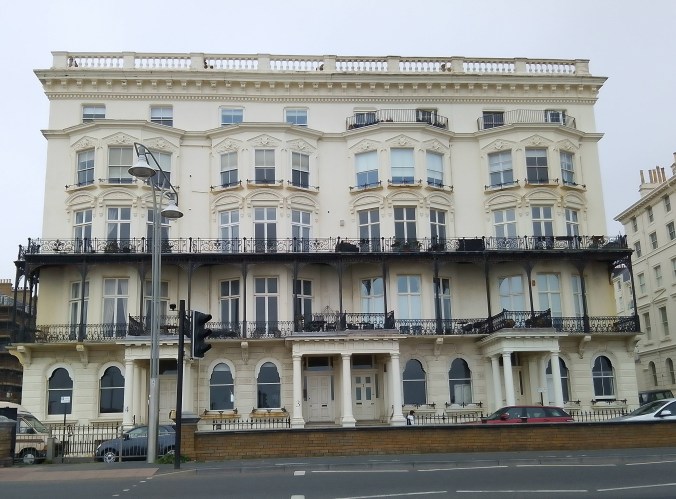
Adelaide Mansions are numbered 1 to 4 from right to left.
Why would Bodley want to live in such a large house? Firstly, he was used to living in chateaux, staying in embassies and occupying other grand residences. Compared to his homes in Sucy-en-Brie and in Biarritz, he was downsizing. Secondly, it is possible that, having been a guest in so many notable French homes, he was obliged to do a great deal of reciprocal entertaining. Alix Bodley, later Viscountess Waverly, became a society hostess admired, amongst many others, by Winston Churchill. Her skills may have been honed in Adelaide Mansions.
During his time in Hove, Bodley continued writing: 20,000 words on France for the 10th edition of the Encyclopaedia Britannica; numerous introductions to books by other writers; a two-part lecture on “The Church in France” given to the Royal Institution in 1906; L’Age Mécanique et le Déclin de l’idéalisme en France (published in 1913) and much, much more. Soon after the end of WW1, at about the time he left Hove, Bodley published the curiously titled “The Romance of the Battle-Line in France”.
The aim of the book was worthy. Soldiers who had fought and suffered in France might come to be curious about the places in which they had suffered. Those who had lost friends and family might want to know more about the place in which their loved ones had died. To some extent, Bodley was cashing in on nostalgia.
Bodley continued to live in Adelaide Mansions until about 1919. His daughter, now known as Ava, married in February 1925, exactly three months before her father’s death… and four years after her father had married Phyllis Helen Lomax who was some 30 years Bodley’s junior.
Bodley did not live to know the grief of losing his own two youngest sons by his marriage to Phyllis: both men were in their early twenties, both were killed within six weeks of each other in 1944, John in Italy, Thomas in Belgium. Their mother lived until 1968 in Cuckfield, Sussex, where her husband, John Edward Courtney Bodley, had died 43 years earlier.




 French Brighton