Who were these women? And were they French?
Author: suzannethinton
Mr White and the Jeu de Paume
What is le jeu de paume, or “real” tennis? And what has it got to do with the Brighton? Hove-based Richard White, explains.
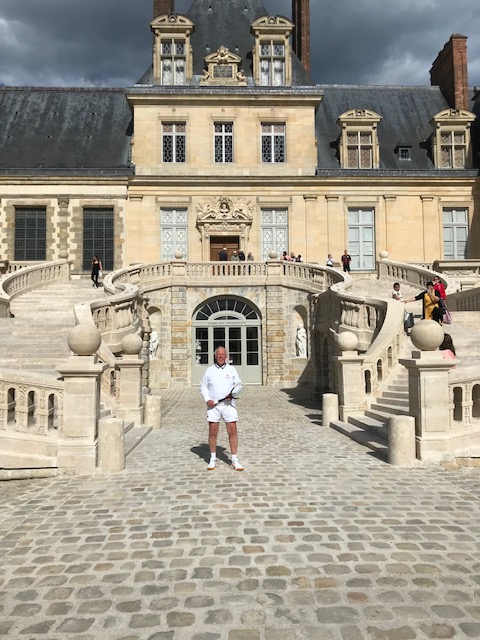
“On 23 June 2022, I was playing a game of jeu du paume [real tennis] in the semi-finals of the World Masters (over 75s) Real Tennis Championship. The venue was the magnificent court in the Château de Fontainebleau.

Richard White at the Château de Fontainebleau in June 2022 (c) R. White
L’assassin de Kemp Street

Gordon Hotels
Anyone who knows the Metropole Hotel in Brighton will recognise the building below: the central turret rising out of a pyramid roof, the cast iron balconies, the mansard roofs on the side pavilions and the dormer windows. And if the image were in colour, we would also recognise the warm red of the brickwork.

Image courtesy of the « Fonds ancien et local de Dieppe » (Dieppe Archive)
Jules Zanole, French Honorary Consul
The French Embassy in London outlines the role of the Honorary French Consul in the UK as: « Les consuls honoraires ne sont pas des agents de l’État mais des particuliers qui exercent leurs fonctions à titre bénévole. Leur mission principale est la protection des Français et de leurs intérêts et le devoir de rendre compte aux autorités consulaires françaises des événements intéressant ces autorités. »
Continue readingBrighton & Hove Francophilia 1900-1914
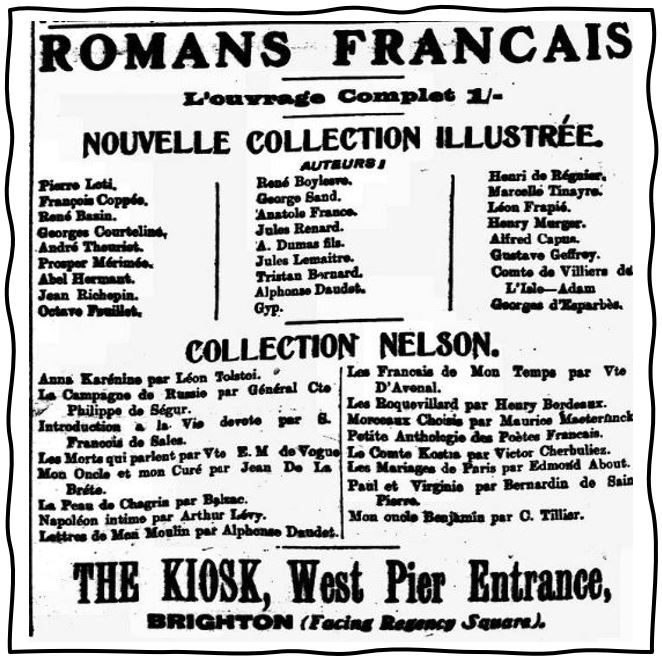
How unusual to see a French language advert for French novels in a Brighton newspaper:

Brighton Gazette 12 June 1912, Source: Royal Pavilion & Museums, Brighton & Hove. This advertisement ran intermittently from October 1910 until October 1912.
Maurice Jacobs : Teacher and French Honorary Consul
The 20th century had dawned just a few short years ago. Their son was a young teenager, so M. and Mme Léon, in Bordeaux, decided that it was high time for their lad, René, to perfect his English. The family was very internationally minded. They knew that Brighton already had an excellent reputation for good schools. Its climate was healthy and its Jewish community was thriving.

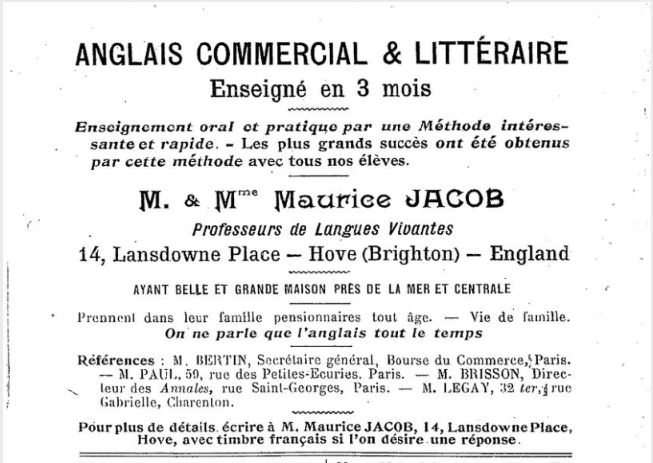
© Gallica : Bulletin de la Société de la Propagation des langues étrangères en France 1906
“Ah”, said M. Léon, “there is a school in Hove that would do very well.” So he sent off a letter of enquiry to 14 Lansdowne Place in Hove. Alas, it came to M. Léon’s ears that this school, run by a Frenchman and his English wife, was very, very small and that it had changed address several times over the previous few years. This did not bode well. The Léons looked elsewhere. Then they remembered that a few years previously, they had seen an advert in the “Jewish Chronicle” for a school in Brighton. This looked more like what they wanted:
Continue readingThe Dell Boys and the Empress
How the Brighton partnership of Dell and Dell came about their status as “Removers to Her Imperial Majesty” remains a mystery, but there are a few clues along the way.
Continue readingFrench Cinema in Brighton (2) 1907-1914
Until early 1909 there was not one single hall or theatre in Brighton dedicated to moving pictures. Patrons could see “exhibitions” of animated images as part of a variety performance or as a novelty on the Palace Pier or the Alhambra on Kings Road.
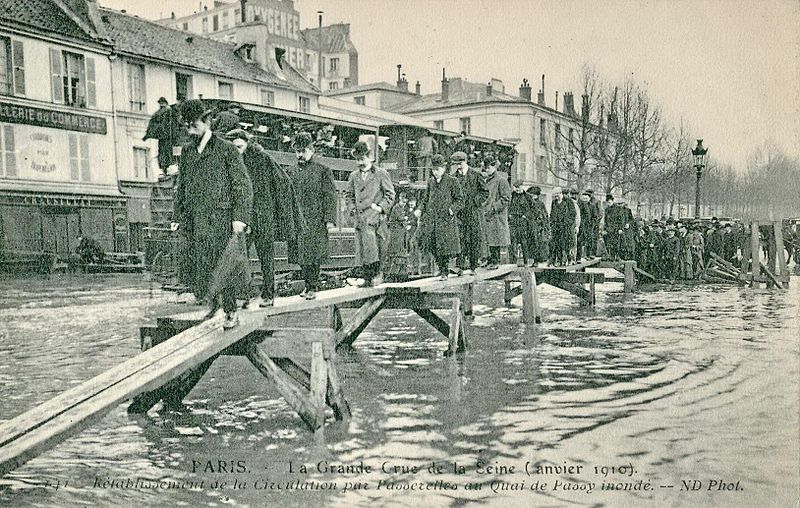
The first “cinema” in Brighton was the Electric Bioscope Theatre in Western Road, just a few yards from the corner of Montpelier Road (where Waitrose stands in 2023). It opened on Saturday 13 February and was immediately successful. The Pathé film of the disastrous 1910 floods in Paris was one of the myriad of French films shown in Brighton before the outbreak of the Great War.

A postcard showing an image that might have been seen in an early version of the Pathé newsreels which were a staple of British cinema until the 1970s. Wikimedia Commons
Brighton seen by Albert Millaud – 1873
When Albert Millaud boarded the ferry in Dieppe bound for Newhaven he found that: sur le bateau où je me suis embarqué, tout le monde était anglaise. [everyone on my boat was English.]

Paddle Steamer Alexandra sailed the Dieppe-Newhaven route from 1863 until 1883. Millaud would have travelled on P.S. Alexandra or P.S. Paris. Image courtesy of “Our Newhaven” / Derek Longly / Del White.