When John Basil Cartland walked out of his front door and down the steps of his home at 11 Powis Square, Brighton on Monday 12 March 1973, he was not to know that within six days he was to be brutally murdered in France.

When John Basil Cartland walked out of his front door and down the steps of his home at 11 Powis Square, Brighton on Monday 12 March 1973, he was not to know that within six days he was to be brutally murdered in France.
When John Sebastian Glouton died in at 98 Western Road, Brighton in 1864, he was described as “a very plain and unpretending man, possessing a kind and genial nature.” He was much more complex than that. Forget the unfortunate name of Glouton [Glutton]. Monsieur Glouton was a highly intelligent man and reputedly a brilliant teacher. Alas, he was no businessman.
Continue readingFor four days in 2022, part of the Unitarian Church in New Road, Brighton became a little bit of France. Look hard and you will see the “writing on the door”. On a background of the French tricolore is the single word Élections.
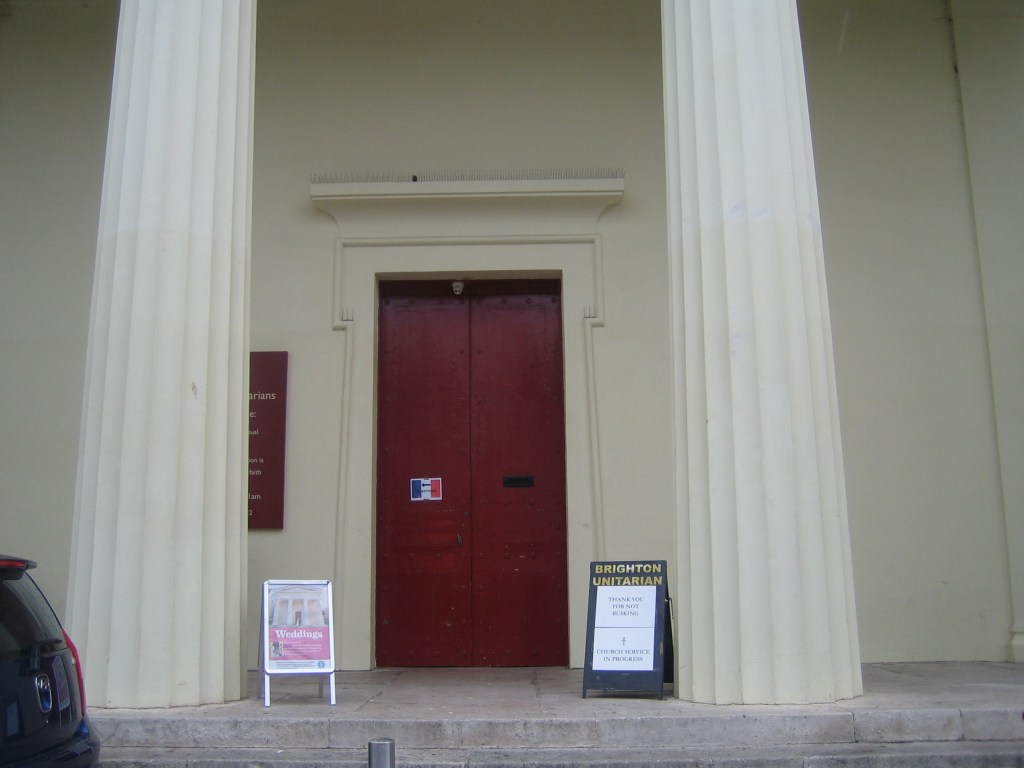
Sunday 10 April was the day of the first round of the French les présidentielles [presidential election]. The several thousand French voters in the Brighton area and wider afield (postcodes BN, PO and SO) seemed to have preferred to stay in bed.
When I started work in October 1974 as the part-time French teacher at Davies’s College in Cromwell Road, Hove, all I knew of my predecessor was that she was called Thyra Creke-Clark and had died suddenly the previous July. According to the Principal of the college she had been “a formidable woman”

French diplomat Auguste-Charles-Joseph de Flahaut de La Billarderie, comte de Flahaut had the characteristics of a Don Juan and those of a courageous soldier in equal parts. With his charm and tact, he must have been a popular visitor to Brighton. It is not entirely clear whether the same can be said of his wife.
Portrait of Charles de Flahaut c. 1864 Source: commons.wikimedia.org/wiki/File:Portrait_de_Charles_de_Flahaut.JPG”>MOSSOT
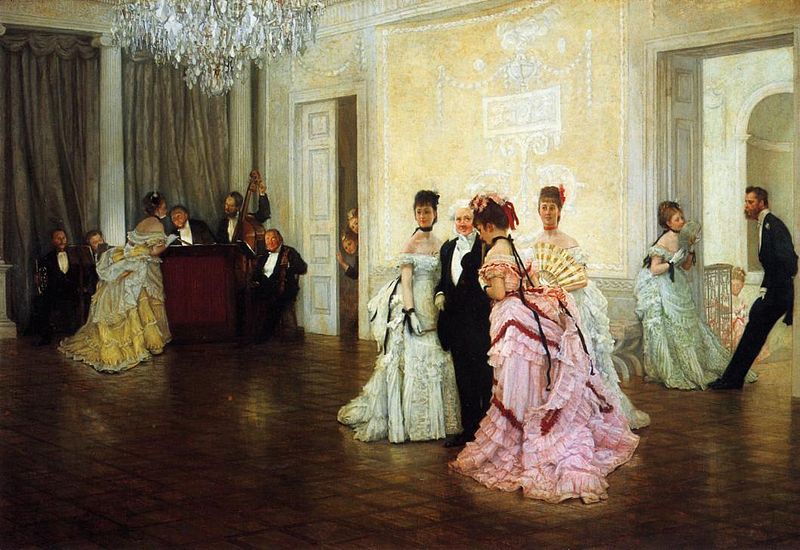
James Tissot “Too Early” (1873) Source unknown
After being wounded in the Franco Prussian-war, and having briefly supported the Paris Commune in 1871, Jacques-Joseph Tissot made his way to London. There he settled from some 11 years. He found immediate success. The public and most critics admired the “delicacy of tone” in his pictures of “pretty English girls”. Continue reading
In March 1920 Pamela Stirling was born, an ordinary little girl to an ordinary family in Wandsworth, Surrey. Replace the word “ordinary” with “extraordinary” and that is much nearer the truth.
Continue readingEarly in 2021 Frederic Laloux was appointed French Honorary Consul for Brighton and Newhaven. M. Laloux is the most recent incumbent of an official post reaching back to at least 1821. This post is unpaid, apart from expenses. It occasionally carries the title Vice-Consul as the local consuls (there are about 30 across the UK) report to the Consul Général in London.

Brighton as the first Honorary French Consul would have known it in the 1820s. Image (c) Regency Society / Society of Brighton Print Collectors
Continue reading
This badge is tangible proof of the fact that there was once a close link between Brighton and Biarritz going back nearly a century.

Delegates badge 1938 – Courtesy of the Royal Pavilion & Museums, Brighton & Hove
Biarritz had hosted a delegation of Brighton worthies in 1932 with a view to forming tourism and cultural ties between the two towns.
It was now Brighton’s duty to return the French hospitality. Not an easy or cheap task for Brighton to emulate the generous hospitality of the French town. At first, a visit to Brighton was projected for 1933 but did not take place. Continue reading

 French Brighton