By the mid-1970s, the Continentale cinema had stopped showing French films. BBC television had started showing them from the mid-1950s. Jean Renoir’s ‘French Can Can’ was shown on the single-channel BBC almost as soon as it was released in 1955. Who would show French films to a Brighton audience in Brighton?
The cinema at 64 North Street would. Originally opened in 1911 as the Bijou Electric Empire, the tiny 400-seater cinema at the heart of Brighton’s shopping area evolved over the years.

Image Courtesy of Mike Blakemore via Creative Commons
For the next twenty years, the venue was known as the Princes News Theater, showing “news and interest films” from 1947 to 1966.
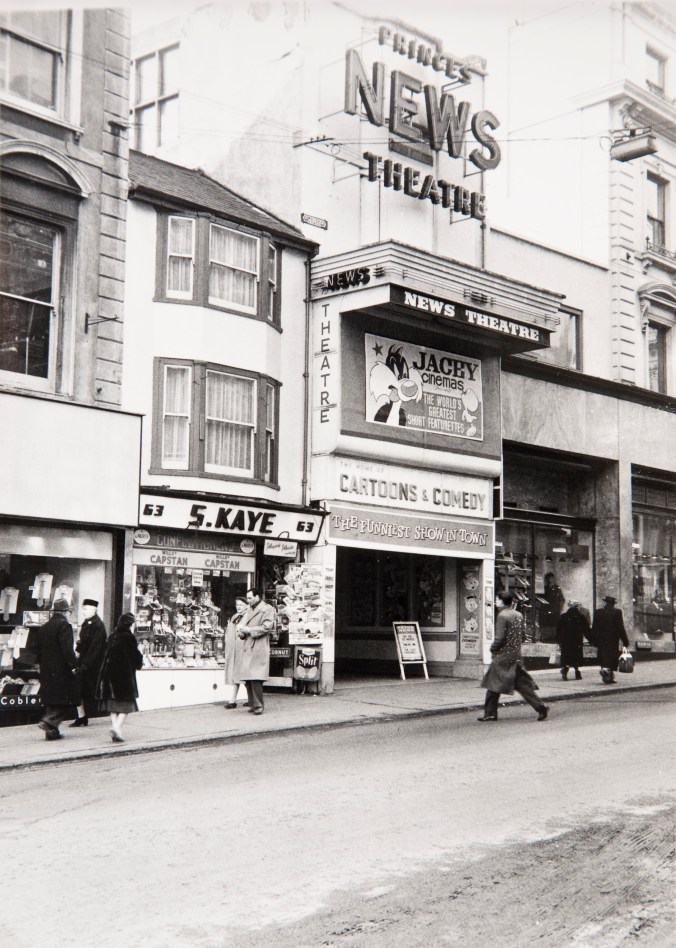
Image courtesy of the Regency Society
The management of the cinema then changed the name to the Jacey.
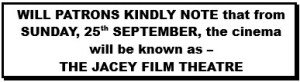
More importantly, they also announced that the cinema would now be “showing films mostly made on the Continent.” They were true to their word, showing films by Lelouche (‘Decadent Influence’ / Une fille et des fusils); Jean-Pierre Melville (‘Second Breath’ / Le deuxième souffle); Alain Resnais (‘The War is Over’ / La guerre est finie), René Clair (Les fêtes galantes) and a “premiere” (presumably UK) of Jean-Luc Godard (Alphaville – every day for a whole week in January 1967 at 2.10, 5.30 and 8.05), not forgetting Brigitte Bardot’s film debut in Roger Vadim’s ‘And God Created Woman’ / Et Dieu créa la femme in August of the same year.
The most bemusing title must have been ‘Cloportes’. French speakers would have recognised the word, cloporte meaning woodlouse and so would have realised that the film might have something to do with ne’er-do-wells, or low-lifes – or was a natural history film about bugs. However, would the average patron at the cinema have realised that the film was in French, or that the original title was La métamorphose des cloportes and was a crime caper?
Admittedly French films were vastly out-shown by the Jacey’s wide range of films which covered every genre: horror, sci-fi and a long list of X-rated films, as well as a tiny handful of films from other Continental countries such as Denmark, Czechoslovakia, Sweden, Italy and even one from Israel.
On 28 February 1969, this snippet appeared in the Worthing Herald:
Glowing from a £6,000 facelift and the provision of new sound and lighting equipment, the former Jacey Cinema in North Street, Brighton, was given a gala opening on Sunday night as the Brighton Film Theatre, a non-profit making venture dedicated to the showing of high quality films.
The audience would be pampered – although smokers and the hungry might not have agreed, the stipulation being that “There will be no smoking, no sales of ice cream and nuts”. However, there was also some good news as “on arrival, each patron will receive a programme note explaining the film they are about to see.” But were the patrons to see French films? Well, not particularly.
The Brighton Film Theatre (BFT) was run under the aegis of, and with money from, the British Film Institute (BFI) as well as funding from the Brighton Council. Ironically, French cinema was rather squeezed out by (albeit excellent) retrospectives, festivals of individual actors (including Buster Keaton and Noël Coward), ballet, all as per the remit of the BFI which, amongst other things, listed the aims of the BFI :
-
- To offer the widest range of UK and international moving image culture through our programmes and festivals — delivered online and in venue
- To use our knowledge to educate and deepen public appreciation and understanding of film and the moving image.
How the orange eating competition, held in the cinema in November 1969 in aid of Shelter, fitted in is not quite clear.
The first showing that could be described as a French film (apart from a film of the Georges Bizet’s opera Carmen) did not happen until a full nine months after opening. This was Eric Rohmer’s La Collectonneuse (1967) shown in December 1969.
Matters improved for Francophiles in the early 1970s. A festival called “The Best of Godard” saw showings, amongst other Jean-Luc Godard films, of the surreal Weekend (1967, not shown until mid-October 1970) along with Les Teenagers directed by Pierre Rostand which featured a cameo appearance by Salvador Dali. These films rubbed shoulders at Christmas time with the likes of the animated comedy ‘Asterix and Cleopatra’ (British premier of the 1968 Astérix et Cléopâtre) and ‘The Red Balloon’ (Le Ballon rouge 1956).
It is strange that often the Brighton Film Theatre advertised the title of a French film in English. In that age of the director as auteur, film buffs ‘knew’ their directors: in September 1972 Chabrol’s Le Boucher appeared as ‘The Butcher’ in one advertisement and Le Boucher in another the same month. His 1973 Les Noces rouges was ‘Red Wedding’ in the local listings when it was shown at the BFT in June 1974. Truffaut suffered the same fate in the same year when La nuit américaine was listed as ‘Night for Day’.
However, perhaps it would have been safer to stick to the English title ‘Happiness’ as, in March 1971, the copywriter of the Sussex Express incorrectly typed this title for printing as La Bon Heur. Would Agnès Varda, director of Le Bonheur, have seen the funny side? Films advertised as R’emsant Sauvage (November 1971) and La Chade (December 1970) completely foxed me. And was the film listed as ‘Conduite’ in June 1972 really Jean Vigo’s Zéro de Conduite (1933). An excellent choice if it was.
To be fair, it is not only the titles of French films which are mangled by copywriters and/or printers: in June 1973 the BFT was purported to have shown a film called ‘Pepe Joan’. Nothing to do with Pépé-le-Moko (a gagnster film dating from1937). This was the 1972 English language ‘Pope Joan’. Shame on you, Sussex Express.
My very favourite typo is in the Sussex Express of 30 June 1967. The advertisement for the Jacey reads: “A tiger likes French Blood”. This certainly caught my attention. I then discovered that the film was called ‘A Tiger Likes Fresh Blood’. However, all could be forgiven as this was indeed a French languages spy film directed by Claude Chabrol: Le tigre aime la chair fraiche.
By the end of 1974, the BFT was in financial trouble, but the day was saved by an injection of cash, initially from Brighton Borough Council and the South-East Arts Association, and later from the Brighton Film Theatre Trust. Ironically, it was after this period that the most French films were shown, on average one a month with the exception of the Brighton Festival of May 1976 which pulled out all the stops for a Jean Renoir retrospective. Films shown ranged from his ‘Little Match Girl’ (La petite marchande d’allumettes, a 1928 “featurette”) to ‘The Little Theatre of Jean Renoir’ (Le petit théâtre de Jean Renoir, a 1970 compilation of shorts “made for TV”).
June and July of 1977 provided a feast for francophiles, with a series of Jean Cocteau films, presented in rather an odd fashion. The Sussex Express puts it quite clearly:
In this season, some Cocteau classics have been combined with less academic and more truly disturbing phantasy films, mostly based on his writing. Particularly the recently rediscovered work of Serge de Poligny, ‘The Phantom Baron’, stands out, some feel, as a masterpiece of surreal-poetic film making.
Other strange bedfellows were Cocteau’s Orphée shown with Godard’s Alphaville, described by the journalist of the Sussex Express as:
Two contrasting notions of “poetry”: Cocteau’s mystic romanticism relying on Greek mythology and 19th century aesthetics vs. Godard’s vigorous engagement with contemporary myths and the most lively traditions of popular cinema, e.g. gangster films, science fiction, melodrama and crazy comedy.
Although de Poligny directed ‘The Phantom Baron’ (Le baron fantôme, 1943) all the dialogue had been written by Cocteau. The film was shown on 3 July 1977 with Thomas l’Imposteur (Dir. Georges Franjou, 1964) based on a Cocteau story of a young man in WW1 “one of Franjou’s most inspiring and disturbing films”.
No sooner had the Cocteau series ended early in July 1977 than a Truffaut retrospective began, followed hard on their heels by a series of Chabrol films at the end of the month. Francophiles then had to wait until October for their next film: Godard’s Numéro Deux and then again until December for his comedy Une femme est une femme,
1978 was true to previous form in that approximately one French film was shown per month. Then, the very next year, came the news that the lease had been sold and the Brighton Film Theatre was to be no more.
Enter Cinescene. Proprietor, Myles Byrne. As with Byrne’s Continentale in Kemp Town, European films were on the programme at Cinescene, minus many of the more salacious X movies that the Continentale had turned to. Cinescene opened in September 1979 and had already shown five French films by the end of the year, ranging from Buñuel’s X-rated Belle de Jour to Jaques Tati’s comedies Mon Oncle (title in French) and ‘Monsieur Hulot’s Holiday’ (title in Franglais). This double bill would go on to be a favourite at Cinescene as it was shown again in late December of the same year, in September 1980, April 1981 and again in April / May 1982.

Les Enfants du Paradis was shown at the afternoon and early evening performances from 7-13 December 1980. Image: A collage created by coversbykaren.com (Licence CC BY 2.0)
On 3 June 1983, the Sussex Express had the following listing:
CINESCENE (738059) Today and Sat: Eating Raoul (18) & Towers of Babel (15) LCP 7.35. Cinema closed for alterations from June 5.
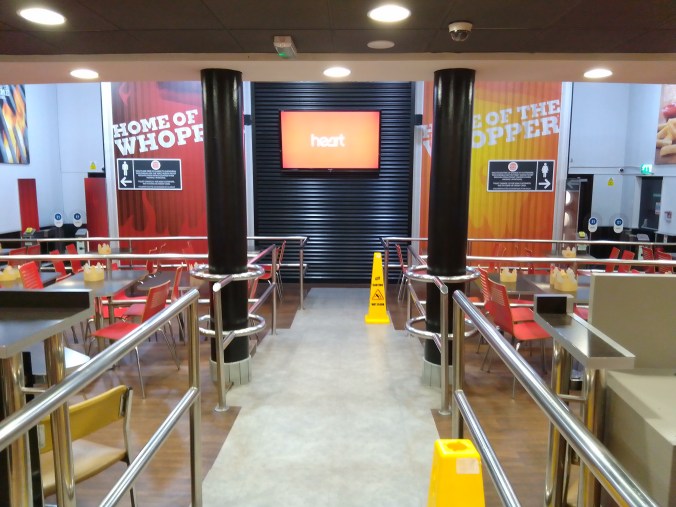
Image: S. Hinton. The space above is just about recognisable as a raked theatre.
And that was it. The building was never used as a cinema again. It lay unused (if not empty as the projectors and screen remained) for a few years until the lease was taken over by the fast-food chain Burger King.
That was more or less the end of French films in Brighton. The Duke of York Picture House at Preston Circus and their sister venue, the Komedia in Gardner Street, Brighton keep the flag of French films flying … sporadically, as does The Depot in Lewes. The most devoted Francophile film buffs now have to rely on streaming, television or buying their own DVDs.

 French Brighton