When you next pass The Poets’ Corner pub in Montgomery Road, Hove, look up. At roof level you will see two effigies of racehorses. The one below is Eclipse.
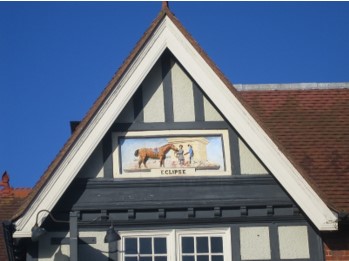
Eclipse was one of the greatest horses of the latter years of the 18th century, both as a racer and at stud. He started his racing career aged five in 1769, but was retired young, after a mere 18 races, because not only was he undefeated, but he won his races by such a large margin that no other owners would enter their horses against him. The only time he won a race in Sussex was at the Lewes course in July 1769.
In 1783 the Prince of Wales (later the Prince Regent) came of age. He loved to gamble on everything, but especially on horseracing. It was then that he started to visit Brighton.
There were several reasons behind the Prince’s decision to escape to Brighton. Probably the main one was to get away from his father, George III. Equally important were the facts that the Prince’s uncle had a house on the Steyne; that Brighton was healthy and beginning to become fashionable; that Lewes had a racecourse just seven miles away; and that racing had just become official on a course high above Brighton on the Tenantry Down.
Long before the Revolution of 1789, French royalty and aristocrats spent a great deal of time in England with George III and the royal household. Many of these French visitors were quite fanatical about horse racing. One of them was Louis-Henri-Gabriel, marquis de Conflans.
The marquis was a career soldier. He was also very close to the younger branch of the French royal family and in particular to Louis-Philippe, duc de Chartres (later duc d’Orléans). Once the Prince of Wales had reached his majority in 1783, it would appear that the Marquis de Conflans became part of his coterie.
But to go back a few years. Even before the marquis de Conflans inherited his father’s title – and possibly a great deal of his father’s money – his mind had largely turned from soldiering to horses.
The marquis de Conflans was a member of the Jockey Club. Founded in the 1750s, the Jockey Club was not a club for jockeys. It was a club for owners who, over the years, have set the standards for horse racing both in England and worldwide.
The marquis had become a member of the Jockey Club when he was a young man. In the 1760s and 1770s he had been very familiar with many of the thoroughbred horses. One of these horses was Eclipse. A hundred years later, in his book ‘Horse-racing in France’, John A Seaverns claimed that “Glowworm, son of Eclipse, was sold to the marquis de Conflans about the same time.” [ie 1776]. Hard to verify. On the other hand, there is no doubt that one of the Prince of Wales’ very louche friends Michael Lade, had named one of his horses, a chestnut colt, ‘Conflans’. It may well be that the horse was named in memory of the marquis de Conflans as the horse does not appear to be on race cards until August 1789.
In 1785 we find the Prince of Wales visiting Lord Pelham at Stanmer House along with the duc de Chartres, the marquis de Conflans “and several other persons of distinction” several of whom were probably French. It was not always easy to get from France to Brighton. The Sussex Advertiser was keen to report in July of that year:
Last Tuesday the Duc de Chartres and Marquis de Conflans landed at East-Bourne; their design was to have landed at Brighthelmston, but the wind being adverse, they could not get round the head [Beachy Head]. The above personages afterwards came post through this town [Lewes] for Brighthelmston. Sussex Advertiser, Monday 25 July 1785
The French party was to stay at the Prince of Wales’ seaside retreat, a small villa (later the Marine Pavilion and even later, the Royal Pavilion) on the Steyne. The time of year is significant. The Frenchmen had come for the races. Saunder’s Newsletter took great delight in recounting a comic event on Brighton beach at the end of that visit. At the time, the Prince of Wales was still (just) a lithe and limber young man of 23. He had to show off to his guests:
On Saturday last, the Marquis de Conflans took his departure for Dieppe from Brighton. The Prince and his company went to see Marquis embark, when a very extraordinary and humorous scene was presented. It being low water, the boat could not approach the shore, the Marquis was anxious to get on board, and stood some time in suspense, when the Prince, to show him that persons of rank should not have the propensities of cats , or the frippery of petits maitres [sic], taking one of his companions by the hand, rushed at once into the water. The Marquis, pour l’honneur de la France, could not do otherwise than to follow him; the line advanced with resolution, but could not long withstand the force of the waves, which overset them; they then rolled like porpoises in the water, til they got the Marquis aboard the packet; when they dispatched him in proper state, to pay his respects to the Dauphin [the French heir apparent]. Saunders Newspaper, Friday 2 September 1785
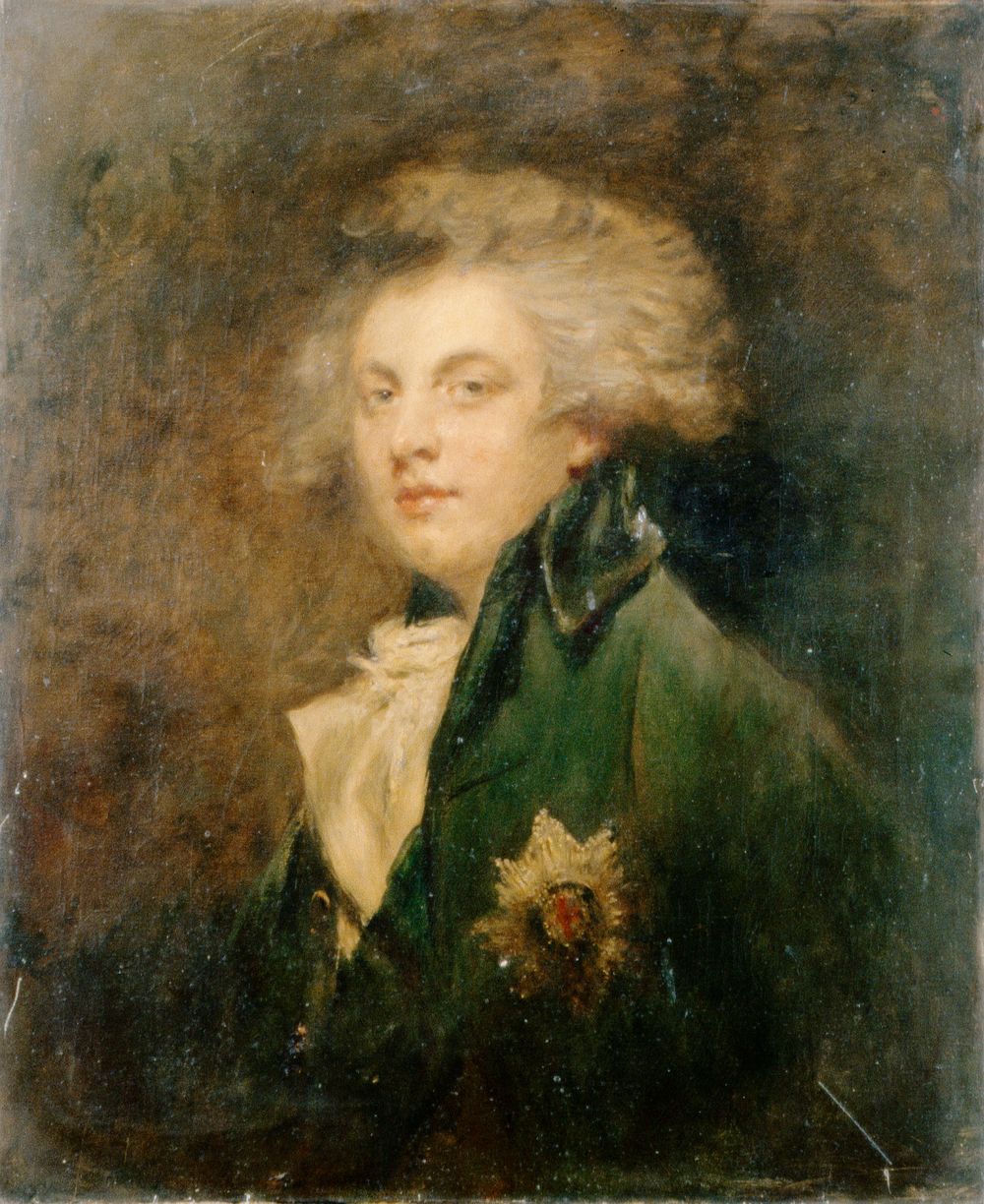
George, Prince of Wales 1779. Courtesy of Royal Pavilion and Museums Trust
The following year, the Marquis arrived in Brighton via London and it was in that year that he was described by the Hereford Journal. He was quite the dandy:
The Marquis, from top to toe, was perfectly à l’anglois [sic], except an earring in each ear, and a watch in each fob, he appeared, what the world most admires, a perfect English gentleman; and to grace the character, he spoke our language with surprizing [sic] facility.
So keen on England and the English was the Marquis, that when he died in 1789 his fellow countrymen accused him of …
… ingratitude to his native land … He it was, they said, who first introduced into France the Anglomania, or rage for everything that was English … but most particularly [for] horses, saddles, bridles, hounds, huntsmen, grooms, and other servants. Cumberland Pacquet, and Ware’s Whitehaven Advertiser, 18 March 1789
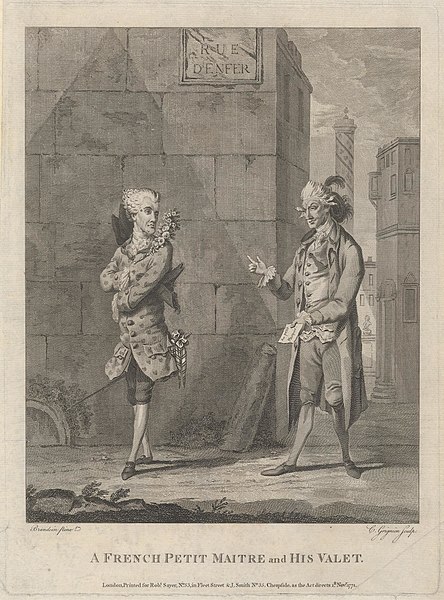
A French Petit Maître and His Valet. Date: 1771 by Charles Grignion. Image courtesy of Yale Centre for British Art. A Petit Maître was a dandy or a fop.
If gifts are anything to go by, the Prince of Wales and the marquis de Conflans were good friends. In 1788, the Prince gifted his friend the race horse Tally-Ho, an animal worth in excess of £300. The marquis was not to enjoy his gift for long. He died within the year, allegedly “while washing his hands”.
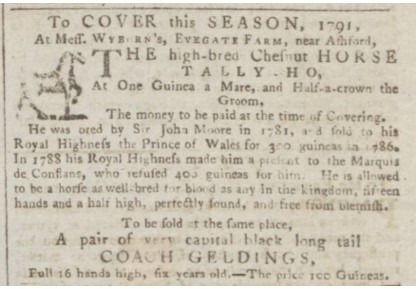
Kentish Gazette, 20 May 1791 Image © The British Library Board: www. britishnewspaperarchive.co.uk
Perhaps an even more prestigious mark of the local favour in Brighton was the establishment of a Conflans Stakes race which was run at the Brighton course from 1786 until 1790 and which – rather surprisingly – was reestablished at the same course, just for a few years, in the early 1970s.
The Prince of Wales lost two of these close French friends when they both died relatively young: the marquis de Conflans died aged 54 – just 6 months before the storming of the Bastille in 1789; the duc de Chartres / d’Orléans was guillotined at the same age, in 1793 – that was his penalty for being a distant cousin to the deposed king, Louis XVI.
Just nine months before the French king, Louis XVI was guillotined, the worse attack that could be made on the British royal family, and the Prince of Wales in particular, was this parody of the Prince’s love of racing.
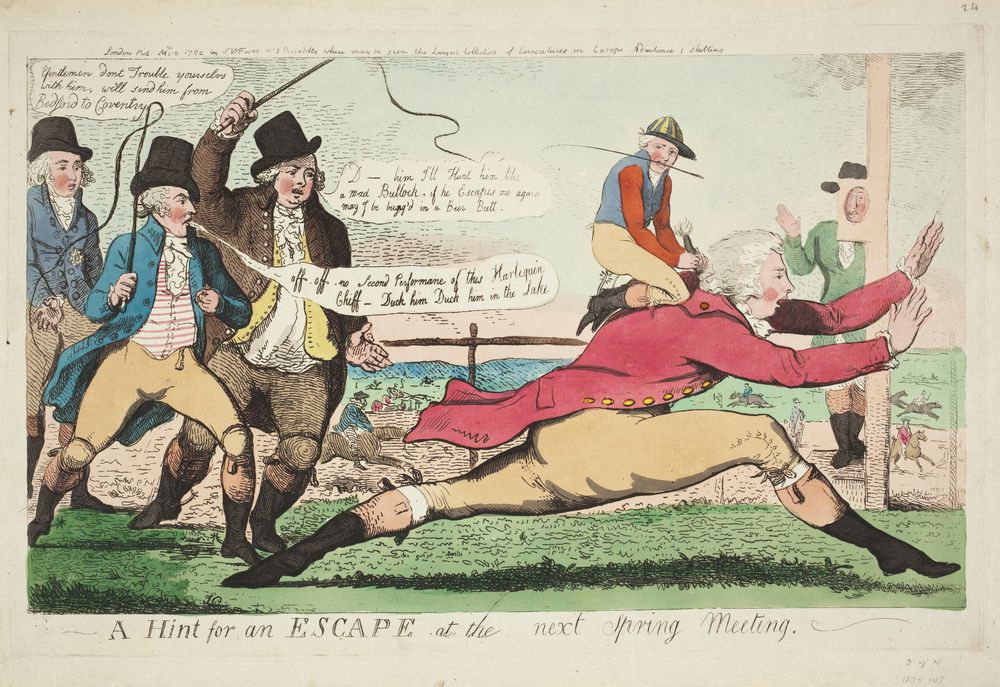
Cartoon by Isaac Cruikshank published 16 March 1792. Image courtesy of the Royal Pavilion and Museums Trust
To come full circle back to Eclipse. On retirement, Eclipse went to stud, siring around 344 foals, including three of the first five Derby winners. Today, the Royal Veterinary College has determined that nearly 80% of modern thoroughbred racehorses have Eclipse in their pedigree. The pub now called The Poets’ Corner was built in 1886 and was originally called The Eclipse. I cannot find out why. Does anyone know?
As for the horse, he died on 26 February 1789, nearly 100 years before the pub was named after him.
And the Marquis de Conflans? He too died on 26 February 1789.

 French Brighton