What is le jeu de paume, or “real” tennis? And what has it got to do with the Brighton? Hove-based Richard White, explains.
“On 23 June 2022, I was playing a game of jeu du paume [real tennis] in the semi-finals of the World Masters (over 75s) Real Tennis Championship. The venue was the magnificent court in the Château de Fontainebleau.
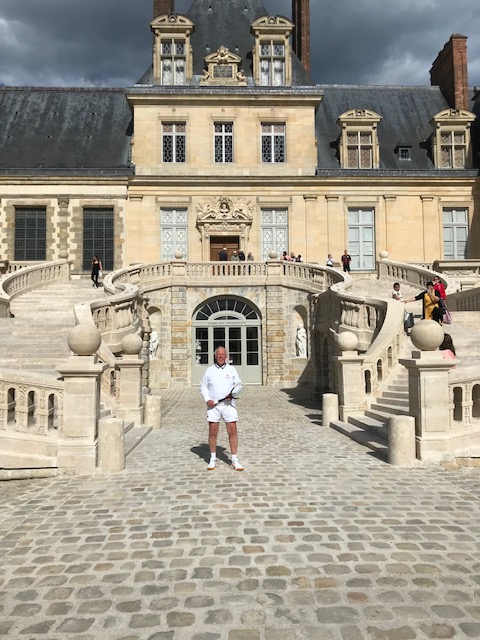
Richard White at the Château de Fontainebleau in June 2022 (c) R. White
“I was unseeded, but after a shaky start I had a convincing win in the first round, 6/3, 6/0, disposing of the 4th seed rather comfortably in the quarter final. Dame Fortune was certainly on my side, when I was stretching to return balls, just hoping to get them back over the net, and they sailed into the winning openings, the dedans, the long goal-like net at the service end, and the grille, the 1 metre square target in a corner at the hazard end.
“In the semi-final I played the much higher ranked, but older (an important factor at this stage of our ‘careers’), first seed, John Ward. Despite losing the match, I felt I couldn’t have played any better, so was pretty pleased with my performances.
“Let me explain some of the technicalities of the game.

19th century image of a real tennis court. Original in the collection of the Manchester Tennis and Racquet Club.
“The main difference between modern tennis and real tennis is that “the latter is played indoors in a ‘court’. The court, apart from being divided by a net in the middle, has a covered corridor with a sloping roof (the pent house / la galerie) along three of the walls, respectively one side wall and the two end walls. As courts are of no precisely fixed size (usually approximately 32m by 11m) I have to readjust my play for each different court.
“The peculiarity of ‘real’ tennis is that the walls and the sloping roof of the corridor keep the ball in play, as in squash.
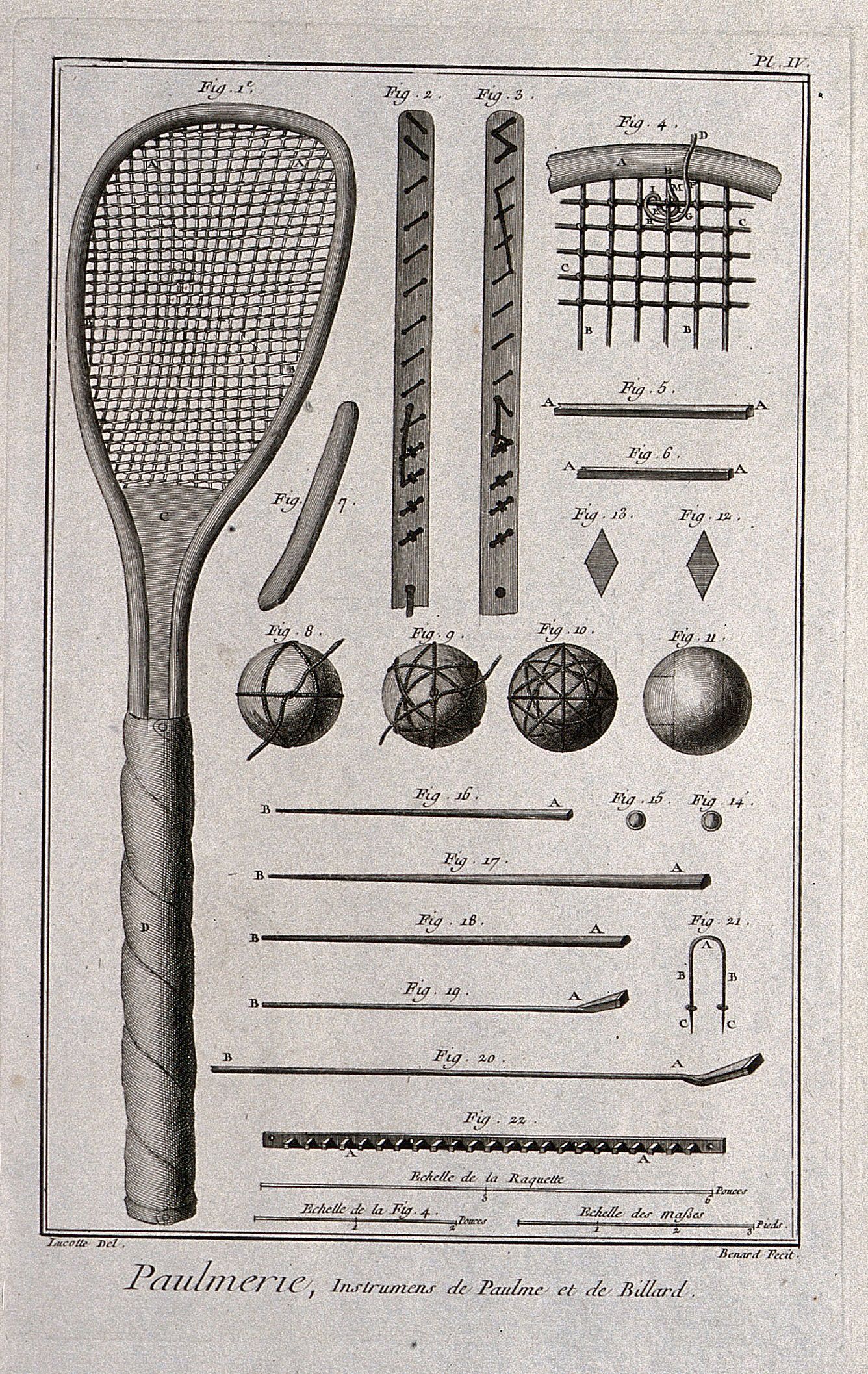
Equipment for the game of real tennis. Engraving by Benard after Lucotte. Wellcome Collection
“The game is played with asymmetric wooden rackets. They weigh approximately 50% heavier than a modern tennis racquet and so it takes some considerable strength to wield them. Even the balls are quite distinctive. They are still hand-made and hard, sometimes become misshapen, and can behave erratically and unexpectedly.
“On either side of the court there are also different targets that, if hit by the ball, give a point outright, these targets are different in size and position depending on what side of the court you are playing.
“The rules of the game also include many peculiarities, like the rule that a point is not concluded on the ball’s second bounce, as in lawn tennis, but the point is replayed later as a ‘chase’, giving you the chance to win the point instead of losing it.
“As with modern tennis, the ball is hit over a net. That is more or less where the similarities end. Understanding even some of the simpler rules can take quite a lot of effort to learn, For example:
When a chase is laid the score does not change, that chase is noted and held in abeyance until the chase is played off. When two chases have been laid, or if there is one chase outstanding and the score is at game point (e.g. one player is at 40 or advantage), the players change ends.
“I have been a real tennis enthusiast for more years than I care to remember and have played in many of the courts in Europe. I was fortunate to have been based in Luxemburg when working as a lawyer-linguist at the International Court of Justice. This made it easy to travel around Europe or back to the UK.
“Now that I am retired, I am looking forward to more matches, more championships and, in the fullness of time, taking part in the over-80s tournaments. Rreal tennis is a sport that can be played well after a player has given up other racquet games.
“In England, I often play on the Petworth real tennis court. This is just one of about 25 in the UK. However, as I am a Francophile, the court at Fontainebleau is one of my favourites.”
*
So is there no real tennis court in Brighton? Well, no, not these days.
A court opened in Brighton in 1836. It was originally built as stables and/or indoor riding house for the Bedford Hotel in Kings Road. The entrance was in Little Preston Street. In their 2010 book “Disturb’d by Chaces”, David Best and Brian Rich give an excellent account of the genesis of the Brighton court: they have discovered that a group of tennis enthusiasts took the decision to convert the disused stables at the Bedford. They bought the property from local magistrate Sir David Scott for the sum of £2,175, the money being raised by the selling of shares in the new venture.
When he saw the court in 1845, Prince Albert was captivated. He “was so delighted” (so claimed the Brighton Gazette) “with the game of Tennis whilst at Brighton, that it is His Royal Highness’s intention to build a Tennis Court, we believe, at Buckingham Palace.” There is no evidence that the Prince Consort built such a court.
By late 1887 the court had fallen out of use after being disused for several years during the mid-Victorian era. It was finally re-opened as “The Princes Tennis Club” in 1895. By the time of the refurbishment and re-opening, the Brighton Gazette was able to report that “precious little of the old, dilapidated structure (was) allowed to remain… The Club is in connection with Prince’s in London, and it speaks well for the completeness of the arrangements when it is stated that the fitting up of the Club has been personally superintended by Mr Hippisley Cox, who founded the well-known Racquet and Tennis Club in Knightsbridge.”
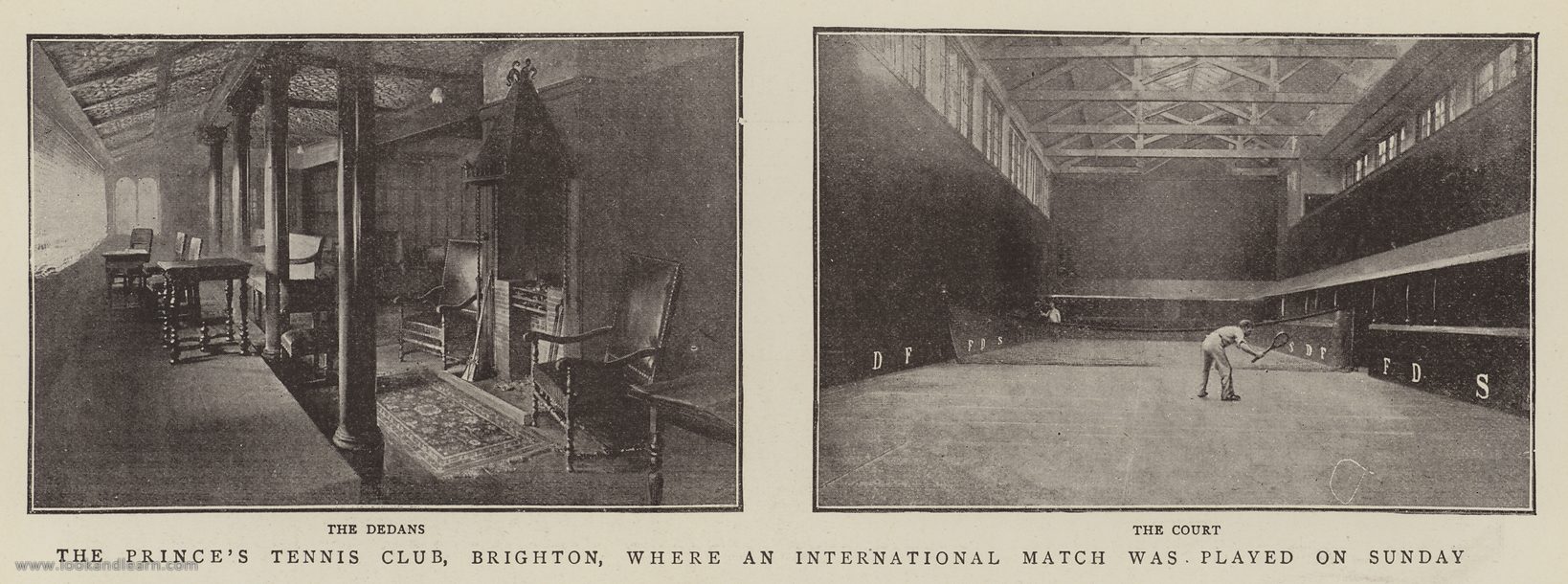
The Prince’s Tennis Club, Brighton, 1894. Illustration for The Graphic, 24 February 1894. Licence via ‘Look and Learn’
The main feature of the newly refurbished building was “a new roof, containing 1,800 feet of glass” which opened and closed as well as “a spacious gallery” running around and above the court.
In the late 19th century, women did not compete in the sport as much as they do today. However, “the ladies” were not forgotten: “Attached to the court are dedans most artistically and comfortably arranged, and which it will be possible for ladies to improvise into a fashionable lounge, and from there watch the games, and at the same time sip fragrant Souchong and nibble the light flaky confections prescribed for afternoon teas.”
Indeed, all needs for both sexes were catered for. Spectators had armchairs, writing desks and even a homely fireplace. For players there was well-appointed dressing rooms “the latter being fitted with hot and cold and seawater baths”. The whole building was “brilliantly lit by the electric light.”
Local MP Gerald Loder was a Real Tennis enthusiast. To encourage the game in Brighton he presented a silver cup in 1902 (last awarded in 1910) and even managed to persuade his father to build a real tennis court on the paternal estate at Whittlebury.
As Richard has explained, courts, balls and racquets all differ from place to place and from château to château. When the French champion Ferdinand Garcin visited Brighton in November 1900, he lost to the Club professional F.C.Tompkins, 8-5, 8-4. However, the report in the Sporting Gazette was gracious enough to point out that “Ferdinand was unknown to the court but he played good tennis.” [Or more likely these days we would say: ‘the court was unfamiliar to Ferdinand’.] However, the above statement is somewhat disingenuous. Not only had Garcin already visited Brighton in 1906 to play the world champion Cecil Fairs, he had also spent three weeks training on the Brighton court prior to the 1900 match.
1906 was an important date for the game of La Courte Paume as it was known in France at that time:
C’est la première fois depuis 1862 qu’un paumier français ose s’attaquer aux Anglais pour le Championnat de Paume ; non pas que les Français soient inférieurs aux Anglais … mais aucun n’a eu l’occasion de s’entraîner spécialement pour jouer des matchs comme le font les Anglais. Les Sports 12 avril 1906]
[This is the first time since 1862 that a French player has dared to take on the English for the Real Tennis Championship; not because the French are inferior to the English … but because none of them has the chance to train, as the English do, specifically for matches.]
At first sight, this might seem like special pleading, but the next line of the article explains the problem: Cela tient à ce que Londres possède six jeux de paume et Paris, un seul, aux Tuileries. [That is because London has six Real Tennis courts and Paris has just one, at the Tuileries.] The court still stands in the Tuileries gardens but is now used as an art gallery.
Nowadays, Real Tennis is largely an amateur sport. However, at the end of the 19th century, large sums of money changed hands: when American Thomas Pettit played Englishman Peter Latham in the International Championship on the Brighton court in October 1898 the prize money was £2,000 – enough to buy the winner a very large house with enough cash left over to decorate and furnish the property. So prestigious and so interesting to sporting fans was this match that, on 18 October, the report in The Times newspaper ran over some 18 column inches. The previous day the same newspaper had used a mere 12 column inches to compare the abilities and backgrounds of the two men.
WW1 barely ruffled the elegant dresses of fashionable Brighton. Society life continued. As did Real Tennis … on the whole. But enthusiasm had waned. Available men players were few and far between during the period of hostilities. And yet some considerable effort was put into reviving the club in the inter-war years.
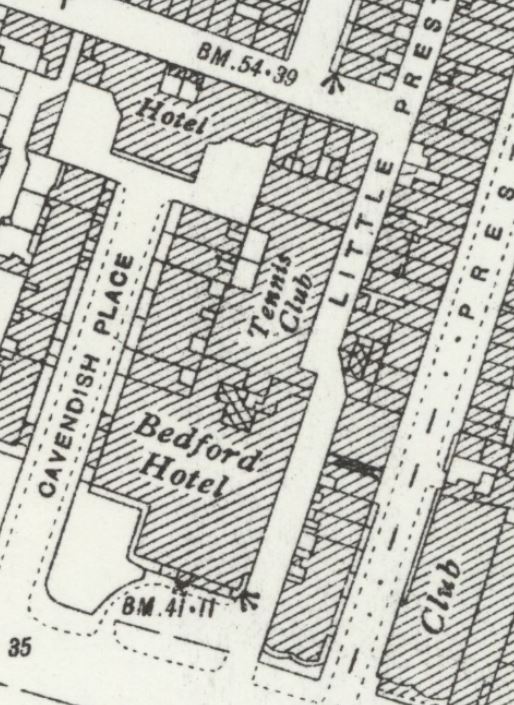
1929 Map reproduced with the permission of the National Library of Scotland CC-BY (NLS)The Bedford Hotel has since been rebranded as a Holiday Inn
Richard White’s assertion that real tennis players are a hardy breed is backed up by a 1928 newspaper report which praises the Rev R.C. Lathom-Brown who “was the oldest real tennis player in the world, and was playing regularly at the Prince’s Tennis Club in Brighton within 10 days of his death” at the age of 83. Despite being threatened with “extinction” in 1931, the club rallied briefly.
It was WW2 which finally put paid to the court. In early 1940 the court was pressed into war service. David Best and Brian Rich reveal that the tennis court was requisitioned, a large hole was cut in its roof, and an ack-ack gun installed. Real Tennis had vanished from Brighton.
On the 1 April 1964, the Bedford Hotel itself was destroyed by fire. In the redevelopment of the site, all traces of the Real Tennis court were lost for ever.
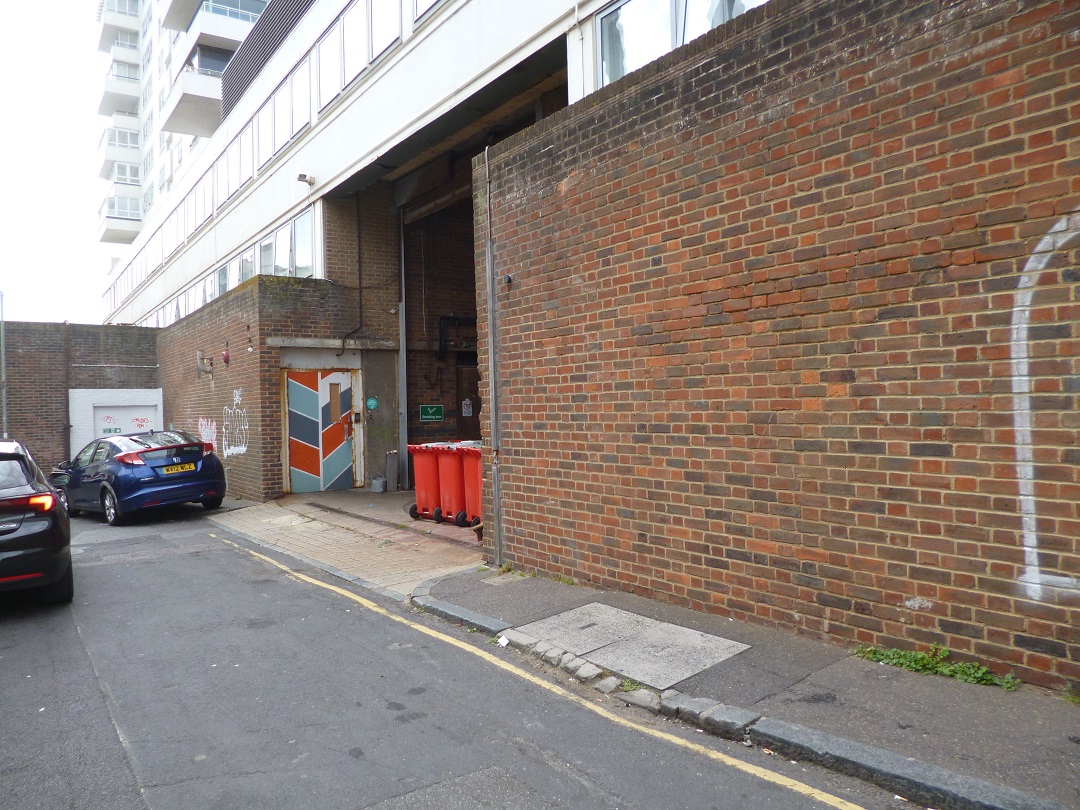
The site of the real tennis court in Little Preston Street, Brighton. Now a goods entrance and garage for the Holiday Inn. Photo: S. Hinton September 2023


We are currently researching Revd R C Lathom Browne who was Rector at our church, St Peter’s in Hever, from 1880 until 1920. Do you have any other information on him or name of to the newspaper containg the article mentioned.
LikeLike