Writing this postcard to a pupil at a prestigious boys’ Catholic school in western France, Marie explains the layout of her school.
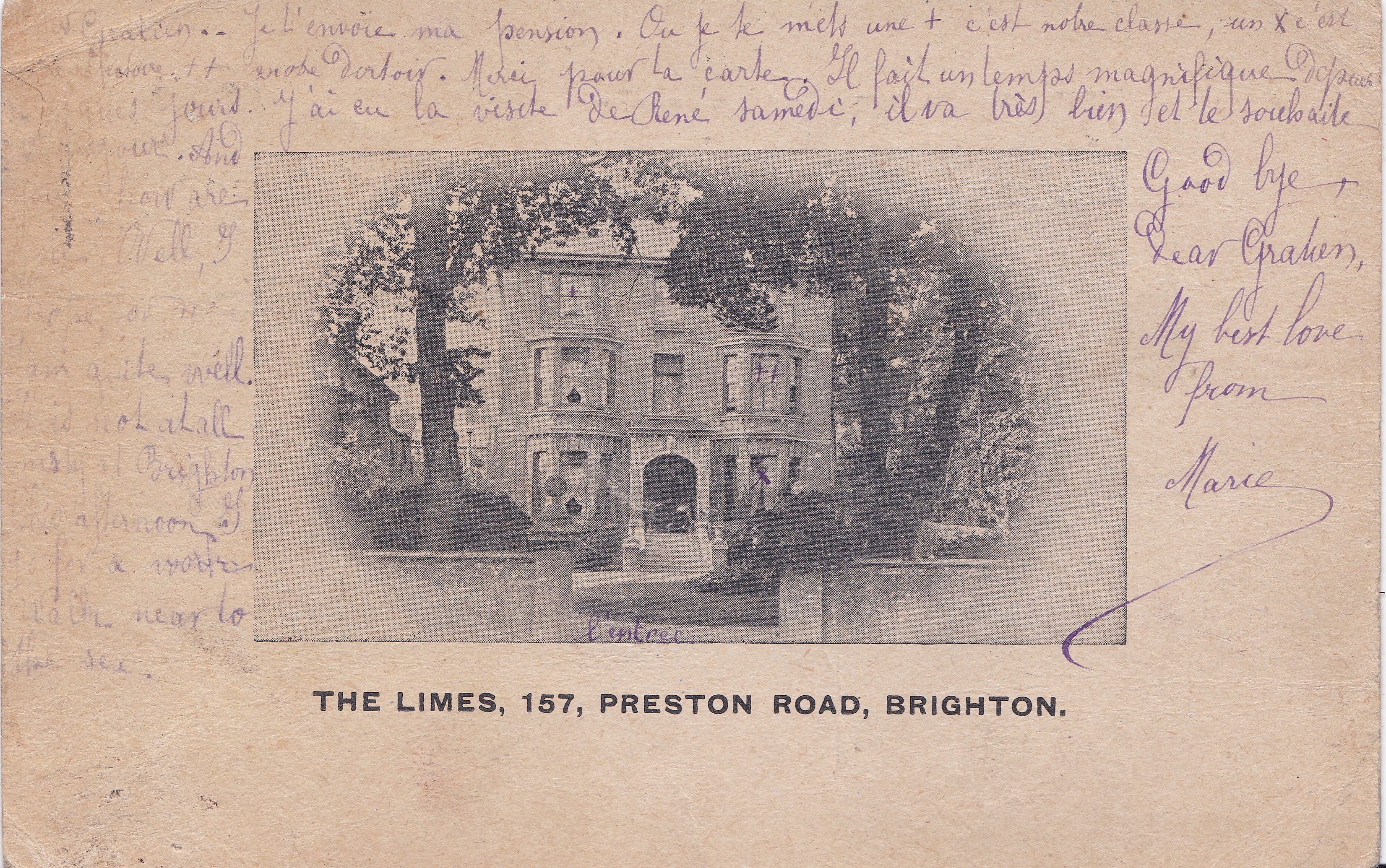
Postcard supplied by Anthony Beeson, See also “North Brighton through Time” by A Beeston
Cher Gratien, je t’envoie ma pension. Où je te mets une + c’est notre classe, une X c’est la réfectoire, ++ notre dortoir. Merci pour la carte. Il fait un temps magnifique depuis quelques jours. J’ai eu la visite de René samedi, il va très bien et te souhaite … bonjour. [Dear Gratien, I’m sending you our boarding school. Our classroom is where I have put a + for you, an X is for the refectory, ++ our dormitory. Thank you for the card. The weather has been magnificent for the last few days. René visited on Saturday, he’s very well and says “hello”.]
The writer was French but was clearly was at ease in writing in English. She was resident in no ordinary English ladies’ school. No 157 Preston Road, opposite Preston Park in Brighton, was a convent school run by French nuns. The 1911 census shows that 10 of the 11 nuns teaching at the school had been born in France, as had all 15 pupils. Even the 15 year old servant, Anna Pescher, was a French national.
For the first few years of the 20th century, French politics had a considerable impact on girls’ education in Brighton.
In 1901, la loi des associations was passed by a Republican government. On the surface, this law seemed very positive: for the first time since the revolution in 1789, groups of more than 20 people could gather together legally to pursue their own interests (occasionally subversive, of course). Nowadays, this law is used to help voluntary groups run their activities.
However, at the time the law came into force, there was continuing suspicion of religious groups. The 1901 law was seen as a way of curbing their hold over young minds. One of the many new rules stipulated that associations which had an “earned income” (usually from teaching, in the case of nuns) would now be taxed on the value of their, often very extensive, lands and properties. Owning property therefore became prohibitively expensive for religious communities.
Most congregations, such as that of les Sœurs de la Providence de Portieux (Sisters of Providence of Portieux), ploughed their income from their fee-paying students into schools for the poor in the same neighbourhood, or into other charitable activities. This did not allay the government’s suspicion of them. By 1904 many congregations, both male and female, had delegated their teaching sisters to set up convents, and particularly convent schools, abroad. Sussex and Kent were at the forefront of welcoming them. Brighton and Hove in particular.
The Community of the Sisters of Providence of Portieux had been founded in the Vosges region (north-east) of France in 1762. As a religious order, they had flourished, surviving the French Revolution, Napoleon and the Franco-Prussian War (1870). The Law of Association in 1901 lead to hundreds of the sister leaving the dozens of schools they had founded across France. In the Paris region alone, seven schools were shut and the nuns dismissed.
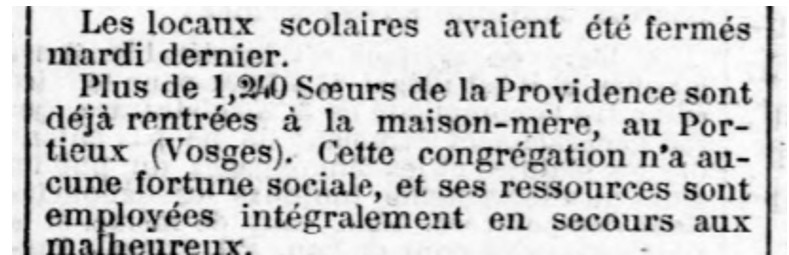
La Libre Parole 26 July 1902 Source: BnF Gallica
[The school premises was closed last Tuesday. More than 1,240 Sisters of Providence have already returned to the mother-house in Portieux (Vosges). This congregation has no communal assets and its income is used exclusively in helping the unfortunate.]
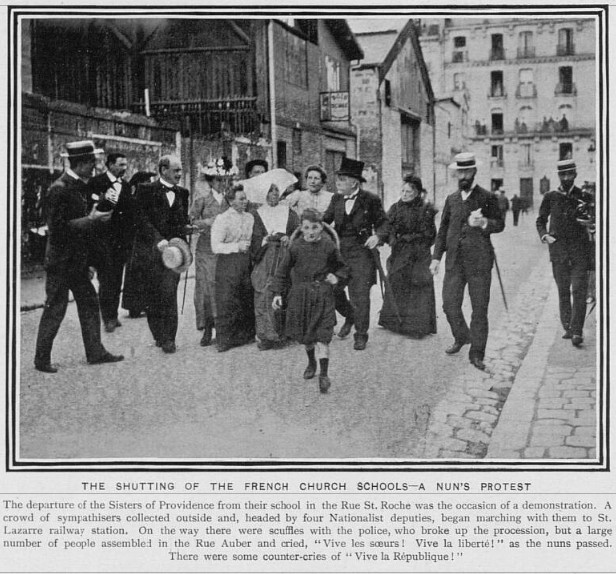
Not all French people wanted to see nuns ousted from their teaching post as reported by The Sphere, Saturday 2 August 1902 Image © Illustrated London News Group. Image created courtesy of The British Library Board.
When a group of refugee Sisters of Providence arrived in Brighton, they were able to settle in The Limes in Preston Road. At The Limes they set about establishing a school.
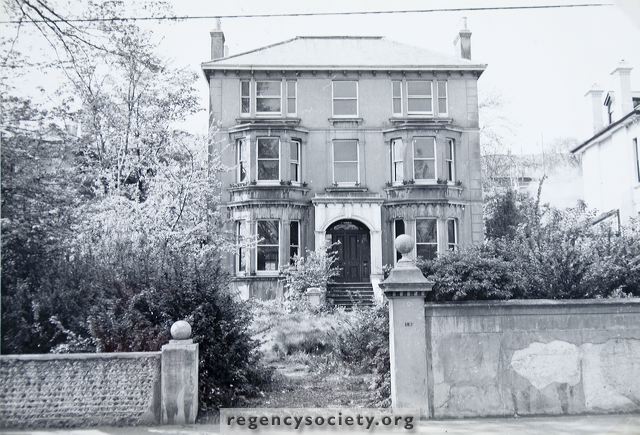
The Limes c. 1960 Image courtesy of the Regency Society of Brighton and Hove
The Limes had been built in 1878. It was a large, detached house, symmetrical in plan and had four floors, including a basement. It was not the largest of the houses along Preston Road, but it had the advantage of having a coach-house and a two-storey cottage in the grounds. The park opposite was well patrolled by members of the local police force as well as its formidable but watchful park keeper. It was a suitable place for young ladies to walk and take exercise.
The Limes was used as a comfortable family home for the final 20 years of the 19th century. The last private owner was John Salkeld Horsley. Horsley ran a cycle shop at 4 Pool Valley. As cycling became a popular and affordable pastime – even for ladies – Horsely made enough money to move both his shop and his home to 75 Grand Parade in about 1902 or 1903. The Limes became available. To let or to buy is not known. The Sisters of Portieux were able to acquire the property and set up their convent and school.
Little is known of the pupils: The card below was sent on 18 May 1907 by the three Parazols sisters, Léontine (aged 11), Adeline (10) and Raymonde (a few days before her sixth birthday). The desire of many Catholic parents to keep their girls in a convent school is perhaps exemplified, if rather to an extreme, by the Parazols family. M. and Mme Parazols had sent their three girls away to England at a time when the family was already mourning the loss of four babies who had died in the five years between 1899 and 1900. Each had died either at birth or within a few weeks of birth.
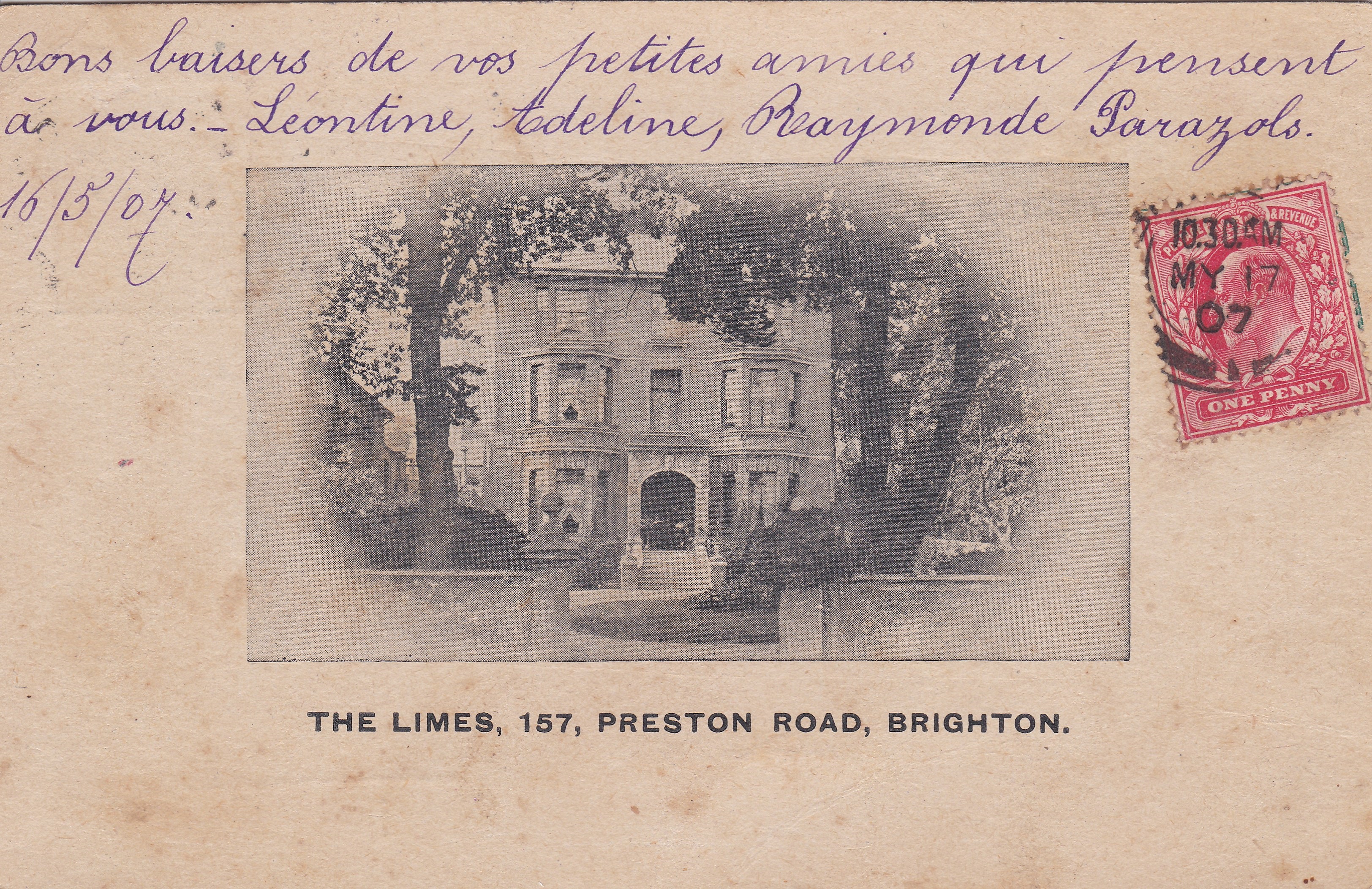
Post card from the personal collection of the Suzanne Hinton
Raymonde Parazols was not the only “tiny” in the school. Both Adrien Lenfant and Jean Rozière, the only two boys in the school, were aged just eight years old when they appear in the 1911 census for the school.
Adeline Parazols died in France, apparently homeless, aged 34; Raymonde married in France; Adrien and Jean would have been too young to serve in WW1. Reliable sources show that Adrien lived to the age of 87, dying in 1990 in France.
Extensive searches for information about the nuns or about the other pupils has been unfruitful.
The school had vanished from Preston Road by 1916. Perhaps it was no longer needed by the Sisters of Providence. A convent school run by a similar community had been flourishing in Bexhill since 1898. Many French parents would be glad that their daughters were out of harm’s way in England during the fighting on French soil in WW1 – but would also feel it prudent to ensure that the girls were further inland, far from any threat of attack or even invasion.
The Limes was subsequently used as a residence for a Ministry of Labour (re)training centre. In 1921, the house and outbuilding were home to about 30 men, mostly in their 20s and early 30s and mostly handicapped following their war injuries. The atmosphere must have been very different from the sedate young ladies’ school of just a very few year previously.

 French Brighton