In 1901 there were just fourteen French nuns living and working in Brighton (there were more in Hove). By 1911 there were over 50 and three new convents had sprung up. During the Terror of 1794, just over 100 years previously, countless nuns had fled France in fear of their lives and sought refuge in England. In the years between 1901 and 1911, a different kind of intolerance drove their sisters from their French convents (see The Limes)
The nuns from Nevers arrive in Brighton
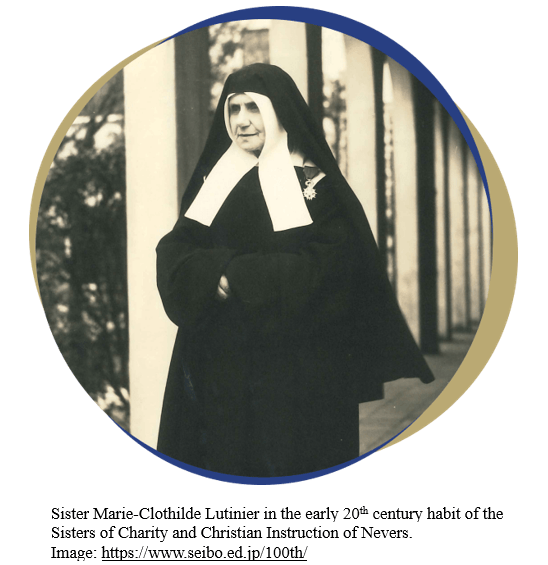
The situation of the Sisters of Charity and Christian Instruction in Nevers was difficult, to say the least. In a letter written, in English, from the safety of Brighton, a nun describes the situation to a local priest:
“You know too well, Revd Father, how much we are persecuted in France; we have already more than one hundred schools closed and our Mother Superior General has, at this moment about nine hundred nuns on her hands and is most anxious to find shelter for them.” 11 October 1903.
Read more: Lourdes Convent – The PeopleThe priest in question was Fr Joseph Livesey, priest in charge of St Joseph’s Church in Elm Grove, Brighton from 1899 until 1905. As early as November 1902 Fr. Livesey was aware of the plight of nuns and priests in France and their need for new, safer, homes. He wrote to Bishop Bourne of Southwark:
“I should most cordially welcome the Sister of Charity to St Joseph’s Mission and I believe that apart from their enabling me to maintain an assistant priest, the help they would render me by the instruction of children and converts and visiting the houses of the poor would be an immense spiritual advantage.”
[It must be said that money could at times be a bone of contention. Collections had to be made. Priests had to be paid. Buildings had to be maintained.]
On 25 July 1903, five nuns from Nevers arrived in Brighton to find that Fr. Livesey had found a new home for them next to his presbytery. The house was No. 10 Wellington Road, Brighton. The sisters named the house ‘Nazareth’ and later it became the Convent of Mary the Immaculate.
At the same time, another community from Nevers was being established in Tonbridge.
The arrival of the small band of nuns had not been without some difficulties on the part of the English authorities. The intercession of at least one highly-respected French priest, Father Rosette, had been necessary for the community to find itself a home.
The sisters had already identified a house they would like for their convent. Formerly run as a Catholic school, it was well placed near Preston Park. However, Bishop Bourne advised the community that setting up in that area would be expensive: as there was no Catholic church in the neighbourhood, the nuns would have to pay for the upkeep of a chaplain – this would cost in the region of £150.00 a year. A more economical solution would be to attach themselves to an existing church of St Joseph’s in Elm Grove. The chaplain would live in the presbytery and this would cost no more than £80.00 pa. As has been seen, Father Livesey of St Joseph’s was ready and willing to accommodate the Sisters of Nevers.
The Sisters set about their work in Brighton
Elles visitent les malades soit à l’hôpital soit à domicile ; elles ont organisé un ouvroir pour les jeunes filles, et sont heureuses de seconder le Curé de la paroisse pour l’instruction religieuse des personnes qui le désirent. [They visited the sick either in hospital or at home; they organised a sewing circle for young girls and were happy to support the parish priest by giving religious instruction to those who wanted it.]
The Sisters made it clear that they were hoping to fit seamlessly into Brighton life. A note made at the time stresses: Dans l’immédiat, il ne faut pas arriver en conquérantes et ne faire concurrence à personne. [At the moment we must not come here as conquerors, nor must we compete with any others.]
This seems a strange attitude for newcomers to take. However, the nuns from Nevers were very aware that the Covent of the Sacred Heart in the Upper Drive, Hove was already a well-established school, as was the Convent of the Blessed Sacrament in Walpole Road. No toes were to be trodden on.
Pupils were few and far between. The community was described as living in poverty, hoping for lady boarders, pupils … and an income:
« La communauté vit dans la pauvreté, en attendant dames pensionnaires, élèves … et ressources. » An income was needed, not just for the nuns day-to-day living expenses. The Bishop of Southwark had put an onerous condition on the five members of the community: they had (in effect) to earn enough money in order to: Fournir des honoraires suffisants pour faire vivre le prêtre qui remplirait les conditions d’aumônier. [Provide adequate remuneration for the needs of a priest who would act as chaplain.]
There was one stipulation which made life, and livelihood, particularly difficult for the community. Initially, they were not allowed to take English students – despite already having applications from two sets of English parents.
In a later, undated, prospectus for the 10 Wellington Road school, terms were modest:
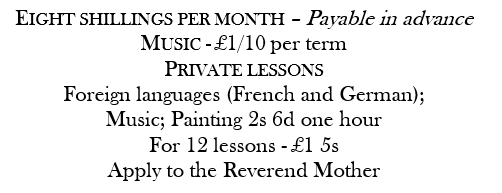
The hoped-for French boarders and pupils did arrive by September 1903 – but by mid-July 1904 the sisters realised that ‘Nazareth’ was too small to accommodate the number of people needed to bring in an adequate income. New premises had to be found.
Arrival at Preston Park
The large house just north of Preston Park was still available. For over 25 years, it had been run as a ladies’ catholic school by Miss Emma Visick. Miss Visick had retired in 1902. This property would prove to be the perfect new home for the nuns from Nevers. The house had been called St John’s. Now the name was to be changed to The Convent of Notre Dame of Lourdes, or more simply Lourdes Convent. The Bishop had stipulated that a small group of the Nevers sisters should stay at Wellington Road and the whole community still functioned under the aegis of St Joseph’s parish.
One year later, on 29 July 1904, a small group of nuns moved into St John’s. They must have had a busy summer getting the school back into good running order. In September, a new term started with 12 young girls and one small boy. The initial refusal to allow the sisters to take in English as well as French pupils, was rescinded, mainly for economic reasons, after the move to Withdean.
Tensions
Finally, by 1905, the sisters “had the consolation of preparing the pure hearts of children for the reception of their First Communion.” Catholic Times and Catholic Opinion 20 June 1905.
Matters were not as settled as the nuns could have wished. Tensions started to spring up after Father Livesey left St Joseph’s. His replacement was Father George Tatum. The authorities had offered Fr. Tatum a parish in Brighton as “the bracing sea air [would help him to] speedily regain is health and strength which has been sorely tried in Lewisham.” (West Kent Argus 21 February 1905). Fr. Tatum had been serious ill with enteric fever (a form of typhoid). At that time, in an age when there were no antibiotics, the medical solution for the disease was a series of abdominal operations. Fr. Tatum was a sick man, probably in pain. This alone may not have caused difficulties between the community at Lourdes Convent and Fr. Tatum.
There may have been a further problem. A convert from the Anglican church in 1883, Fr. Tatum was perhaps less open to continental influences than his predecessor, or was he less familiar with the traditions of convents (despite the fact that there were at least three Anglican convents in the area at the time), or was he a Francophobe or simply somewhat of a misogynist?
Whatever the case, in his letters, Fr. Tatum wrote many harsh comments about the small band of nuns: both about those who remained to help out at St Joseph’s and about those who had moved away to set up the convent at St John’s in Withdean.
As early as March 1905, Fr. Tatum was writing, rather uncharitably, a private letter to a fellow priest:
“I am not favourably impressed by them. The two who do the Sacristy here look so gloomy and sulky that it is depressing to see them. I dislike having women creeping about the Sacristy but I suppose there is no help for it… one is sorry for these nuns but they are not interesting and away from France have no object to justify their existence. The Withdean nuns do not strike me as being intelligent. I wonder what sort of education they are capable of giving.”
In subsequent letter, Fr. Tatum uses the word “irritating” twice to describe the sisters. He then goes on to reveal that, to him, “the impression they give one is that the French religion has become so overwhelmingly feminine that men are distrustful and that this is why no one moves a finger to keep them in France.” By March 1906 he wrote to a fellow priest: “They are the most odious set of women that I have ever met with.” So much for being a brother and support to those who had been hounded out of their own country.
At this stage, six nuns had settled in Withdean, leaving five nuns at 10 Wellington Road to teach and to serve Fr Tatum’s parish of St Joseph’s (Elm Grove). By May 1905, Fr Tatum seems to have run out of patience and at the end of May is suggesting to the Bishop of Southwark that the Mother General from Nevers “should be asked to close the convent at 10 Wellington Road and remove the nuns.” Two hastily written notes at the top of the letter tell a slightly different story: the first is from the Bishop’s office asking his chaplain Fr. Du Plerny: “What do you think of these nuns?”; the second is from Fr. du Plerny saying “They are alright”. Faint praise admittedly, but it was not the general will that the Convent of the Immaculate Conception at Elm Grove be closed. But closed it was not long after.
The school
The excellence of the teaching at Lourdes Convent was quickly recognised in the wider community. Within a couple of years of setting up the school, the nuns’ pupils were passing important exams – at a time when many girls were expected to go into basic clerical or manual jobs, or prepare to get married. In 1907 even French newspapers were prepared to praise the teaching skills of the nuns:
[The Sisters of Nevers, who, in France, so rightly deserve their name of Sisters of Charity and Christian Instruction are still worthy of their reputation even in exile. Of the four pupils who sat the University of Oxford exams, four passed this year. Congratulations to the dedicated mistresses of St John’s, Withdean, Brighton.] Note: The girls passed the Oxford Local Senior School Examination for students over 19. All the girls took the exam using their second language: English.
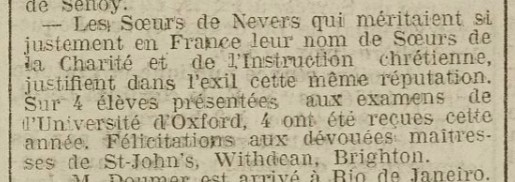
La Gazette du Centre 2 September 1907 Source gallica.bnf.fr / Bibliothèque nationale de France
[The Sisters of Nevers, who, in France, so rightly deserve their name of Sisters of Charity and Christian Instruction are still worthy of their reputation even in exile. Of the four pupils who sat the University of Oxford exams, four passed this year. Congratulations to the dedicated mistresses of St John’s, Withdean, Brighton.] Note: The girls passed the Oxford Local Senior School Examination for students over 19. All the girls took the exam using their second language: English.
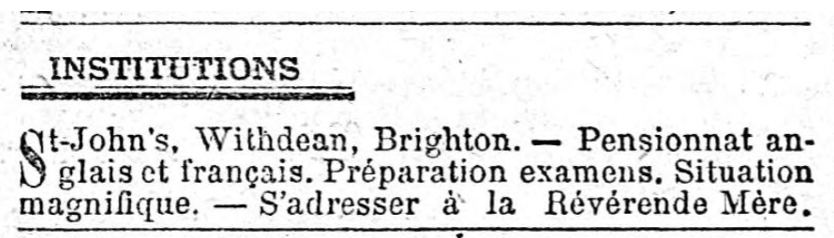
Le Gaulois 18 April 1908 Source gallica.bnf.fr / Bibliothèque nationale de France
Fifty years later, according to the 1957 report on the school by H.M. Inspectors, girls at the school (or their parents) had not raised their sights much higher:
“out of 111 leavers over the past 3 years, 21 were transferred elsewhere as a result of their parents leaving Brighton, 10 went to other schools, 4 have gone to university or technical college, 3 are training to be teachers, including one at the Royal Academy (studying speech and drama), 6 have gone to art school, drama or dancing, 7 ln to nursing or physiotherapy, 2 into catering, 1 into modelling, 4 to be hairdressers or cosmeticians, 6 into banks or offices, 5 into shops, and 37 (or almost one third of the total) into secretarial training.”
But back to earlier times.
The pages of the 1911 census pages relating to the school have been filled out in beautiful copper-plate handwriting – the work either of the Mother Superior, Marie Péguillan or one of the other seven French-born nuns who were teaching at the school. Details were completed with scrupulous accuracy. The home town of each nun is mentioned (eight French, two English), as were those of the nine French pupils and the four English ones. The oldest person in St John’s was Sister Bernard Bradley.
The sisters
Sister Bernard Bradley deserves at least a paragraph to herself. Born in Leeds in 1852, Clara Theresa Bradley had become a novice in the convent at Nevers in 1872, taking the veil four years later. Her chosen name in religion was Sister Bernard. She started her teaching career in a girls’ convent boarding school in Limoges, but on the expulsion of teacher-nuns from France, Sr. Bernard, as an English speaker, was a natural choice to accompany the advance party of nuns who arrived in Brighton in 1903. Sister Bernard remained at Lourdes Convent until her death in 1931.
The Visitation (Bishop’s Inspection) of Lourdes Convent in 1905 reveals very much more about the character of Sister Bernard: “An old English sister [she was 53 at the time] who thinks she ought to be the Rev. Mother or failing that, a chief adviser of the Mother General at the Mother House [in Nevers], would prefer to return to France. Speaks too freely to externs; submissive spirit wanting, was warned by Superior of the difficulties she lays herself open to through her discontent; effect [of the warnings] apparently slight.”
However, Sister Bernard was not the only one who had dreams of being Mother Superior. The Visitation reveals much the same thing about Sister Marie Grenet. Sister Marie-Stanislas, the Superior spoke “little English”. The convent was a true community composed of quite disparate personalities.
Three little girls from Brighton
Jillisen Taylor had been born in Great Yarmouth but by 1920 her parents had moved to Rottingdean which at the time was a village outside the boundary of Brighton. Jillisen’s mother, Mabel Loates, came from a Newmarket family closely connected to horseracing – Mabel’s four uncles were famous jockeys. Uncle Tom was, in particular, spectacularly wealthy. After his retirement at the very beginning of the 20th century, Tom Loates came to live in Brighton, at Lion Mansions on the seafront. (Lion Mansions was later absorbed into the Royal Albion Hotel.) The lure of living near Brighton racecourse, where he had so many successes, must have been great.
When Tom married his nurse, Isabelle, in 1909, he and his new wife moved to 139 Preston Road (since vanished under the Wellsbourne development). After Tom Loates’ death in 1911, Mabel, the daughter of his brother Charles, came to live with her aunt Isabelle in Preston Road. Mabel must have known about Lourdes Convent which was only half a mile north in the same road. Mabel later married Mr Taylor and eventually moved back to the Brighton area.
Jillisen is the first of the three Brighton girls to have close connections with the Preston Park area. She was also first of three conversions: in this case, the Taylors were a protestant family. There is no way of knowing why Jillisen embraced Catholicism and became Sister Mary Christine. Sister Mary Christine died 2003.
A new pupil arrived in the school in 1908. Phoebe (Effie) Hobbs had been born in Dorset, but had accompanied her mother to Brighton in 1895. Mrs Hobbs, Effie’s mother, had taken the post of housekeeper/companion to an elderly lady in a house almost immediately opposite Lourdes Convent, so although Effie was a Protestant, the school gave her a good Catholic education. So much so that she converted to Catholicism and took her vows in 1919. Effie later became a teacher at the school.
Violet Coen was born in 1903, not a stone’s throw away from Miss Visick’s Catholic school, or to be more precise, she was born at 22 Preston Park Avenue, a 500m walk across Preston Park to the newly founded Lourdes Convent school – a school she probably would not have attended, despite its proximity.
Violet’s parents had been born in Russia. Louis Coen was a successful tobacco and cigarette manufacturer with a shop in fashionable East Street in Brighton. The family was Jewish. There is no indication as to why Violet converted to Catholicism. There is no indication that any of her family converted. Her parents are buried in the Brighton Jewish Cemetery. Maybe Violet could not reconcile her father to her choice of religion: Louis died in 1922, but Violet did not take her final vows as Sister Martha until 1927.
Sister Martha’s life as a nun was fairly typical: her first “posting” was to a convent of the Nevers community in Genoa where she taught for 12 years. She then returned to the community’s Tonbridge convent in Kent in 1939. There she became a senior teacher before finally coming to Brighton as Mother Superior from 1969 until her death in 1972.
The community expands
By the time of the 1921 census the school and convent had grown considerably: eleven teachers, mainly natives of France, were in charge of 26 almost exclusively English-speaking pupils. An excellent staff ratio. Phoebe Hobbs is not described as a “nun” until she appears in the 1939 Register. The use of Phoebe’s birth name in the 1939 description may well have been a legal requirement. In religion, Phoebe was Sister Marie Agnes. In 1963, at the age of 70, she had the distinction of becoming both Mother Superior of the convent and head teacher of the school. Effie / Sister Marie Agnes died in Hove at the grand age of 90.
Paradoxically, as with Sister Bernard and Effie Hobbs, it seems to have been the nuns from the English side of the Channel whose names have lingered.
Mother Theresa McMurdie was born Alice McMurdie in 1857. She was the fifth of her parents’ 10 children, all born in London. The Irish Weekly and Ulster Examiner newspaper claimed, in 1947, that Sister Theresa had taken her vows in Nevers in 1866. She would have been only nine years old at the time. This would have been not only unlikely, but illegal under canonical law. However, the point of the Irish Weekly article was that Sr. Theresa had actually met, in person, Sister Bernadette Soubirous. Perhaps more importantly, the article revealed that Sr. Theresa had been teaching at Lourdes convent for 43 years, putting her firmly in the first cohort of teachers in St John’s.
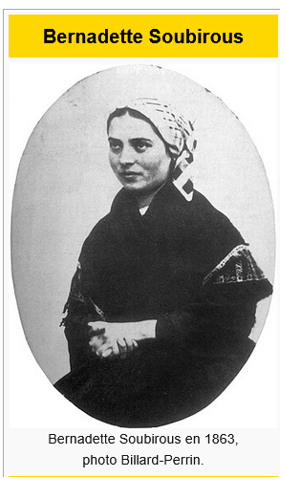
Public domain
Bernadette Soubirous (1844-1879) ) Sr Bernadette took her vows in Nevers in 1866. She was canonised in 1933. The primary school now on the site of Lourdes Convent was given her name: St Bernadette.
The nuns of Lourdes Convent did not hide themselves from the world. Alice McMurdie, along with most of the other English born nuns, were regular voters in general and local elections. On electoral rolls for the years 1931 until the year of her death in 1954 Alice appears, sometimes under her “civil” name, sometimes as Marie-Therese.
Off to Japan
I have left the most adventurous of the nuns until last.
In 1907, two young women passed the Senior Oxford Local exam. They were placed in a group for candidates “having exceeded the age of 19 on July 1st 1907”. The two were MJ Gourmand and JH Gourmand, in other words, Marie and Jeanne aged 28 and 19 respectively. It would at first appear that the two young women were rather old to be taking these exams which later became A-levels.
Paris-born Marie had taken her vows in Nevers in 1904.
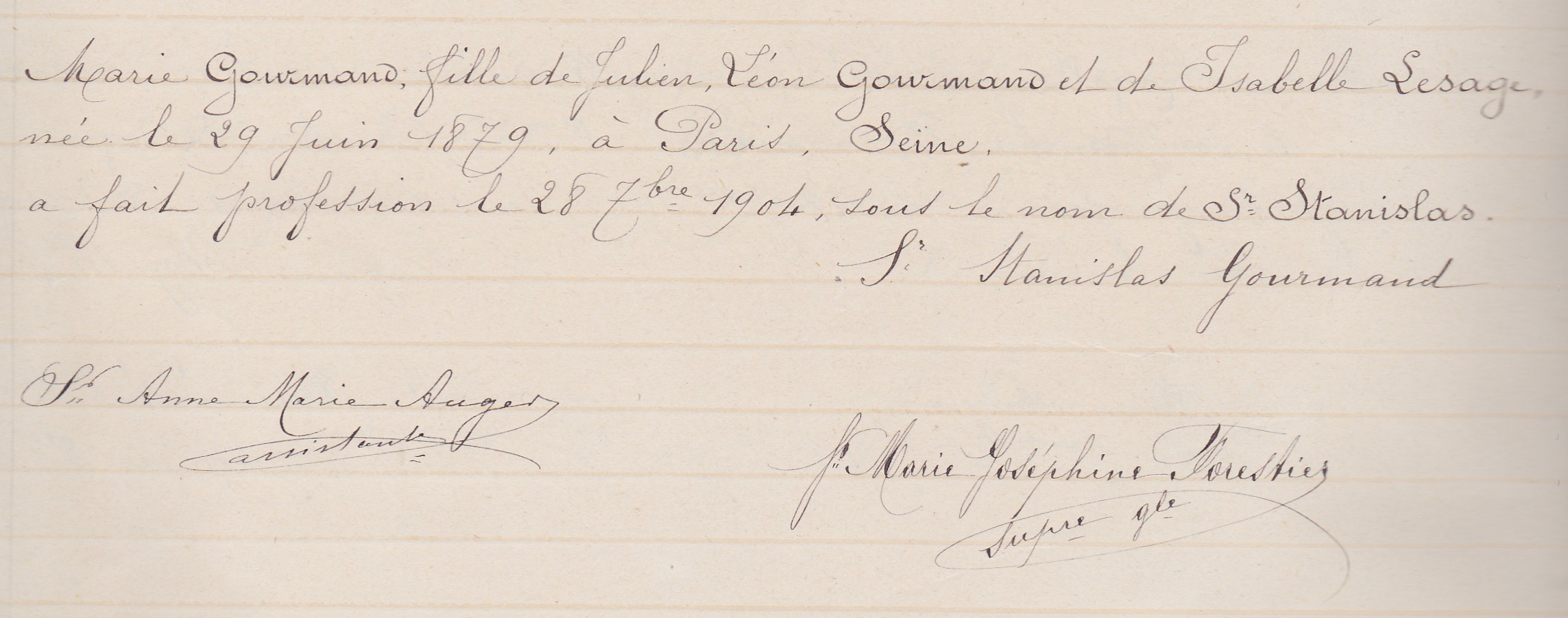
The certificate detailing Marie Gourmand’s profession © Archives de la Maison-Mère des Sœurs de la Charité de Nevers
Almost immediately afterwards, Marie had made the journey to Brighton to help set up the new community. She was now Sister Stanislas Marie. Presumably, as a teacher at the school, she needed to improve her English and, for the reputation of the school, acquire some “professional” qualification.
Marie’s little sister, Jeanne, had been a pupil at a convent school in Provins (just south-east of Paris) until 1902. She was 16 when her school closed (or was forced to close as a result of the new Loi des Associations), so in 1904 she followed Marie to Withdean to continue her schooling. On her return to France, she entered the convent at Nevers shortly after her father’s death in 1907 and had taken her vows in 1910. Her first “posting” was to Italy before she was recalled to France where she taught in Montpellier for 64 years. By now she was 90, but life still held five years of peace for her in a religious retirement home in Pau. She died aged 95, in 1982.
Marie (Stanislas Marie) does not appear in the 1921 census for Withdean. She had already been given a new mission. With Mother Marie Clotilde Lutinier and five other sisters from Nevers, she had set sail for Japan.
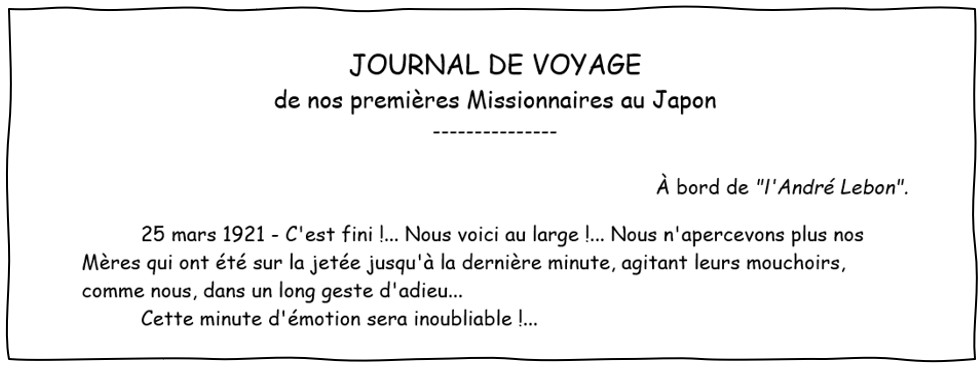

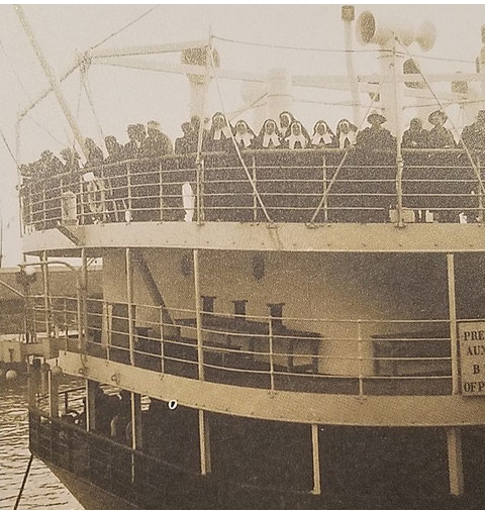
1921, seven sisters set sail from Marseille, France, as “seed sowers” bound for the unknown – Japan. https://neyagawa.goguynet.jp/2022/04/19/nevers-seibo-raymond/
Two months later, on 8 May, the sisters landed in in the port of Kobe. And how strange these young Japanese women must have appeared to the nuns.
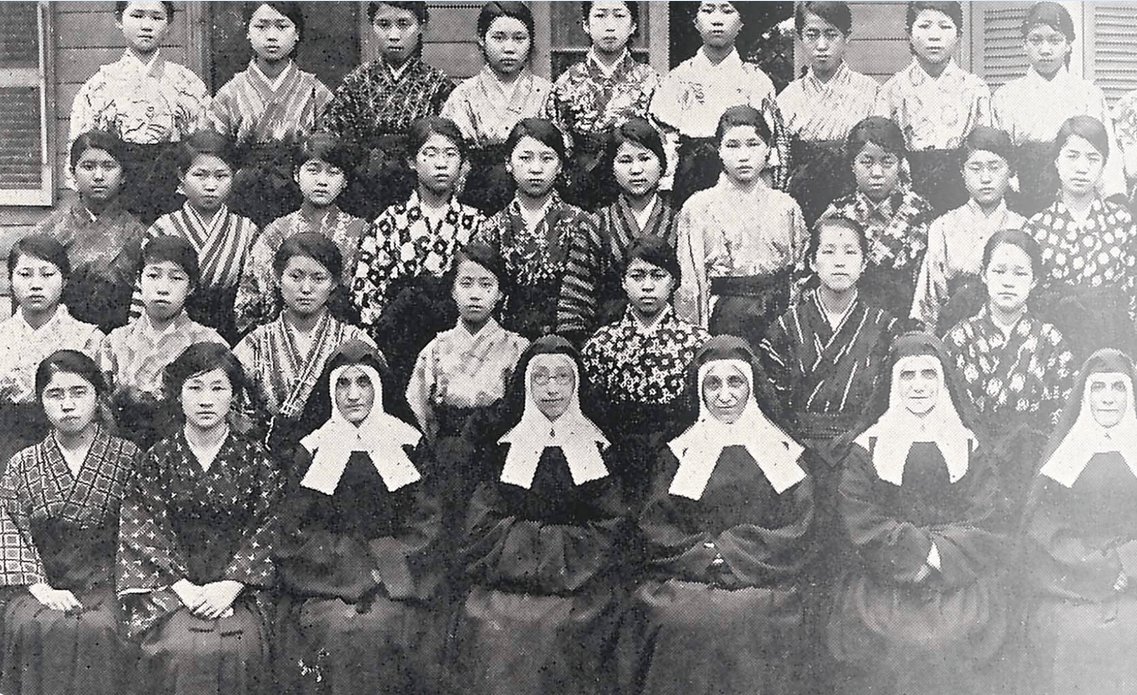
Sister Stanislas, clearly identifiable by her spectacles, https://neyagawa.goguynet.jp/2022/04/19/nevers-seibo-raymond/
The Archivist at Nevers has confirmed that the picture below shows the following. Top row: left, Mother Marie Clotilde Lutinier; right: Mother Xavier Delmas; middle row, Sœur Henri Lamadon; Mother Charles Berthelin; Mother Stanislas Gourmand: bottom left: Mother Agnès Coustié; bottom right: Sœur Saint-Yves de Corbion.
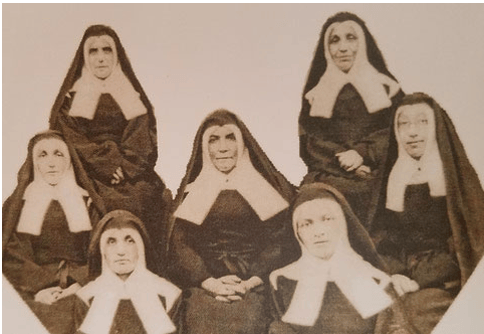
Photo: https://www.neversjapon.org/
Even the poor reproduction of the photograph above gives a clear indication of Sister Stanislas’ benevolent features. These did not desert her in later life.
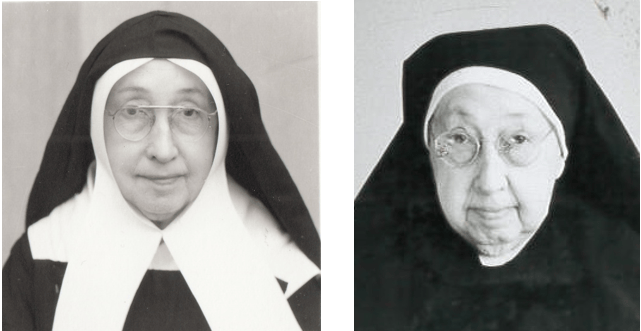
Sister Stanislas in middle age and in old age. © Archives de la Maison-Mère des Sœurs de la Charité de Nevers
Life in Japan must have been challenging. Sr. Stanislas seems to have thrived on the challenge. She died aged 91, still in Japan, which perhaps she had grown to love.
Astonishingly, the Visitation of 1905 had described Sister Stanislas in the most laconic terms: “Somewhat nervous, but appears to be satisfactory”. What a brave woman to have overcome her nerves to set out on a great adventure.
Mid-20th century
Unfortunately, much of the convent’s history from 1906 until the 1940s has been lost, as very few letters and documents from that time have been preserved in the diocesan archive of Arundel and Brighton. Fortunately, information has survived in the archive of the mother house in Nevers.
By the early 1950s, there were still at least 11 sisters teaching, or working as servants, in Lourdes Convent.
The 1957 Department of Education Inspection of the school is not glowing but shows that the 330 pupils were getting an above-average education. The school was classed as a grammar school (before the abolition of the 11+ exam in Sussex) and so, of the 179 pupils in the senior school, 52 were having their fees paid by local authorities.
Exactly how many of the Lourdes Convent community were of French origin in the mid-20th century is impossible to tell. The 1960 electoral register lists eleven voters who must have been British citizens. Both Phoebe Hobbs and Jillisen Taylor appear regularly in those registers.
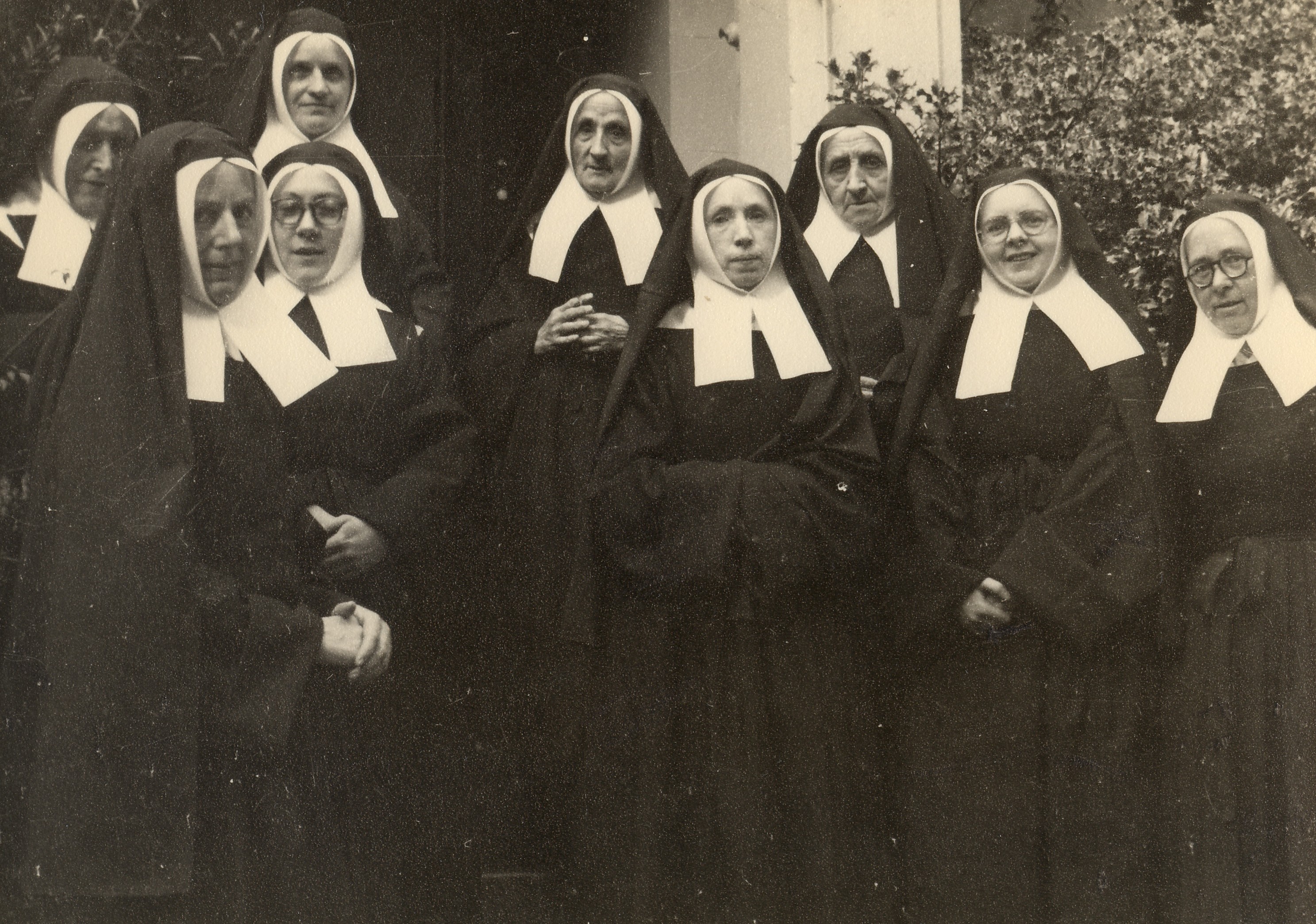
Photograph of the nuns of Lourdes Convent. Possibly taken in the 1950s. © Archives de la Maison-Mère des Sœurs de la Charité de Nevers
It is a pity that not one of the nuns is identified in the photograph above. Whatever their native language, the nuns left a strong impression on their pupils. Contributors to the website MyBrightonandHove (add link) recall, amongst others, Mother Clare (the cook), kindly Mother Mary Elizabeth, Mother Mary Agnes (Effie Hobbs), and fun-loving sports teacher, Mother Mary Margaret. Mother Mary Margaret appears to have been zealous in her support of sports for girls: the pupils of the school hosted netball matches, won tennis matches and generally did well in many aspects of sport.
A 1963 document from the Archives at Nevers reveals that in June, « il y avait 11 Sœurs dont six pour les classes, quatre pour les enfants et les services généraux. 350 élèves catholiques et protestantes (le quart de l’effectif total). » [There were 11 nuns, of which six were classroom teachers and four took care of the children or were servants. There were 350 pupils, both catholic and protestant (the latter making up one quarter of the number).]
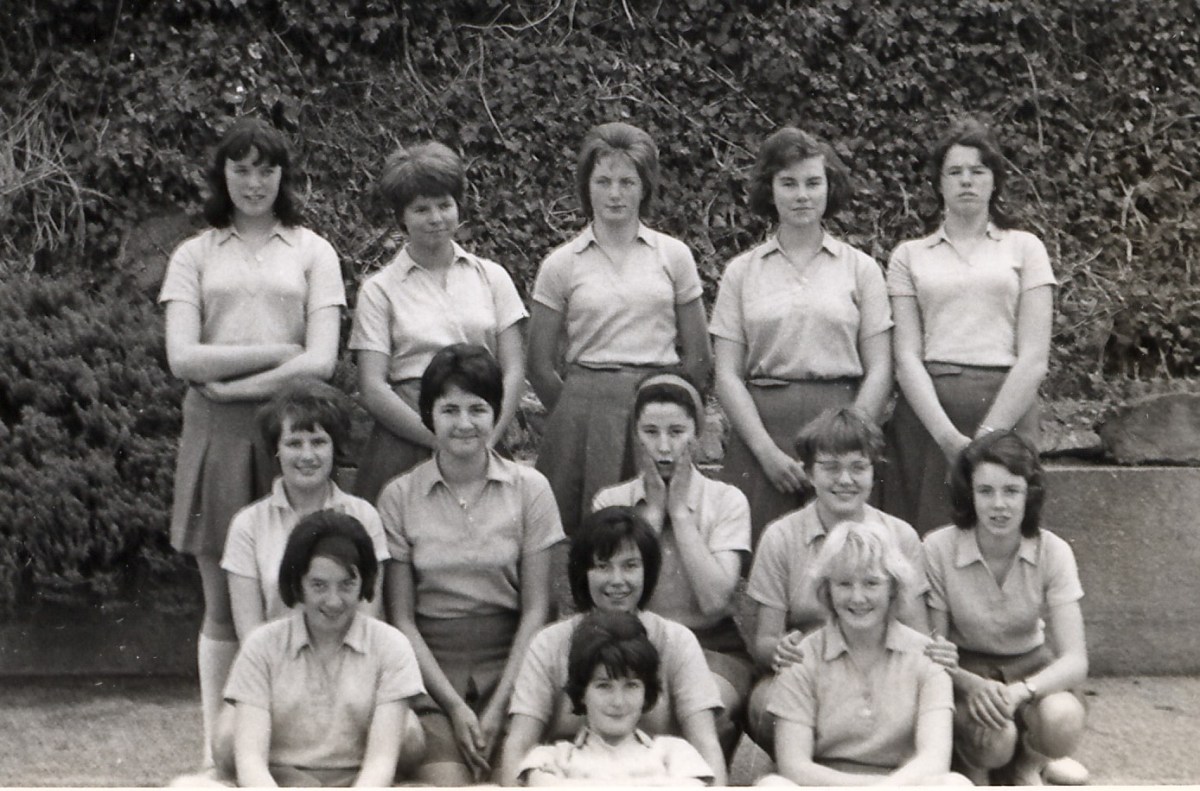
The bouffant hair styles and the rather cheeky grins seem to be typical of the early 1960s. These tennis players were photographed in 1962. © Archives de la Maison-Mère des Sœurs de la Charité de Nevers
The community contracts
Gradually over the years, as fewer and fewer girls took the veil and as the numbers in the school rose to over 300, the nuns were joined by several active lay teachers who were also remembered by the “old girls”. Newspapers show that there were even dog shows at the convent in 1966 and 1968. They do not reveal which enterprising sister or teacher organised the events.
One unsettling event for some of the pupils followed the death of Mother Superior, Marie-Bernard Colombiès, in 1956. A pupil recalls that “we all had to file past her body to pay our respects”. The Archives in Nevers quote a homily from a senior nun in 1959:
« La vaillante Mère Marie-Bernard Colombies est morte à la tâche, comme il convenait à son actif tempérament. Identifiée à Lourdes Convent qui lui doit sa parfaite installation, la charge semblait ne pas peser à ses 85 ans. Elle en restait l’animatrice et l’âme par son autorité indiscutable et indiscutée, et néanmoins très maternelle, son amour de nos traditions familiales, son abandon confiant en la Providence » [Doughty Mother Marie-Bernard Colombiès died in harness, as befitted her energetic personality. She was synonymous with Lourdes Convent which owes its flawless organisation to her. Despite her 85 years, she bore the burden lightly. She remained the Convent’s guiding force and its soul through the strength of her indisputable and undisputed, yet maternal authority, through her love of our community’s traditions and her trusting submission to Providence.]
The habit
In the early days of the convent. the sisters were still wearing their full habit with its white cornet beneath a black veil. The distinctive white bands which lay over the bodice of the nun’s robe, alas, disappeared from the habit in the 1960s as seen below.
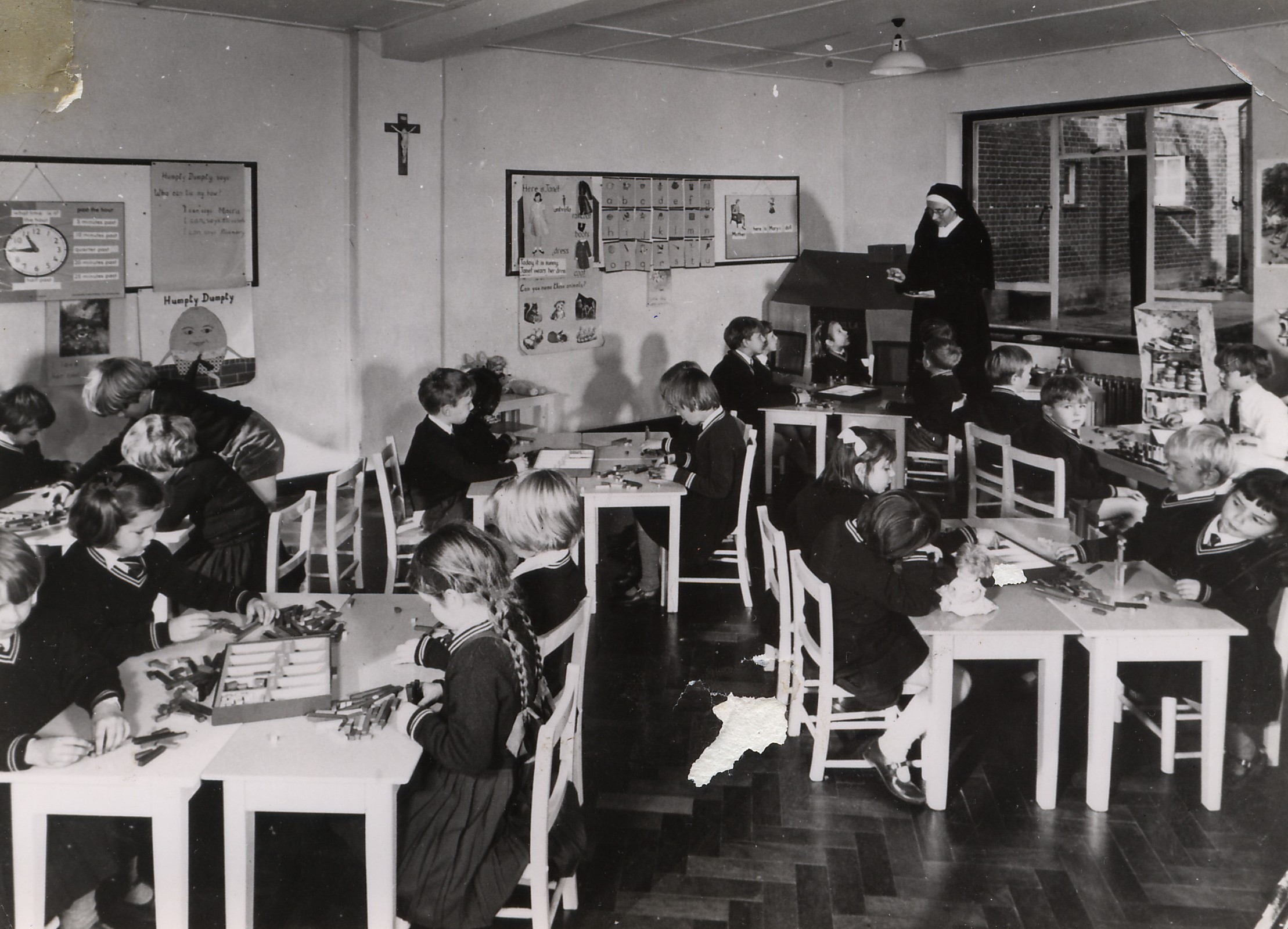
An unnamed nun teaching in Lourdes Primary School. 1960s © Archives de la Maison-Mère des Sœurs de la Charité de Nevers
Today (2026), sisters of the order are most likely to be in sober knee-length skirt, blouse and cardigan.
The senior school is closed
A crisis in Catholic education was reached in the early 1970s. There were too few pupils and too many empty school desks. Schools within the Catholic diocese of Arundel and Brighton were to be reorganised. The community took the hard decision to sell the major part of their land and buildings, including the chapel. Their plan did not meet with approval from several parties. Albert E.J. Benham may have been typical of the local lay Catholics. In May 1972 he wrote to Bishop Bowen:
“… We are concerned first as Catholics because it is felt that the Sisters of Nevers do not appear to have been advised or persuaded to discuss with some of our lay organisations the possibility of putting these beautiful properties to a more Christian use or project for the good of the community.”
The Bishop had sympathies with both view and replied to Mr Benham:
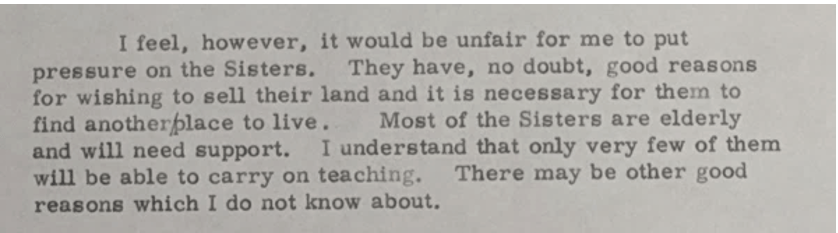
Image courtesy of the Arundel and Brighton Diocesan Archive
Sister Mary-Columba Downey, an Irishwoman by birth, was the only nun to continue teaching under the new lay regime. Today, little remains of the nuns’ teaching heritage. The Archives from Nevers end with this rather sad comment:
La communauté se retire à Dyke Road, dans l’action de grâces pour le travail accompli. [The community withdrew to Dyke Road, with a service of thanksgiving for all the work completed.]
The community lived on
Information returned to the Bishop of Arundel and Brighton reveals that, by 1973, nine sisters had moved, as a temporary measure, to No. 289 Dyke Road, Brighton – a delightful late-1920s property with a garden. Those who had taken up residence included Sister Mary Agnes (Effie) Hobbs (now aged 88) and Sister Mary Christine (Jillisen) Taylor. At 53, Sister Mary Christine was one of the younger members of the original Lourdes Convent community. Sisters Elizabeth Alazet (74), Claire Lelong (64), and Thérèse Tanguy (36) were French. The other four sisters were Irish.
In 1974, history repeated itself. Regional Superior Sister Marie Michelle Kelly wrote from 289 Dyke Road, confirming to the Vicar General of the Arundel and Brighton diocese that the community wished to avail themselves of Bishop Michael’s permission “to form a community in St Mary’s Parish and another in St Joseph’s Parish, Brighton”. A letter almost identical to those written in 1902 and 1903.
The project to move to St Joseph’s parish failed as the community had difficulty finding a suitable house and “difficulties in finding sufficient sisters.” However, it was St Mary’s parish which provided the sisters with a “new” home. In fact, they were back near Preston Park. Ten sisters moved into 44/46 Harrington Road in mid-1975 … and were living less than 300m away from St Bernadette’s junior school – the school which they had founded as part of Lourdes Convent.
Over the years the numbers at Harrington Road dwindled from ten to eight to seven and finally to five. Two of the sisters later lived at 40 Cornwall Gardens. By 1999, Sr. (Jillsen) Taylor was in a nursing home where she died, aged 86 in 2003.
The sisters were still active. An undated account (possibly from the very late 1980s) records:
“ …The first Community, now in Harrington Road, Brighton, consists of five Sisters. One had just given up regular teaching and now helps to serve meals to the homeless once a week, teaches English to immigrants and attends a prayer-meetings for the Handicapped once a month. Two others are teaching part-time, one of whom works in an Oxfam shop twice a week. One had worked with the SVP [St. Vincent de Paul Society] for twenty years before giving up teaching …”
The last official information relating to the community is contained in the annual “Questionnaire” from the Arundel and Brighton diocese of 2008. The community consisted of just two nuns: Sister Margaret Mary Homan who was active in working with converts to Catholicism, at Birch Grove Nursing Home, at St Ann’s Day Centres and with “Churches Together” and Sister Theresa Downey who “is a member of two mediation groups, Also belongs to an ecumenical group.”
The end came in 2011, announced in this brief snippet from BBC Sussex on 19 April:
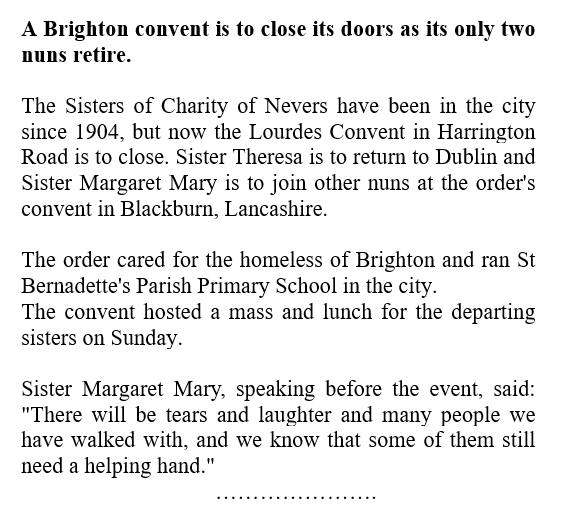
To follow shortly: “Lourdes Convent, Withdean: Part 2 – the buildings”
My thanks
Religious sisters are not well documented outside their community. I owe a great debt of gratitude to Sister Élisabeth de Tonquédec, Mother Superior of the Mother House of the Sisters of Charity of Nevers for granting access to documents from the Community.
My thanks also to Madame Brigitte Rimbert of the Archives of the Sisters of Nevers for her patience in supplying documents and answering all my questions. I am most grateful to The Diocese of Brighton and Arundel for access to its archive and for the help of diocesan archivist Amy Mostert.


