France is so near Brighton. Hundreds of Brightonians take the short hop across the channel in order to walk or cycle, usually in the French countryside. Sometimes in towns. However, at the turn of the 21st century, three Brightonians left a record of their visits in book form. Each one is fascinating in its own way. In order of publication:
Continue readingHospitality is the fertiliser of the soul
In 2002, when the organisers of the Golden Jubilee Party in Regency Square (of which this blogger was one) invited the Orchestre d’Harmonie de Dieppe to play, they did not realise that they were following a long tradition.

Jack Brown or the living parcel
On the 18 March 1895, this strange tale appeared in more than a dozen French newspapers.

[Jack Brown or the living parcel
An elderly man, whose strong English accent left no doubts as to his nationality, appeared last evening at the post office in the rue de Choiseul. He asked for hospitality overnight, saying that he was penniless and reduced to vagrancy.
When he was taken to the police station in rue Marsollier yesterday morning, he gave more or less this account, in a mishmash of English and French:
“Name of Jack Brown. 64 years old, retired non-commissioned officer in the English army, two stints in the dragoons of Her Gracious Majesty …”
At this point he saluted respectfully and continued:
“Live in Brighton, three shillings pension a day. Two nights ago, in Brighton with friends, drank more than usual. My friends – played a joke, très common in the England – sent me to Paris as a parcel; sewed label on my back: ‘Jack Brown en route for Paris’; Brighton – Paris ticket stuck in my buttonhole. Me completely drunk …”
“It’s disgraceful, getting that drunk on gin …” exclaimed the police inspector.
“Non” he replied, “it was whisky, très bon… ]
Léa, The Albion’s footballeuse
I have just signed for Fleury 91 in my native country of France, but I shall be sad to leave The Seagulls and Brighton. I arrived in Brighton in August 2019, but in March 2020, at the beginning of the Covid-19 lockdown, I became very homesick and decided to go back to Paris, back to my partner and my lovely cat Newton.
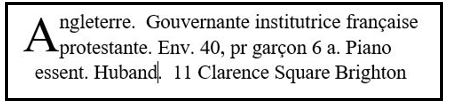
A francophile family in Brighton
In January 1923, the Huband family was advertising in the French press for a governess for their little boy. Initially, the stipulation was that the lady should be about 40 years old. She had to be able to teach piano. And she had to be of the Protestant faith. The address given was 11 Clarence Square, Brighton.

Brighton goes to the Paris Exhibition
As far as is known, no Jemima ever went from Brighton to the Paris Exhibition of 1867, but if she had, these might have been her letters to her friend Emily.
* * *
Brighton,March 1867
Dearest Emily,
At last! Father has said we can go to the French Exhibition in Paris in September. First, he says we must all improve our French. Father is a little distrustful of the Parisians, so he says we must at least know what they are saying. Mother and I will go to Mlle Witter in Holland Road (such a nice safe area of Hove, Father says) but Father has chosen to go to Mons. Lamette in East-street. Continue reading
D’Aubigny Road
D’Aubigny Road is a pleasant street to the west of the Lewes Road in Brighton, not far from a large junction known locally as the Vogue Giratory. The streets neighbouring D’Aubigny Road carry ‘good, plain’ (at that time) British names: Round Hill Crescent, Richmond, Princes and Mayo Roads. And tucked away at the eastern end of the estate, the relatively exotic D’Aubigny.

Plan for the Roundhill Estate. Image reproduced courtesy of the Royal Pavilion & Museums, Brighton & Hove
The 1853 plan above makes clear that, when the Round Hill Park Estate was first laid out in 1853, none of the newly-traced roads had names, with the exception of Round Hill Crescent itself. Lennox Road was never built and Ashdown Road, which was built later, is not on the plan.
The Old Folks of Brighton
One fine day in 1953, a Frenchman brought his five-year old son to Brighton. The father said Au revoir, gave the boy a peck on the cheek – at most – and then left him. In an old people’s home. These are the facts given at the beginning of Les Vieillards de Brighton [The Old Folk of Brighton] written by Gonzague Saint Bris and published in 2002.
The narration is set in the former French Convalescent Home in Kemp Town. However, the text shows that it is unlikely that Saint Bris knew the building well. It seems more likely that he saw the Convalescent Home once, perhaps only fleetingly, but was so impressed by it that he determined to set his novel in and around the building. There is little doubt that Les Vieillards de Brighton is a work of fiction, but an imaginative and absorbing one at that.
Pigeon Post

Source: gallica.bnf.fr / BnF
Telegrams are always cryptic. Let’s start with trying to untangle the text above. Continue reading
Bonnes nouvelles, mauvaise nouvelles

March 2020
It was wonderful to see the Paris Wine Bar in Church Road, Hove newly re-opened in February. The cafe looked wonderful with its bright new paint and inviting chairs and tables.
It was also good the see the renaissance of La Cave à Fromage in Western Road, Hove which has become L’atelier du Vin and Whey – both of which are fortunately still trading, albeit on a much reduced scale.

The Covid-19 virus has very sadly meant that, for the time being, such wonderful French themed small bars, cafes and restaurants cannot operate fully. Let’s wish all the best for “after” the lock-down to: Mange Tout in Trafalgar Street, Petit Pois in Ship Street, Terre à Terre in East Street, Le Nantais bistrot in Palmeira Square, La Fourchette in Queens Place, Hove and others that may have been forgotten. Many of these businesses now offer a delivery service, so do support them if you can.


Bonne chance pour l’avenir.
Good luck for the future.