Hove Francophiles

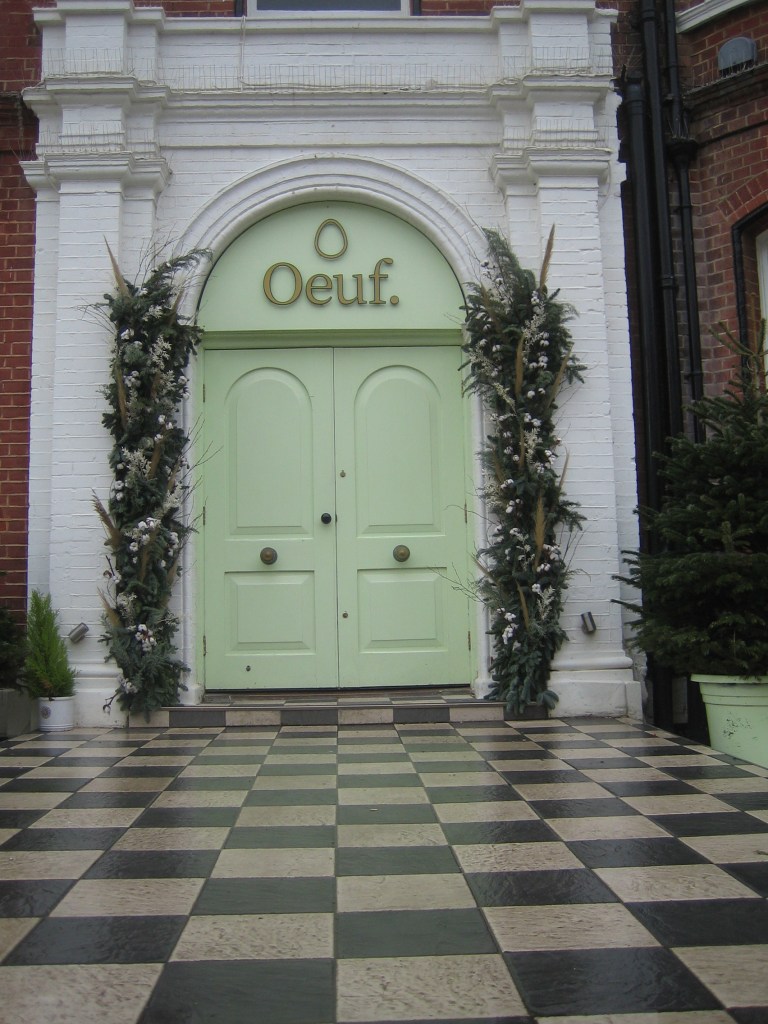
Great to see Œuf café open once more. English afternoon tea (egg sandwiches, anyone?) and a beautifully secluded garden in Third Avenue.

Let’s hope that the name of this house [My Dream] in Marmion Road lives up to its occupants’ expectations.

Do the owners of La Mouette [The Seagull] in Windlesham Avenue support Brighton and Hove Albion, or do they just love the bird?

Brighton-Biarritz 1938 and 1946

This badge is tangible proof of the fact that there was once a close link between Brighton and Biarritz going back nearly a century.

Badge

Delegates badge 1938 – Courtesy of the Royal Pavilion & Museums, Brighton & Hove

Biarritz had hosted a delegation of Brighton worthies in 1932 with a view to forming tourism and cultural ties between the two towns.

It was now Brighton’s duty to return the French hospitality.  Not an easy or cheap task for Brighton to emulate the generous hospitality of the French town.  At first, a visit to Brighton was projected for 1933 but did not take place. Continue reading

Check your facts, M. Manevy

The Labour Party was in power. The Labour Party was in town.  In Brighton, on 3 October 1966. All was not well in the state of Britain. The French newspapers did not hesitate to mention the fact:  Prime Minister Harold Wilson was announcing a pay freeze; 750 strikers from car-plants in the Middlands (sic) had marched on Brighton and were shouting, according to Paris-presse, l’Intransigeant newspaper, at members of the cabinet: 

Continue reading

Brighton goes to the Paris Exhibition

As far as is known, no Jemima ever went from Brighton to the Paris Exhibition of 1867, but if she had, these might have been her letters to her friend Emily.

* * *

Brighton,March 1867

Dearest Emily,

At last! Father has said we can go to the French Exhibition in Paris in September.  First, he says we must all improve our French.  Father is a little distrustful of the Parisians, so he says we must at least know what they are saying.  Mother and I will go to Mlle Witter in Holland Road (such a nice safe area of Hove, Father says) but Father has chosen to go to Mons. Lamette in East-street. Continue reading

D’Aubigny Road

D’Aubigny Road is a pleasant street to the west of the Lewes Road in Brighton, not far from a large junction known locally as the Vogue Giratory.  The streets neighbouring D’Aubigny Road carry ‘good, plain’ (at that time) British names:  Round Hill Crescent, Richmond, Princes and Mayo Roads.  And tucked away at the eastern end of the estate, the relatively exotic D’Aubigny.

Roundhill Park Estate. Brighton

Plan for the Roundhill Estate. Image reproduced courtesy of the Royal Pavilion & Museums, Brighton & Hove

The 1853 plan above makes clear that, when the Round Hill Park Estate was first laid out in 1853, none of the newly-traced roads had names, with the exception of Round Hill Crescent itself.  Lennox Road was never built and Ashdown Road, which was built later, is not on the plan.

Continue reading

The Old Folks of Brighton

Les Vieillards de Brighton Saint-BrisOne fine day in 1953, a Frenchman brought his five-year old son to Brighton.  The father said Au revoir, gave the boy a peck on the cheek – at most – and then left him.  In an old people’s home.  These are the facts given at the beginning of Les Vieillards de Brighton [The Old Folk of Brighton] written by Gonzague Saint Bris and published in 2002.

The narration is set in the former French Convalescent Home in Kemp Town. However, the text shows that it is unlikely that Saint Bris knew the building well.   It seems more likely that he saw the Convalescent Home once, perhaps only fleetingly, but was so impressed by it that he determined to set his novel in and around the building.  There is little doubt that Les Vieillards de Brighton is a work of fiction, but an imaginative and absorbing one at that.

Continue reading