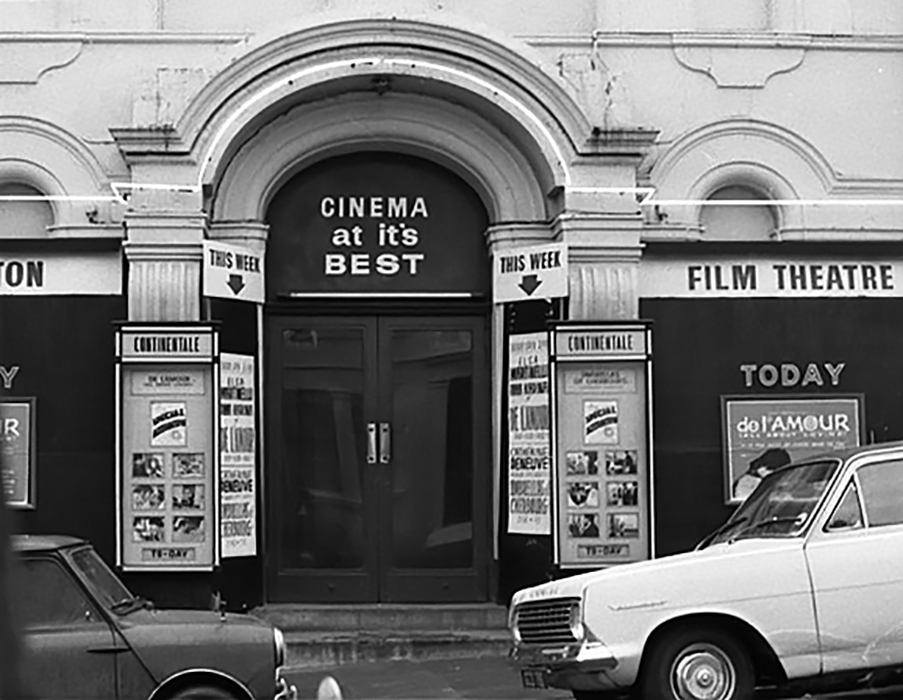
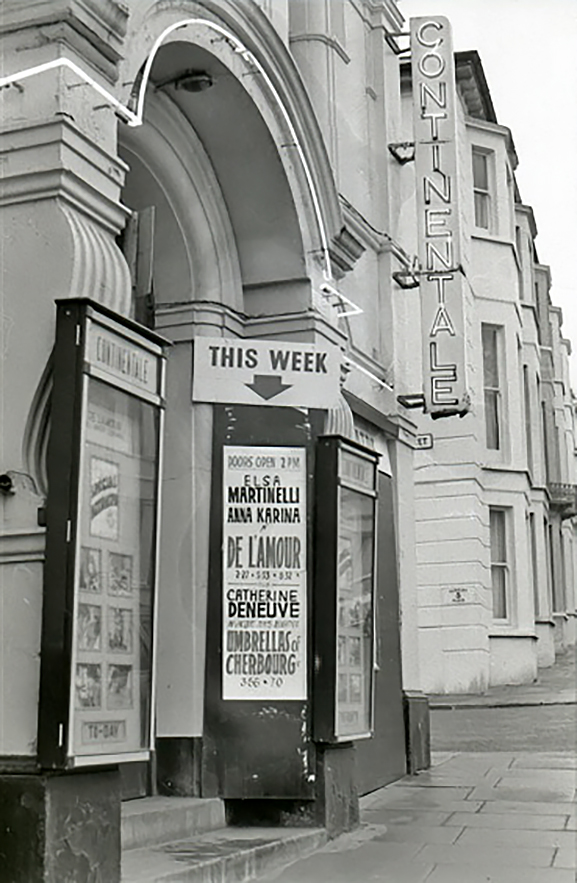
By the mid-1970s, the Continentale cinema had stopped showing French films. BBC television had started showing them from the mid-1950s. Jean Renoir’s ‘French Can Can’ was shown on the single-channel BBC almost as soon as it was released in 1955. Who would show French films to a Brighton audience in Brighton?
The cinema at 64 North Street would. Originally opened in 1911 as the Bijou Electric Empire, the tiny 400-seater cinema at the heart of Brighton’s shopping area evolved over the years.
Image Courtesy of Mike Blakemore via Creative Commons
When Roger and I settled down in our cinema seats we were in for rather a surprise. The date was Wednesday 2 August 1972. We were at the Continentale Cinema in Sudeley Place, Brighton. The film was Le souffle au cœur [‘Murmurs of the Heart’ aka ‘Dearest Love’]. The film was billed as a comedy-drama. We, (an ‘old’ married couple in our late 20s) were rather taken aback by the scenes of incest toward the end of the film – despite it being “all done in the best of possible taste”.
The Continentale had opened originally as The Sudeley Place Picture House in the 1920s. Later, when the theatre went by the name of The Playhouse Cinema, one of the first films screened in June 1949 was “the prize French film l’Idiot” with the ravishingly handsome Gérard Philippe and Edwige Feuillère. A month later, Pierre Fresnay was appearing in La Fille du Diable. More French films followed in the next couple of years.
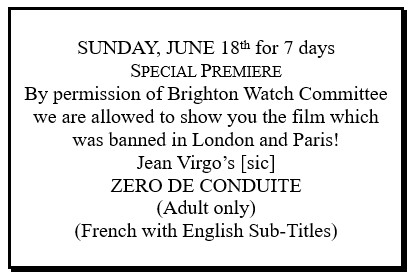
Admittedly, the Playhouse Cinema had a bit of a reputation for ‘naughty’ French films. Perhaps we can blame the Watch Committee of Brighton for that. In mid-June 1950, the cinema was showing Jean Vigo’s Zéro de conduite. The advert for the film which appeared in the Worthing Herald was unusual (or inspired to catch a certain kind of audience):
Later that same week, the minutes of the Watch Committee recorded that:
“The Chief Constable [of Brighton] presented a report dated 27 June 1950 on the film Zéro de Conduite which was showing at the Playhouse, Sudeley Place, Brighton. Resolved: that in future, whenever applications are received to show uncensored films, the Town Clerk be instructed to enquire of the British Board of Film Censors the reason for the refusal to issue a certificate.” (Watch Committee Minutes DB/B/12/49)
So the Watch Committee seems to have been hedging its bets along the lines of “we will allow the film to be shown, but just in case there are any complaints, we’ll cover our backs.”
In 1951, the Playhouse became the Continentale. This was distasteful to some, exciting to others. It might mean (possibly sexually explicit) French films. One of the first films to be shown, in March 1952 was Plus de vacances pour le bon Dieu (1949). The film was advertised with the French title – none of this hiding behind an English translation. Granny need not have worried. This film was about a group of Parisian urchins out to kidnap a dog to amuse themselves during the long summer holidays. No nudity, a little drama and a happy ending. The film had been classified as “Certificate A” (not suitable for children under 16 years old) … but then, Disney’s “Snow White” had also been deemed “A Cert” by the censor a few years earlier.
It must be assumed that Plus de vacances was subtitled. Hardly likely to attract the local urchins in Kemp Town. However, in the following week, local Francophiles would have been able to decipher this offering: advertised as ‘Caroline Sherie’, those in the know would have been delighted to point out that the name of the film was Caroline Chérie (1951), an historical comedy that comes nowhere near the bodice-rippers that were thought to be connected to French cinema. ‘Art films’ were a staple of the Continentale with films by Marcel Carné, Jean Cocteau, Marcel Pagnol, René Clair, Jacques Becker and Julien Duvivier. However, films by these cinéastes were often accompanied by films with titles such as ‘Flesh and Fantasy” (1943) and ‘Isle of Sinners’ (Dieu a besoin des Hommes, 1950) neither of which was nearly as shocking as Granny may have thought.
Whereas the 1960s was to be the decade of the French cinema auteur, the 1950s were still dominated by actors such as Louis Jouvet, Fernandel, Raimu (the complete Marseille trilogy of Marius, Fanny and César was shown at the Continentale in 1953), Jean Gabin, Simone Signoret and Arletty.
1954 saw a modest acceptance of French films in the more “popular” cinemas. Jacques Tati’s Les vacances de M. Hulot (1953), a largely silent film with English voice-over by Christopher Lee, had arrived in Brighton at the Astoria by April 1954. Being more sophisticated than the Odeon, the Continentale had already screened Tati’s Jour de Fête (1949) in November 1953 along with Pépé le Moko (1937), starring Jean Gabin. It is hard to find another French film in mainstream Brighton and Hove cinemas until September 1959 when Jacques Tati’s most recent film (at the time), Mon Oncle, was put on at the Odeon in West Street.
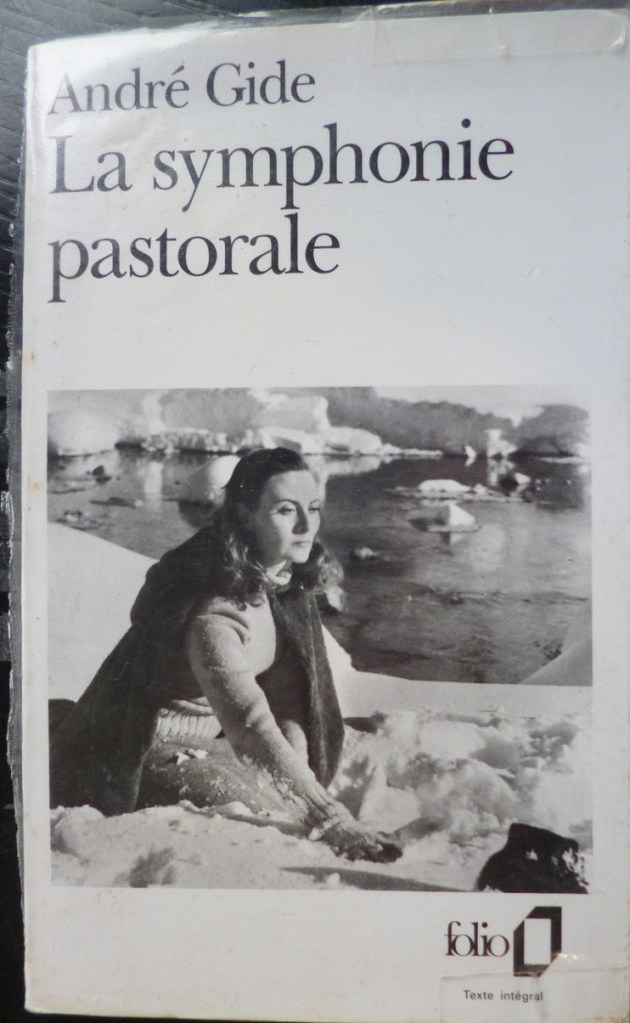
In the mid-1950s, the ‘naughty’ Continentale was showing films such as La Symphonie Pastorale (1946, Certificate A) based on the novel of the same name by André Gide. By the 1960s, the novel had become a set text for A-Level students studying French, many of whom would have later been shown the film at school.
As far as French films were concerned, the Continentale was given a run for its money by the Paris Continental cinema in New Road.
In the last week of August 1957 from Sunday to Wednesday at the Paris Continental you could watch ‘A Pig across Paris’ also known in its country of origin as La traversée de Paris (1956). The film had nothing to do with farming or livestock. It was “a cynical and unconventional portrayal” of black-marketeering during the Occupation of France. And it was a comedy. From Thursday to Saturday, the supporting short was the wonderful fantasy of childhood Le ballon rouge [‘The Red Balloon’].
The front cover of my copy of Le ballon rouge
1959 was the year of the birth of the Nouvelle vague [French New Wave] of adventurous young film makers such as François Truffaut, Jean-Luc Godard, Eric Rohmer and Claude Chabrol. It would appear that the Paris Continental Cinema in New Road, Brighton pipped the Continentale to the post in first showing a New Wave film: ‘The 400 blows’ (Les 400 coups 1959 directed by François Truffaut) was shown on 2 September 1960 but for one day only. The film must have been successful with Brighton audiences. The Paris Continental programmed the film again, but this time for a full seven days, in July 1961.
There was clearly some anxiety amongst cinema managers as far as French films were concerned. A cinema manager wanted to ensure that he was not overstepping the mark by showing risqué French films. On 24 March 1958, he brought in our old friends, the Watch Committeeto watch Femmes de Paris (1953). The committee “visited the Continentale Cinema, Sudeley Place, and viewed privately the above mentioned film prior to considering an application from Mr G H Fernie, Manager of the Paris Cinema, for permission to show the film in Brighton in April next.” Permission was given as an ‘A’ certificate film: at the time, the A certificate merely meant that a child under 12 had to be accompanied by an adult – this was later replaced by the ‘Parental Guidance’ certificate.
It was indeed the Paris Continental and not the Continentale which showed the film on several weeks between June and December 1958. Possibly the minute secretary at that Town Hall meeting had got his or her cinemas mixed up.
The British ambivalence about sex is clearly shown in a review of Femmes de Paris:
“… this must surely be the dizziest, funniest naughtiest film ever to be shown in Eastbourne. Crammed with pretty girls, who bare themselves at the slightest pretext … “Femmes de Paris” is the most tintillating [sic] spectacle imaginable. Apart from making cinema history in Britain by showing nudes who move, the daring film is hilariously funny…” Eastbourne Express 7 June 1958
Brighton and Eastbourne did not really seem to share the same angst as other parts of the country.
Les Femmes de Paris was still showing at the Paris Continental in December 1958 – and was programmed with the cheeky Clochemerle – an X-rated film (“Explicit Content – For public exhibition when no one under 18 present”). Clochemerle is based on the novel of the same name. The basic story is very Gallic: the Socialist mayor of the town of Clochemerle wishes to construct a public convenience directly behind the parish church; the incumbent priest will do all he possibly can to thwart the plan.
At the same time as Les Femmes de Paris was being shown at the Paris Continental, in 1958, the Continentale in Sudeley Place was showing much tamer fare: ‘The Bells of St Mary’s’ with crooner Bing Crosby.
Brigitte Bardot hit the screen of the Paris Continental with her first film Et Dieu créa la femme (1956), but not until February 1959, by which time it had already been screened in Hove, Hailsham and Horsham. But then most cinemas, suburban or otherwise, seemed only too keen to show films featuring the ‘sex kitten’ of the 1950s and 60s.
The Paris Continenal cinema in 1963. Closed and awaiting demolition. Image courtesy of the Regency Society
It was however, the Continentale which was the flagship for French films in Brighton. Students from the local Art College, the College of Technology and the newly founded University of Sussex at Falmer seem to have been keen cinemagoers, as they recount on the My Brighton and Hove website.
The Sussex Daily News had a very observant film reviewer. He (less likely she) spotted that, not only was the Continentale showing a filmed version of Verdi’s opera ‘Il Trovatore’ but that:
In the same programme, however, is a little gem which no one who has not yet seen it is advised to miss [sic]. This is a sparkling French comedy called “Drole de Drame,” which puts it right into the front rank of its kind. There are most worthy performances from M. Louis Jouvet, M. Jean-Louis Barrault and Mlle. Françoise Rosay to name a few.
Unfortunately for the Continentale, as local cinema historian David Fisher points out, after extensive refurbishment in 1965 the cinema’s programmes changed “to art-house films in the evening, pornographic films in the afternoon.” By 1969 the cinema was showing mainly X-rated films (no admittance to patrons under 18 years old!).
However, even then, when for example the first of the Angélique series (1964) or Mon Amour, Mon Amour (1967) reached the Continentale in January 1969 and February 1970 respectively, not only were they French-language films but, perhaps more surprisingly, the original French names were posted on the advertising boards and in the newspapers. Both, of course, would have shocked Granny terribly. The irony is that the latter, at least, has become somewhat of a classic, being both a rare film to be directed by a woman (Nadine Trintignant) in the 1960s, and one of the first roles for later superstar Jean-Louis Trintignant.
By the mid-1970s, programmes at the Continentale tended to be characterised by programmes such as this one for the week of August 1974 (same film both afternoon and evening):
In Love with Sex (English, X-rated);
Hot and Naked’ [Quand les filles se déchaînent ] (French, X-rated);
Quiet days in Clichy (Danish, X-rated)
Cold Blooded Beast (Italian horror, X-rated).
And my own favourite title? It was difficult to choose between these two which I spotted in the listings for late 1986: ‘Knickerbockerless’ and ‘Sister Susie’s Sexsations’.
The Continentale “closed until further notice” in late December 1986. That “further notice” never came.
So in the 1970s, where could the cinephiles and Francophiles of Brighton and Hove go to get their “fix” other than by watching television? To be continued.
The talkies arrived in Brighton in the first week of July 1929 (about 10 days after they had arrived at the Rivoli in Worthing). What had been needed to get this up and running? At the Palladium on Brighton seafront “Six engineers have been engaged constantly on the task and a special screen has been provided and a new generator installed with the object of producing a picture which will give the highest satisfaction.” Mid Sussex Times of 2 July 1929. The film on offer, “The Doctor’s Secret” (1929, USA).
The Scala in Western Road. By November 1932 the cinema had been renamed Regal. Image courtesy of the Royal Pavilion and Museums Trust
From 24 – 26 May 2024, the Brighton Fringe promised us “the true flavours of Normandy! The entertainment was “very Brighton”. Whether it was “très Normandie” is hard to say:
First up was La Sirène à Barbe, the cabaret group based in Dieppe.
In the first weeks of the Great War, the Bioscope journal noted:
“There are very few signs of the terrible struggle in which the country is engaged to be noted at Brighton. The panic of the first week, of course, had a very bad effect, but things soon resumed their normal course. The picture theatres are doing a brisk business, and the patriotic and war films which are the order of the day are proving a great draw.” The Bioscope,10 September 1914
It was indeed the case that in Brighton and Hove, residents (and many visitors) continued to amuse themselves as well as busying themselves with their contributions to war work and fund raising.
The Great War is dragging on. As the festive season approaches, Brighton is doing her best to show her support for Britain’s French Allies. On 16 December 1915, the Brighton and Hove and South Sussex Graphic certainly gave France pride of place.
In the newspaper, a journalist simply called Aigrette pens a splendid article about Madame Adolphe and her French ladies’ tailors in Preston Street. At this emporium “the reducing pencil has been hard at work and lovely bargains are on sale”. Aigrette is mightily impressed by one outfit: “a triumph of fashionable elegance.”
Image: Royal Pavilion and Museums Trust
Alas, to our, fortunately, greater sensitivity to these matters in the 21st century, the cloth is shockingly described as “tête de nègre velour cloth of beautiful supple quality.” It is unlikely that in 2023 any fabric would be compared to a black person’s hair, however supple it may be.
Until early 1909 there was not one single hall or theatre in Brighton dedicated to moving pictures. Patrons could see “exhibitions” of animated images as part of a variety performance or as a novelty on the Palace Pier or the Alhambra on Kings Road.
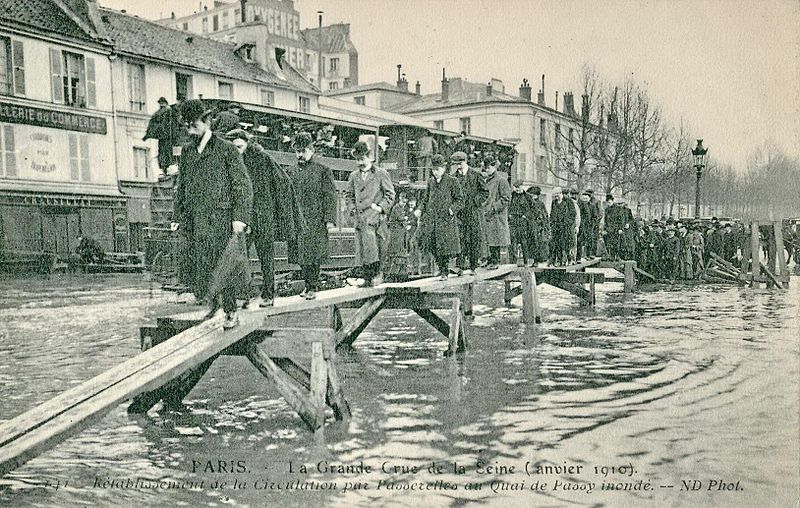
The first “cinema” in Brighton was the Electric Bioscope Theatre in Western Road, just a few yards from the corner of Montpelier Road (where Waitrose stands in 2023). It opened on Saturday 13 February and was immediately successful. The Pathé film of the disastrous 1910 floods in Paris was one of the myriad of French films shown in Brighton before the outbreak of the Great War.
A postcard showing an image that might have been seen in an early version of the Pathé newsreels which were a staple of British cinema until the 1970s. Wikimedia Commons
School-friends Jemima and Annabel are swapping their experiences of a new invention.
Albion House,
135 King’s-road,
Brighton,
Saturday, 4th July, 1896
My Dearest Jemima,
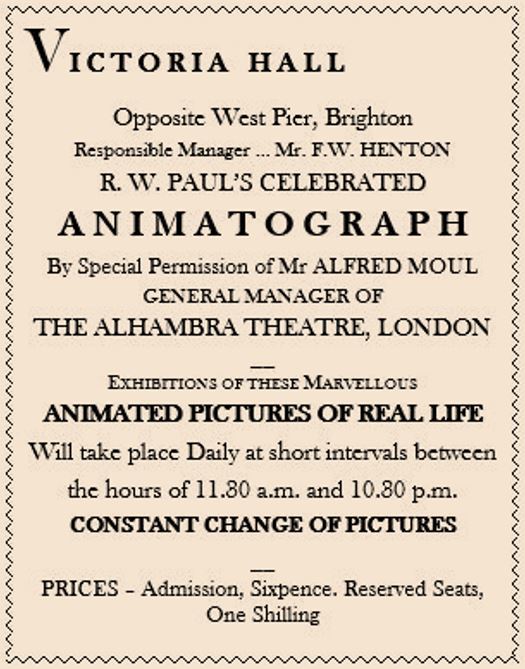
How I love being on holiday in Brighton! We’re staying in Mr Hockley’s boarding house on the corner of Preston Street and my room has a view of the sea and the West Pier. Everything is so exciting but last night was really special. I cut out the advertisement for you from the Brighton Gazette on Thursday. Mother, Father and I just had to go and see what it was all about.
You might not think you would ever encounter a full set of cornemuses Auvergnates or cabrettes [bagpipes from the Auvergne region] in a Sussex pub, nor hear the wail of a French hurdy-gurdy as you come round the corner in Shoreham, but for the last thirty years someone has been doing this in Brighton, and dancing to it too.
Dansez Français demonstrate their skills at the Centenary celebrations of the Brighton and Hove French Circle. Her Majesty the Queen gazes benevolently at the Breton flag. The Hove Club, 2015. Image: Suzanne Hinton.








 French Brighton