On 10 July 1833, young Mr Peter Black inserted the following advertisement in the Brighton Guardian.
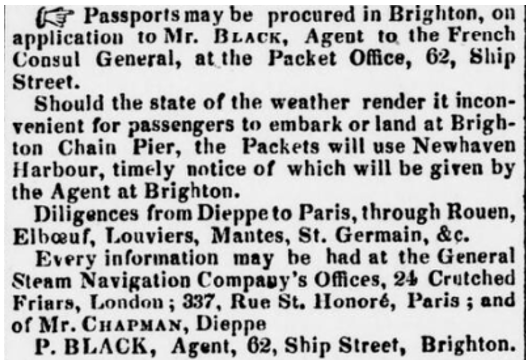
Typically, the French consul in Brighton was connected in some way with navigation – ship broker, master mariner, ship owner, merchant. As Peter Black was the son of a Scottish seafaring captain, it was not surprising that he had become Agent for the General Steam Navigation Company in 1829 aged just 27. Within two years he was appointed “French consular agent for the coast between Hastings on the east and Selsey Bill on the west.”
Evidently he was a very competent man. One of the great strengths of the honorary consular service is that the post has no set academic or professional requirements. Quite simply, the Embassy choses the best person for the job.
What sort of tasks did the French consul have to perform?
His main task was to issue passports – ideally written in French and still needed to move from one part of France to another. This Mr Black did from his office at 62 Ship Street.
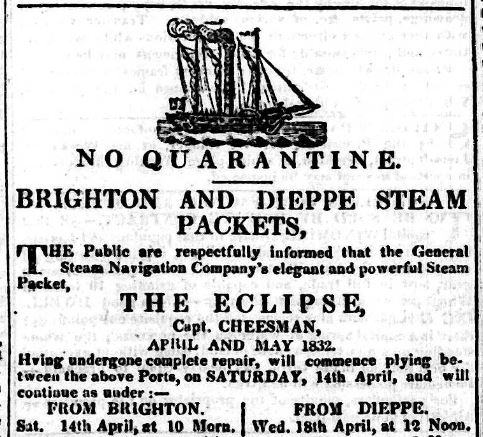
One of Peter Black’s first jobs as consul was to ensure that every “packet or vessel” leaving the Sussex coast bound for France carried a bill of (clean) health. Cholera was widespread in England, so quite rightly it was the French consul’s duty to protect French citizens in their own country.
Brighton Gazette 28 June 1832. Courtesy of the Royal Pavilion & Museums, Brighton & Hove
Some consular tasks were grand if not grandiose. When the young Duke de Nemours (son of the King of the French, Louis Philippe) visited England in June 1838, he was scheduled to arrive at the Chain Pier at 7pm.
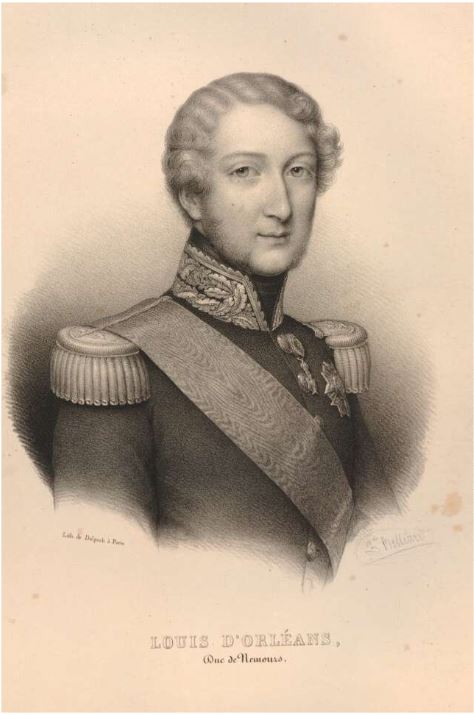
A local newspaper “understood” that 4000 people had paid at the toll gates for entry onto the Chain Pier and that the Marine Parade was lined for a mile and a half with “perhaps 6000” spectators. The town band was ready to play on the Steine, the whole of the police force was on duty (around 30 men in those days) and the coast guard was at the ready. There were even plans to fire a salute from the antiquated Battery (site of the present Grand Hotel). “Mr Black, in his uniform as French Consul, was in attendance.”
Image: Louis d’Oléans, Prince de Nemours 1839. © The Trustees of the British Museum, released as CC BY-NC-SA 4.0
Alas, “a strong gale prevailed all day” and the Belfast, bearing the royal personage, could not land on the Chain Pier. The ship veered off toward Shoreham Harbour. In these (just) pre-railway days, imagine how the Consul, other dignitaries and hundreds of general onlookers hot-footed it to Shoreham by horse, cart and carriage to be there by 10pm when his Highness finally landed.
Other consular tasks were grim: in 1842, the consul had to organise the salvage of a plundered French ship, the Alexandre, “her hold … crammed with casks or brandy and wine, with a few cakes of mustard seed.” As the French vessel, blown off her route from Bordeaux to Rouen, was only 12 miles off Worthing, it must be assumed that the pirates were English. Not one of the crew of the Alexandra was found, all assumed drowned.
A few years earlier, in 1836, there had been a happier outcome to a near-tragedy when the little ship Les Deux Sœurs was wrecked at Wall’s End (Pevensey Bay). Fortunately the master, two men and the ship’s boy were rescued, and it was Mr Black’s responsibility to ensure they returned safely to their home port of Fécamp.
Anglo-French relations were not always sweetness and light. Territorial rights became a bone of contention in 1844 when new and “complicated” British regulations came into force. The captain of the Newhaven Coast Guard saw fit to take the captains of two French ships before the Lewes magistrates as he had noticed that:
the vane at the mast head required by the regulations affecting French vessels coming within three miles of the coast was not of the prescribed colour (blue), and also that the numbers and initial letters of the port to which the boat belonged were painted on only one side of the bows. Brighton Gazette 14 March 1844.
Brighton solicitor Mr David Black (Peter Black’s brother and probably a fluent French speaker like Peter Black) defended the seamen, pointing out that, as foreigners, they were not in possession of the new regulations. Mr Peter Black very sensibly “promised to write to the French authorities, suggesting that copies of the rules should be furnished to every boat, in order that masters might not suffer from ignorance of a complicated law.”
The seamen were released from Lewes goal and fined the minimum penalty.
In 1850, Mr Black was put into a difficult position. Boats out of Shoreham had been caught illegally dredging oysters off the French coast near Le Havre, or, as le Courrier du Havre put it:
Depuis quelques mois, les croiseurs français ont fait aux bateaux de pêche anglais pris en contravention aux conventions qui existent entre les deux pays, une très rude chasse. C’est ainsi que nous avons vu plus d’une trentaine de ces bateaux amenés dans notre port. Il parait qu’il en est ainsi dans les autres ports … Les autorités françaises ont donné l’ordre au vice-consul, à Brighton, de poursuivre judiciairement les pêcheurs d’huitre.
[For some months since, French cruisers have been hunting down English fishing boats which have been flouting the conventions existing between the two countries. Thus we have seen more than thirty such boats brought into our port. It would appear that it is the same in the other ports … The French authorities have ordered the vice-consul in Brighton to prosecute these oyster fishermen.]
It was therefore Mr Black’s duty to gather convicting evidence about the crime, which he duly did. However this evidence was in written form which had come from a contact of Mr Black’s in France. This did not suit the English fishermen. They wanted the “witnesses” (captains of the French cutters) to come and give their evidence in person. Being a sensible man, Mr Black made an observation:
Monsieur Black, agent consulaire de France à Brighton, a fait observer … que s’il fallait, à chaque infraction, que le commandant de la croisière française quittât sa station pour venir en Angleterre déposer en personne la convention deviendrait par le fait une lettre-morte.
[Mr Black, consular agent for France at Brighton, observed … that if, every time there was an infringement of the regulations, the commander of the French cruiser would have to leave his station to come to England and give evidence in person, the convention would indeed become a dead letter.]
Alas, Mr Black’s wise words did not sway the magistrate and the case was dismissed.
It was vital that the General Steam Navigation Company, Mr Black’s employer, should have adequate berthing as both the Chain Pier and the port of Shoreham (at Kingston) would be less convenient for travellers than Newhaven. It was Peter Black who in 1847, negotiated with the Commissioners of Newhaven Piers.
So efficient and effective a consul was Peter Black that when he retired in 1871, aged 69, a gold medal was struck for him at the Paris Mint. It bore the inscription: “In recognition of long and honourable services, from 1829 to 1871”. On the other side was an effigy of Marianne with the words: Liberté, Égalité et Fraternité.
The dates quoted on the medal showing continuous service reveal that a somewhat blind eye had been turned to the fact that the French State had, briefly, in effect sacked Mr Black in 1856. The reason given, indirectly from the French Minister for Foreign Affairs, was that :
“…there was no fault with whatever to be found with Mr Black, whom he would have gladly left at his post, but that the change was part of a system now being carried into effect” and that “another person had already been appointed.”
However, a newspaper advertisement shows that in 1859 Mr Black continued as an employee at the General Steam Navigation Office.

Brighton Gazette, Thursday 08 September 1859. Courtesy of Royal Pavilion & Museums, Brighton & Hove
On his return to the consular post in 1861, Mr Black ran the consular offices from 59 West Street after a brief spell before his fall from grace when he ran the office from 58 Old Steine. There he lived, with his large family, “above the shop”.
Although Mr Black’s home and the consular office were usually combined, the family moved relatively frequently. Following the stint in the Old Steine, the family moved to 71 London Road, very near Preston Circus. The happy event of daughter Clementina’s wedding took place from this home. Eleven years later, in 1867, the funeral of 15 year-old Agnes Black took place from her parents’ home at 5 London Road, the family home from 1864-1877.. The couple and their surviving children had lived briefly at 43 Rose Hill Terrace (1859-1864).
Peter Black died in Brighton in 1884 at 43 Rose Hill Terrace where he was a visitor as by then, he and Mrs Black had retired to Fowlers at Cold Waltham in Sussex.

 French Brighton