In the first weeks of the Great War, the Bioscope journal noted:
“There are very few signs of the terrible struggle in which the country is engaged to be noted at Brighton. The panic of the first week, of course, had a very bad effect, but things soon resumed their normal course. The picture theatres are doing a brisk business, and the patriotic and war films which are the order of the day are proving a great draw.” The Bioscope,10 September 1914
It was indeed the case that in Brighton and Hove, residents (and many visitors) continued to amuse themselves as well as busying themselves with their contributions to war work and fund raising.
Six days before the outbreak of the war, the Theatre de Luxe at 150 North Street was showing, from Thursday 29 July (“for three nights only”), “A Film Johnnie” with Charlie Chaplin and “Fatty” Arbuckle as well as several other USA productions. The evening ended with, of all things, “Love Triumphant” a film made in Germany as Die Liebe Siegt in 1912. No French films despite France being Britian’s ally.
Fortunately, the Palladium continued to feature silent French films. Le Chevalier de Maison–Rouge (Pathé Frères, 1914), is the story, based on a novel by Alexandre Dumas, of an attempt to free Marie Antoinette from her imprisonment by the Revolutionaries. By now, some films were of several reels and could last over an hour as with this one.

Intertitle for the film ‘Le Chevalier de Maison-Rouge’. 1914
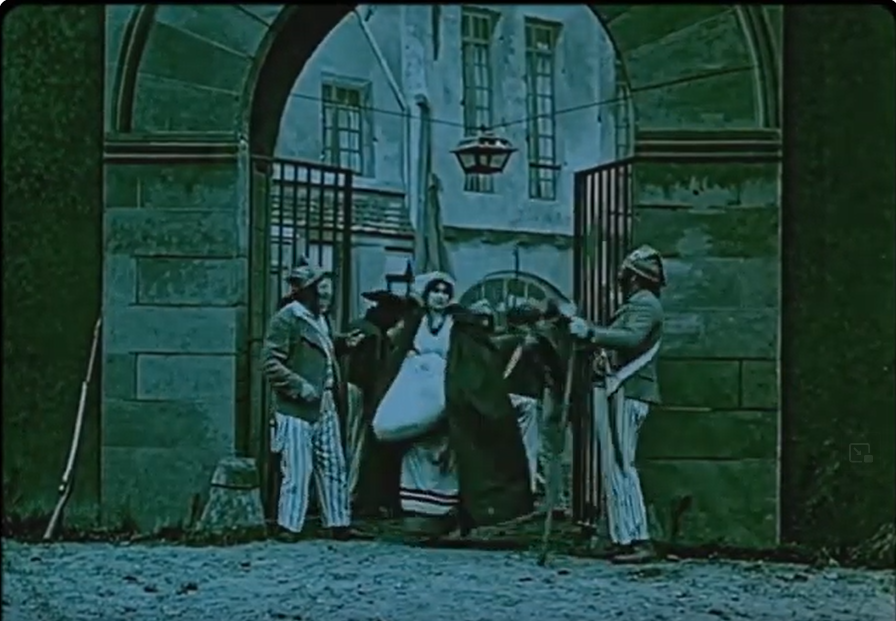
‘Le Chevalier de Maison-Rouge’ A very fine restauration of this film can be viewed on line: https://commons.wikimedia.org/wiki/File:Le_Chevalier_de_Maison-Rouge_%281914%29.webm
However, on the same programme there was still room for various shorts including “Charming French Health Resorts” a film “produced in natural colours” and an episode of one of a French series of comic films.
Film-goers continued to frequent the fourteen cinemas in Brighton and Hove, but the French production of films had slowed to a trickle. Again, a snapshot will be enough to show what these audiences were watching. Many of the French films were part of several long series based around a main comic character, the two main ones being Rigadin [Wiffles] and Ambroise Girier.
In July 1915, a Wiffles film was shown at The Academy, West Street. ‘Wiffles’ was the English name given to actor Charles Prince’s comic creation. This was most likely one of very many Rigadin films shown in Brighton. Prince was described as “at his best” in this film. But the reporter fails to mentions which of the 125 Wiffles films (made between 1911 and 1919) was shown that day.

Rigadin à l’âme sensible (1911) Pathé films. Watch at: https://video.ploud.fr/w/1c8a0310-938f-4ad0-b9de-1ad7fb9c1dee
Three months later, at the Hove Electric Empire in George Street the audience could watch the “wonderful French actor – M. Girier – who should prove a formidable rival to even Charles Chaplin, [and who] appeared in a very funny farce produced by Pathé Frères entitled ‘A Leaning to Leaness’.”
By late 1915, American cinema seemed to have well and truly taken over the industry, including adaptations of French stories. That November the Graphic reported on a film showing at the Prince’s Picture Palace at 64 North Street:
Alphonse Daudet’s ‘Sapho’ is acknowledged to be the greatest novel of one of the most gifted if not the greatest of French fictionists. There was a time when, though not exactly “on the index” as they say in Rome, it was kept carefully under lock and key in “respectable” households “lest the young people got hold of it”. This may seem strange in this in the days of broadened ideas … Nowadays we watch the story of the illicit passion of Jean Gaussin for Fanny Legrand with as calm an equanimity as keen delight.” (Brighton and Hove Graphic and Sussex, 4 November 1915)
“Sapho” (1913) may well have been based on a French novel, but it was filmed in America, starred American actors, had an American director and, despite having the French name Éclair, the production company was American. But at least it was shown in ‘racy’ Brighton. Leeds, on the other hand, banned it out of hand.
As the war progressed, films tended towards the sentimental or the patriotically rousing, although detective films and Charlie Chaplin and his likes were also much in demand. The “French connection” was not very much in evidence. The Empire Cinema in Hove (“a comfortable little picture theatre” in Haddington Street) showed “a picture of the fine French Hussars, who made one proud to be their Ally” (The Graphic, 10 February 1916) whilst the Imperial Picture Palace in St James’s Street was showing “The Mystery of d’Orcival” a USA made film based on the 1867 French novel, Le Crime d’Orcival.
L’après-guerre [The post war] period proved to be even more difficult for the French film industry than the war itself. Almost 1,700.000 French citizens had died during the war. Some 4,000,000 were injured. There just was not the workforce to expand the entertainment industry. Neither was there money to invest. North America was gaining the upper hand over film production. Even Italy produced more films than France immediately post-war.
Cinemas in Brighton had a final fling with French silent films in the mid-1920s. The Theatre de Luxe, by then, advertising itself as “BRIGHTON’S ARISTOCRAT OF SMALL HALLS” showed Le Miracle des loups [The Miracle of the Wolves]. This entirely French, slightly jingoistic historical drama had been filmed partly in the castle of Carcassonne – a place which virtually none of the Brighton audience would have ever had the slightest chance of visiting. Exotic indeed.
And then came ‘The Jazz Singer’ in 1927. Audiences no longer wanted to be bothered with intertitles (full-screen captions) in English or French. The first French film parlant [talking film] was an historical drama called Les Trois Masques and which was not made until 1929 . It was filmed at the Twickenham studios, there being no sound stages in France at the time. The French just did not have the financial resources to invest in very expensive “new” technology. Les Trois Masques seems to have sunk with very little trace on the British market.
Better known to Brighton audiences than French history would be the story of Victor Hugo’s Les Misérables. Not only did the Palladium show both parts of the two-part film several times, but via the newspapers, the management also encouraged teachers to inform their pupils of this rare event.

François Rozel as Marius and Sandra Milovanoff as Fanine in Les Misérables. Image courtesy of University of Washington (Public domain).
The Palladium on the Kings Road and the Theatre de Luxe seem to have cornered the market in French films. Le Navire aveugle was showing at the de Luxe in May 1928. Brightonians would have known the film under the title “The Blind Ship”, described as “a thrilling story of the sea”, although the storyline appears to have been rather fantastical. The following month, the Palladium was showing “A Marriage of Convenience” starring Dolly Davis. All rather misleading as Miss Davis was 100% French as were most of the cast and crew. The French knew the film as Mademoiselle Josette, ma femme – certainly the sort of film you would expect from the flighty French. The scenario goes like this:
Voulant épouser, malgré l’opposition de son père, son camarade de golf, Joë Jackson, Mlle Josette contracte un mariage « blanc » avec son parrain, étant entendu que le divorce la rendra prochainement libre. Mais Josette se prend à aimer son parrain et elle ne veut plus du divorce. Tout est pour le mieux car, au cours d’un voyage en Turquie, Joë Jackson a épousé la fille d’un cadi. (Filmathèque Pathé-Baby)
[Despite her father’s opposition, Miss Josette wants to marry her golfing partner, Joe Jackson, and so arranges a fake marriage to her godfather. The understanding is that a divorce will soon set her free. But Josette starts to fall in love with her godfather and no longer wants the divorce. All’s well that ends well. On a trip to Turkey, Joe Jackson has married the daughter of a Turkish judge.]
On the programme with “A marriage of convenience” was a film with the cringe-inducing title “On ‘ze Boulevards” (1927). The film was set in Paris. Other than that, the only French element in this American production was the star with the rather improbable stage name, Renée Adoreé.
The talkies came to the Palladium Cinema in Brighton at the end of June 1929. Was this to be the end of French films in Brighton?
À suivre / To be continued
 French Brighton