Who were these women? And were they French?
Despite her rather prosaic married name, Virginie Dawney was, indeed the genuine article. Born Virginie Atanaïse Perrot in 1806, she had arrived, via Shoreham-by-Sea, as a teenager and had set up business almost immediately as a dress maker at 26 Dorset Gardens. She married prosperous silk mercer, William Dawney in 1830 and carried on dressmaking from his premises (and their home for over 20 years) at 7 Pool Valley.
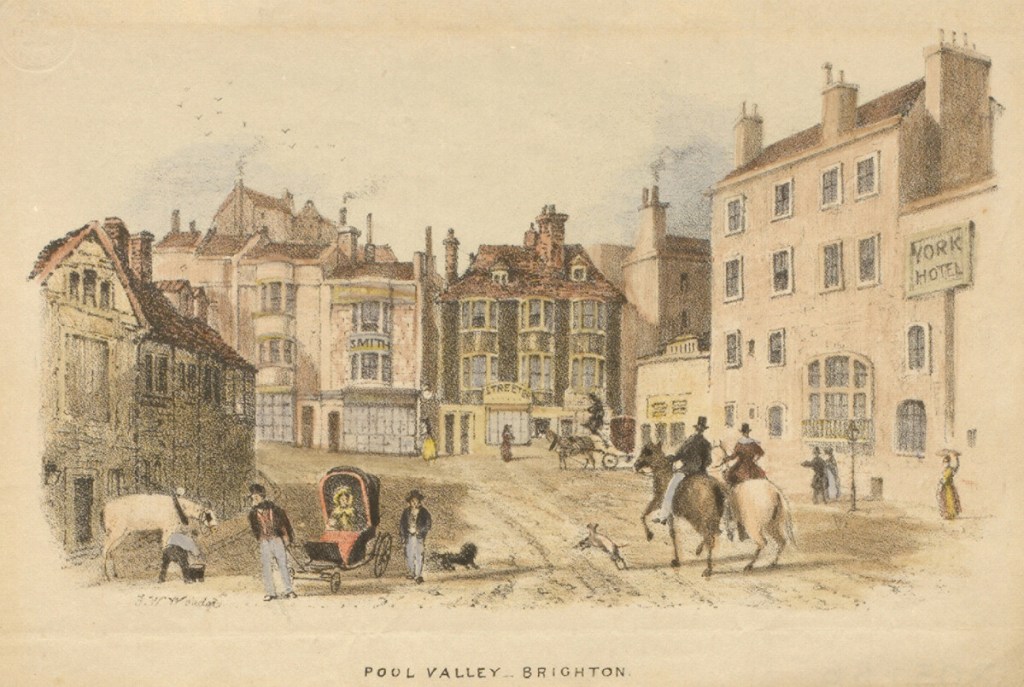
It was when Mme Valerie found herself a widow 1853 that she started a vigorous advertising campaign in local newspapers. For some 20 years, she used the phrase (or a riff upon the same statement): “Madame Virginie has just returned from Paris with a large assortment of MILLINERY of the newest Fashions.”
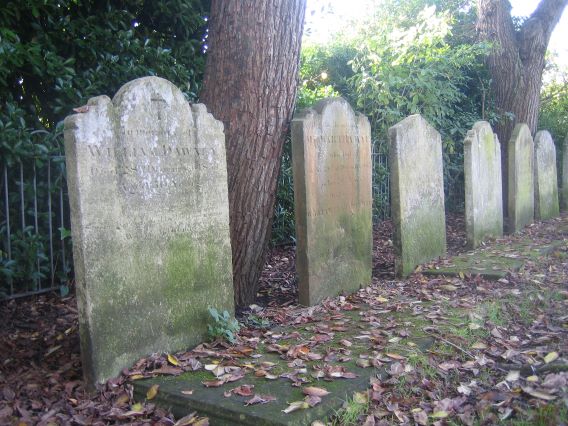
Conveniently for Madame Virginie, all things French became even more fashionable in the mid-1850s: those brave French soldiers fighting with “us” in the Crimean War had made up for Napoleon’s threat to England some 50 years earlier as well as for those worrying revolutions in 1830 and 1848. Madame Virginie dared to extend her use of French in her advertisements:
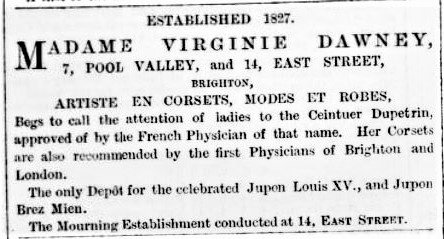
As a native French speaker Mme Virginie would not have spelled ceinture (belt) incorrectly. That error must be attributed to the compositor on the newspaper. The Jupon Louis XV was a smaller 18th century precursor to the crinoline. I have been unable to find what a jupon Brez Mien is. Information from costume experts would be welcome.
In fact, the person who placed the advert was not necessarily Mme Virginie Dawney herself, but her younger daughter, Virginie Marie, born in 1833. Miss Virginie had married Frederick Beal, an accountant, in 1859 and the couple moved to East Street. A business partnership between Virginie and Frederick was officially dissolved in 1863 and Miss Virginie moved her dressmaking business round the corner into The Avenue for a couple of years. On the other hand, the marriage must have been a considerable success: by 1871 the couple had7 children, the youngest being just one month old.
Madame Virginie relinquished the lease on the shop at Pool Valley May 1864. Henceforth her business would run from “more commodious premises, 14 East Street, which is now her only establishment.”
Madame Virginie / Mrs Dawney had one last attempt at romance. After 13 years of widowhood, she married Alphonse Fortuné Lamette in 1866. They set up home together at 14a East Street where M. Lamette advertised himself as a “Teacher of French and mathematics”. Madame Virginie died in 1871 but Alphonse lived on. He remarried and became first a wine merchant, then a “boarding-house keeper” at Dudley Mansions, Lansdowne Place in Hove. He died in 1897.
The business known as ‘Madame Virginie’ continued to trade at 14 East Street until 1878. ‘Her’ advertisements continued until at least 1875. As Virginie Atanaïse had died in 1871, it seems clear that one of her daughters, Virginie or Louise, had tried to continue the business, but by 1880 it had gone from Brighton.
Further along East Street, initially at No. 5½ and then later at No. 9 (possibly the result of a renumbering of the street) was the Jacob family. Colette Jacob had been born in Dijon in 1795, her husband in Metz (Alsace-Lorraine) in about 1780. Five of their children were born in France and the two youngest boys were born in Canterbury. It is therefore unlikely that the family arrived in Brighton before 1835. The family was well and truly French.
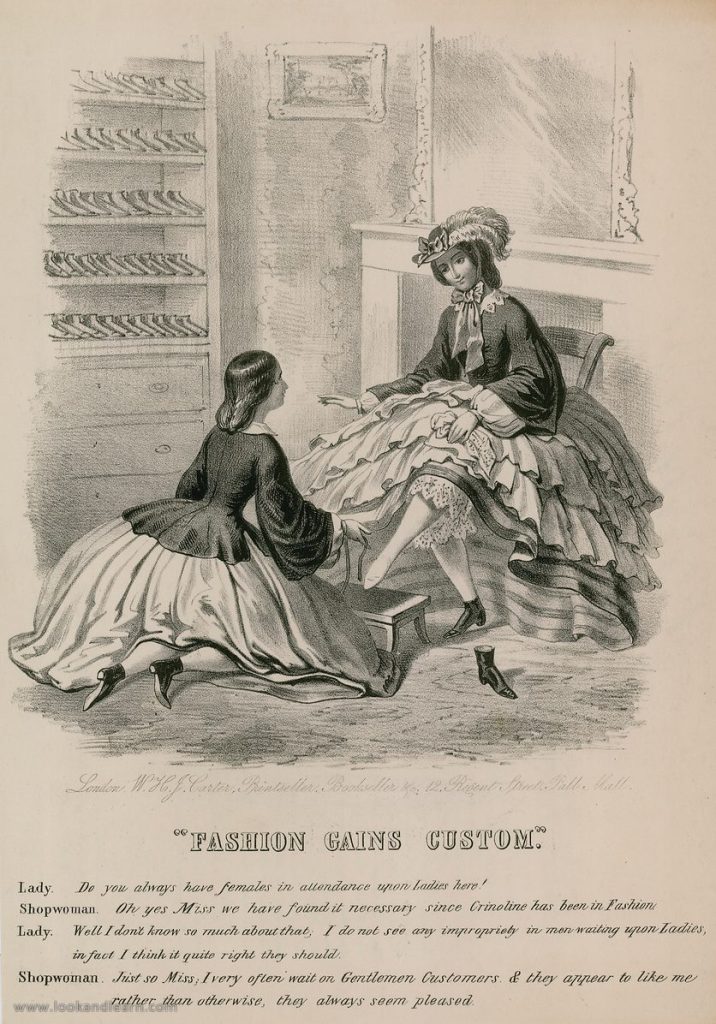
Madame Jacob, described by the Sussex Advertiser as “a French Jewess” took up the trade of her husband, Bing, who was a “ladies’ boot & shoemaker” trading at 29 Dorset Gardens, at or near its junction with St James’s Street. Their daughter Célestine had joined the team by 1845 as a chiropodist. Bing Jacob died in 1855 but by that time the family had moved to a shop in fashionable East Street. The family continued there until about 1866.
And then there was ‘Madame Normanville’.
French-born Angélique Monory had married Londoner William Blessauxnaux in 1787. Their daughter Harriet (also called Henriette and Harriot in various documents) was born in Soho, London in 1790. 1824 she married elderly (he was probably in his 60s) French widower Louis de Normanville. The small family, with Hariet’s mother Angélique, then moved to Brighton where, from at least 1832, Louis de Normaville is listed in street directories as a ‘plumasier’[sic] at 102 St James’s Street. The plumassier dealt in ornamental plumes and feathers.
Madame de Normaville also played her part in the business as seen from the advert below:

Louis de Normanville died at the St James’s Street property in 1834 aged 75. He left all his money to his wife and made her sole executrix. After Louis’ death, Harriet had initially run the business with her eldest son, William John. The partnership was dissolved in 1839. Possibly Harriet may not have been a skilled businesswoman. Or she may simply have suffered from a slump in the feather trade: between the fops of the 18th century and the plumed hats of the Gaiety Girls of the 1890s, feathers were not in vogue for the smaller hats of the early Victorian period. Whatever the cause, in 1844 all Mme Normanville’s property including “shop fittings and fixtures … counters, shelves, glass cases, show glasses, cannisters, boxes, gas burners, &c.” were sold off for the benefit of her creditors.
Harriet’s youngest son was called Louis as was his father. His millinery business, flourishing by 1845, was at 25 East Street operating under the simpler name “Lewis Normanville”. However, the temptation to trade on his French antecedents was too great for him: by 1848 he had reverted to the grander “Louis de Normanville”.
Harriet seems to have left the business to her son. By 1851 she had moved to London with her married daughter and there she lived until past the age of 91.
Under Louis, the shop at 25 East Street reverted to the trading name ‘Madame Normanville’ until 1869 the year in which a certain “L. de Normanville, Brighton, milliner” was declared bankrupt. At this point, the Normanville shop sign vanished from East Street forever. However, the family tradition lived on. As Louis Jnr, Harriet’s son, had died in 1865, it was a third-generation, grandson Louis, who was the bankrupt and yet seems to have managed to set up yet another ‘Madame de Normanville, milliner and florist’ which carried on until about 1885 in Ship Street.
The last Madame de Normanville, wife of grandson Louis, was born Susanna Knight in Firle, Sussex. Given that Louis de Normanville of Ship Street was English by birth and by education, then by the late 1870s the connection with France must have been tenuous.
Matters came full circle by 1888 when “Madame Normanville, millner” shared a premises with a firm of dyers. On the electoral roll, Louis Normanville is registered at 99 St James’s Street – just three doors away from his grandfather’s first shop in Brighton over 50 years previously.

 French Brighton