How unusual to see a French language advert for French novels in a Brighton newspaper:
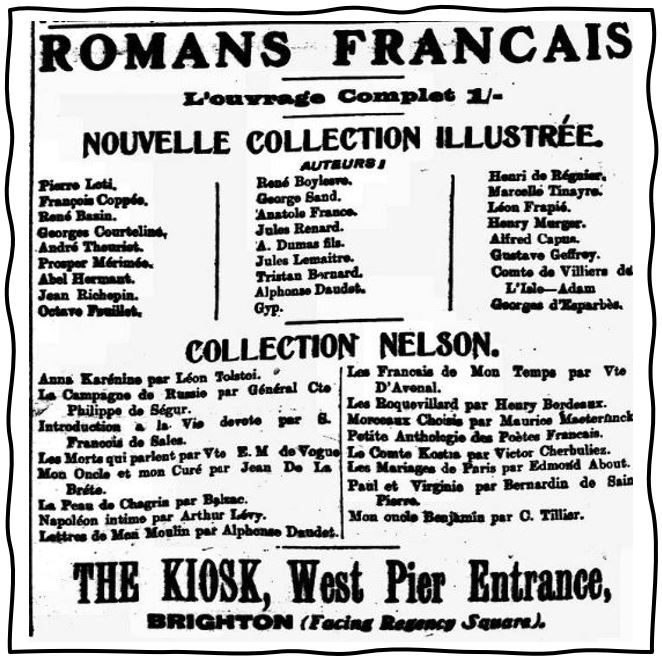
Brighton Gazette 12 June 1912, Source: Royal Pavilion & Museums, Brighton & Hove. This advertisement ran intermittently from October 1910 until October 1912.
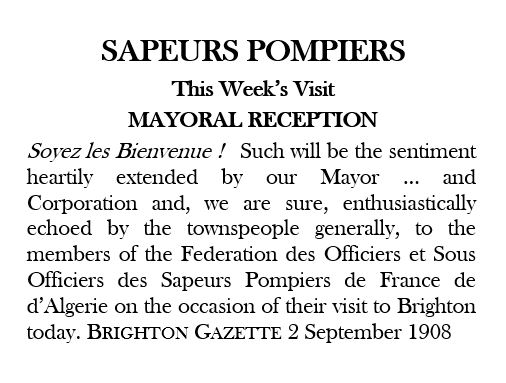
This had not been the first time that the Brighton fire brigade had recently welcomed their French counterparts. Unfortunately, it was to be the last for many years.

The newspapers of day reveal a great enthusiasm – amongst certain sections of the community at least – to learn about France and to learn the French language. Almost as soon as he had arrived in Brighton, Pasteur Joye of the French Reform Church in Queensbury Mews began a series of monthly lectures on French literature at the Y.M.C.A. in the Old Steine. These were not for the faint-hearted. The subjects included the philosophers Pascale, Rousseau, Voltaire and other literary giants. The lectures were attended by the great and the good of Brighton and Hove including the Mayoress of Brighton, Mrs Thomas-Stanford and a Lady Seymour.
As far as learning the French language was concerned, Pasteur Joye was somewhat of an optimist: his advertisements claimed to teach “le Français en Six Mois” [French in six months]. As he was advertising lessons on three afternoons a week from 5 to 6pm at his home at 21 Powis Square, students could avail themselves frequently of his teaching.
More realistic was Mdelle Thomas who hired (or lived in) a first-floor room at 12 Grand Avenue on the corner with Church Road (next door to the former Hove Library). She advertised “Cours de Français” to which she sensibly adds, in brackets for prospective anglophone pupils, “French Classes”. She proudly announces that her patroness is the Countess of Chichester – although what that patronage involved is not clear. Mdelle Thomas was clearly a driving force behind the promotion of French in Brighton at the time. It would be intriguing to have an insight into her relationship with Pasteur Joye as she too organised lectures in French, also attended by the great and the good… and possibly on an even larger scale, as her lecturers gave their talks in Hove Town Hall.
Excellence in the French language was lauded by the newspapers from at least 1901 when two local girls, Miss Gladys Salmon and Miss May Williams, won two of the three major prizes awarded by the London-based Société Nationale des Professeurs de Français. They were taught at, respectively, “Mrs Willis’ School, Walsingham Mansions” and “Miss L’Estrange’s, 17 Lewes Crescent.” Although such a feat was not repeated, Brighton and Hove students nevertheless continued to be awarded prizes by the Society.
Indeed, Miss Thomas must have been a pillar of the Société nationale as she undertook the organisation of a Fête de Charité in Brighton in order to collect funds for it.
It is not known how much Mdelle Thomas, Miss L’Estrange or Mrs Willis and the many other tutors in the town charged per lesson, but 1/- per hour might have been the going rate as per this 1907 advert:
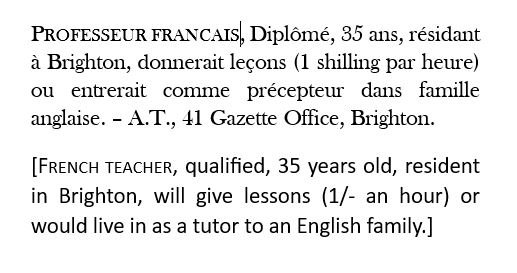
The young man, A.T., may not have realised that the days of the live-in tutor were over. Let’s hope he garnered quite a few shillings for his hourly teaching.
Hove’s new library was very responsive to its French and francophone clients: as early as 1900 a local Hove councillor commented that “there had been many requests for French books, and as there were so many French people, French scholars and teachers in the town, some well-selected literature might be in the list” [of books to be purchased]. It has to be said, however, that of the foreign language books acquired by Brighton Library in 1905, only one was in French compared to 12 in German as well as a handful in Latin.
But … was it the Entente Cordiale which spurred the growth in teaching French in Brighton and Hove at this time? Or was it the fact that France had clamped down on nearly all religious teaching orders in France in 1905? This was the year of the law separating Church and State which sent hundreds of Catholic nuns, priests and often their pupils fleeing to England. But that is another story.

 French Brighton